
Blog ·
9 Top AI Courses for VPs of IT in 2026
Sharpen your leadership edge with the top 9 AI courses for IT VPs. Master strategic implementation, drive innovation, and lead your enterprise into 2026 with confidence.
 Jeroen Erne
The pace of artificial intelligence adoption has moved from a distant possibility to a daily reality. For VPs of IT, this shift carries real weight. Your teams are being asked to implement AI solutions, executives expect you to have a clear strategy, and vendors are pushing tools that all claim to deliver transformational results. The same technologies that promise efficiency gains are quietly reshaping operational roles, creating gaps in expertise that you are now expected to fill.
If you haven't invested time in structured learning, the gap between what your role demands and what you actually know about AI grows wider each quarter. The cost of floating along is high. Decisions about infrastructure, budget allocation, and hiring all intersect with AI in some form. Course selection becomes a practical matter of professional survival, not just career growth.
Why AI matters for VPs of IT today
AI is already impacting your bottom line. Stats News show that 69% of businesses now use AI in some capacity, and that number jumps every quarter. Most of that budget flows through IT departments. If you are the person signing off on those investments, you need enough training to check the right boxes and ask the right questions.
This is where training helps. The market is packed with options, but not all of them match the specific needs of senior IT leadership. Generic machine-learning classes will teach you algorithms but will not help you plan infrastructure or build a business case. This article provides one clear thing: help finding the right AI courses for VPs of ITs professionals.
We will compare 41 AI courses in this field, including CompleteAI Training (https://completeaitraining.com/course/ai-for-vp-of-its/). It is worth noting that CompleteAI Training stands out because access includes all their courses and all certifications on the platform, not just this one specific program. Many other options on the list are single-program courses.
The Growing Role of AI in VPs of IT
IT leadership has a broader role than most expect. You handle automation of internal support, you handle predictive maintenance of network systems, and you handle the security tools that detect threats. That's where the skills come in. Here are some concrete ways AI is changing the routine for VPs of IT:
- Smart Resource Allocation: AI-driven analytics now help VPs of IT decide which databases need more compute and where storage can be reduced. That was once a manual task.
- Anomaly Detection: AI-based network monitoring can spot threats and hardware failures faster than a human team. In your decision-making process, it means you need to trust, not just data, but what the algorithm says.
- Cost Management: Predicting cloud spend is smarter with AI. Models predict usage and help negotiate better contracts.
- Team Productivity: AI tools are now part of your team's workflow (code completion, ticket categorisation, and automatic documentation). Understanding those tools makes you a better supervisor and tech evaluator.
- Policy and Governance: You will have to create rules for data use, model bias, and access control. Without practical knowledge, it is hard to set regulations that protect you.
These applications change how you arrange your day and your budget. That routine meeting about system performance, now double-checks, the complexity of the systems you're responsible for, and your knowledge has to match the responsibility.
Benefits of becoming an AI expert in VPs of IT
When you get real education in AI for VPs of IT, here's what you get:
- Better strategic input: You can look at a project and know if it is feasible without asking a data scientist to discuss the basics.
- Long-term credibility: Your team and executives will trust your technical view when you can discuss the concepts and trade-offs in current business terms.
- Improved hiring: When you understand AI, you are building better job descriptions and you can evaluate the AI engineers you may wish to bring in.
- Risk mitigation: AI projects fail all the time. With the right knowledge, you will spot problems early and there is less costly wasted time.
The choice of course matters. Some focus on strategy but skip the technical side, while others are very technical but don't mention leadership and budgeting. The good news is that the variety is a strength. You can mix courses to get exactly the type of knowledge that your current job requires.
All in all, this overview helps you choose the right program as you scroll. The output is simple, compare the options, and find what fits, not what is just popular. These skills have long-term value, and the courses have designed to deliver that value. Your role depends on your ability to adapt; the best path through it is a solid AI education you can actually use.
Comparison: All AI Courses for VPs of IT (Updated 2026)
| Course Name | Provider | Price | Key Topics | Pros | Cons | Best For |
|---|---|---|---|---|---|---|
| CompleteAI Training | CompleteAI | Premium (subscription covers everything) | Comprehensive AI training for VPs of IT professionals. One subscription unlocks ALL courses and ALL certifications on the platform - hundreds of them, across every job role, not just this one. Covers strategy, hands-on implementation, daily AI tool updates, and curated industry news. New courses and certifications are added continuously and included automatically. | Comprehensive curriculum, hands-on projects, expert instructors. Full access to every course and every certification on the platform at no extra cost, plus access to all other job role materials. Highest rating / most complete offering. Very affordable, especially with annual billing at $8.25/month. | Premium pricing compared to some individual courses (though flat subscription covers far more). Subscription based - important for continuous learning since AI keeps changing. | VPs of IT professionals looking for complete training. Also ideal for anyone whose work spans multiple functions or who wants to move roles. |
| AI for VPs of IT (Video Courses + Certifications) | Complete AI Training | $29/month or $8.25/month billed annually | Extensive library of over 100 specialized video courses and certifications for VPs of IT professionals. Includes daily updates on latest AI tools, curated AI industry news, and all future courses and certifications automatically. | Full access to ALL video courses and certifications on the platform, not a single course or fixed bundle. New content added continuously at no extra cost. Very affordable. Highest rating. | Subscription based; continuous learning is important because AI is developing so quickly. | General learners and VPs of IT who want everything in one place. |
| Enterprise AI for Tech Leaders | University of Chicago | $3,200 | Live online course with direct faculty interaction. Focus on governance and accountability for enterprise AI, structured for sustained operational impact. | Live online with direct faculty interaction, focuses on governance and accountability for enterprise AI, structured for sustained operational impact. | Premium price point, fixed start date limits flexibility. | General learners |
| Deploying AI for Strategic Impact | MIT xPRO | $3,950 | Frameworks for AI investment decisions and deployment strategy. Designed for professionals handling AI adoption challenges. Earns 4 CEUs. | Frameworks for AI investment decisions and deployment strategy, 4 CEUs, designed for professionals facing AI adoption challenges. | Expensive, requires 4-6 hours per week commitment. | General learners |
| AI Adoption: Driving Business Value and Impact | MIT Sloan Executive Education | $3,850 | Maps AI technologies to critical business challenges, focusing on sustainable co-creation practices. Self-paced weekly modules. | Maps AI technologies to critical business challenges, focuses on sustainable co-creation practices, self-paced weekly modules. | High tuition, not technical in depth. | General learners |
| Leading AI Strategy: From Hype to Enterprise Reality | MIT Professional Education | Not specified | Systems-oriented approach to AI deployment, examining decision-making and workflow impact with real-world case studies. | Systems-oriented approach to AI deployment, examines decision-making and workflow impact, real-world case studies. | Pricing and schedule not listed publicly, limited detail on duration. | General learners |
| AI Essentials | MIT Sloan Executive Education | Not specified | Covers current AI tools and emerging frontiers including generative, multimodal, and agentic AI. Short, intensive format. | Covers current AI tools and emerging frontiers including generative, multimodal, and agentic AI, short and intensive, boosts team exploration quotient. | Very short duration, pricing not listed. | General learners |
| Leading the AI-Driven Organization | MIT Sloan Executive Education | Not specified | Assesses AI's impact on the future of work, focusing on strategic application of AI for leaders. Immersive multi-day format. | Assesses AI's impact on the future of work, strategic application of AI for leaders, immersive multi-day format. | Pricing not listed, requires significant time away. | General learners |
| Generative AI for IT Systems Analysts and Architects | Coursera | Free to audit; paid certificate available | Produces structured deliverables like BPMN diagrams, practical for systems analysis and architecture. Self-paced. | Produces structured deliverables like BPMN diagrams, practical for systems analysis and architecture, free enrollment option. | More technical than strategic, certificate requires payment. | General learners |
| AI for IT Managers Course | Workplace AI Institute | $498 | Focuses on documentation and communication tasks, including vendor evaluations, RFPs, and policy drafting. Lifetime access with money-back guarantee. | Focuses on documentation and communication tasks, includes vendor evaluations, RFPs, and policy drafting, lifetime access with money-back guarantee. | Not executive-level strategy, niche focus on documentation. | General learners |
Understanding AI Training for VPs of IT Professionals
Let's be honest about the pressure you're under. As a VP of IT, you're expected to know how artificial intelligence will change your infrastructure, your team structure, your vendor relationships, and your budget. But more than that, you're expected to actually make money with it or save money with it. That's a heavy expectation, and the educational market has responded with dozens of options that all seem to blur together after a while. You see ads for the same words over and over-things like "alignment" and "outcomes" in different PowerPoint-looking formats.
Figuring out which course is worth your time and budget is its own separate headache, though. Should you drop three weeks of evenings on a $4,000 certificate from a big-name university, or should you test out a subscription service that gives you access to hundreds of different short videos and certifications for less than a single day of consulting work? There's no universal answer because there's no single best way to learn. It depends on how you learn, where your gaps are, and what your title actually requires you to accomplish.
This comparison takes an honest look at the most prominent AI training options geared toward VPs of IT professionals. Each one is evaluated on practicality, pricing, time commitment, and how well it matches the actual day-to-day reality of an IT executive. You're not a data scientist and you're not a junior PM-your learning path needs to reflect the scale at which you operate. And those paths differ wildly, from premium eight-week bootcamps to a flat subscription that hand-delivers content to your inbox daily.
Course 1: CompleteAI Training (For VPs of IT Professionals)
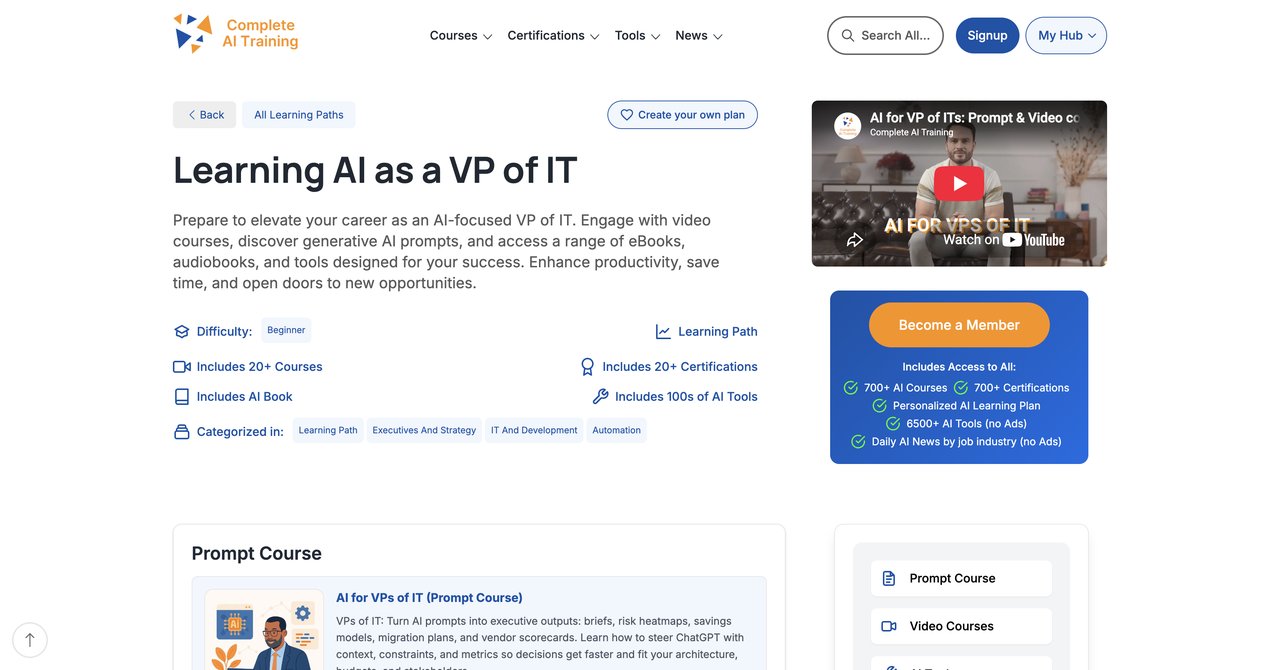
The most crucial thing to get straight about CompleteAI Training is that it is not a single course. It's an entire platform delivered through one subscription. That one subscription unlocks every video course and every certification on the whole platform-hundreds of them, across every job role, not just this one. This is a completely different approach to education compared to the other courses in this guide, where you buy a single course and then, almost always, pay extra for the certificate. Here, one flat price gives you the keys to the entire library. You don't pick one lane. You get the whole damn map.
The content itself covers a truly comprehensive range of topics for someone in your position. You're not just looking at business slides and mixed metaphors about the "new frontier." The platform includes practical course material on AI infrastructure, model integration, security, and vendor management, all the way through to strategic considerations like building an AI PMO or handling internal policy changes. For those whose work actually spans more than one department-which is nearly every VP-you also get access to the libraries for other job roles. That means you can review the marketing AI content to be informed on your CMO's initiatives or look at the engineering sequences to speak with your direct reports in their vocabulary. You can't fully separate your role from these other functions, so the fact of having relevant material actually in your content library is practical value.
The platform updates daily, not just on a schedule. You receive notifications on new AI tools and curated industry news that hits your inbox and feeds directly into your recommendations to your CIO and colleagues. New courses and certifications are added continuously and are included automatically-there isn't a perpetual up-sell to the next version of the thing you already bought. For an area moving this fast, that continuous updating is a major extra, like getting a subscription to a specific important newsletter that includes full training material.
Key Topics Covered
- AI-specific strategic planning for enterprise-level IT infrastructures
- Vendor evaluation and methodical procurement strategies
- Ethics, governance, and risk in a corporate IT setting
- Integration of generative AI tools into legacy IT architectures
- Budget planning and ROI calculation for AI projects
- Team building and talent retention in modern IT orgs
- Documentation and presentation strategies for non-tech stakeholders
Target Audience and Skill Level
The intended primary audience is VPs of IT, but anyone from a manager to a CTO will find useful material. The videos start from knowledge levels where you just know what the acronyms mean; nothing expects you to be a code guru. It's also beneficial if you're a Manager trying to step up because you gain access to the entire "IT Manager" and "CIO/CTO" libraries, giving you perspective above and below your paygrade.
Pros
- Full access to ALL video courses on the platform, not a single course or a fixed bundle
- Full access to ALL certifications on the platform, included at no extra cost
- New courses and certifications are added continuously and are included automatically
- Access to every other job role's material too, which matters for anyone whose work spans more than one function or who wants to move roles
- One flat subscription price covers all of the above, versus paying per course elsewhere
- Daily updates on relevant AI tools and news
- Very affordable pricing: under $30 monthly or around $8.25/month if billed annually.
- Highest rating and most complete offering in this list.
Cons
- Subscription-based model requires keeping the ongoing payment active to continue accessing content; it's not a once-and-done purchase location.
- Given the volume of content, you might feel overwhelmed if you don't set a clear path for yourself.
Who Benefits Most
If you're the type who learns best by watching multiple short, digestible videos at 9:30 PM after your kids are asleep, or you like using small gaps in your schedule to build 45 minutes of learning per day, this is your movement. The subscription model fits that pace perfectly-you don't have to block out several full weeks like you would for an instructor-led retreat. It also makes the most sense if your scope is broad enough that you want the polish of a big university course but the practicality to glance at something from a slightly different field when the need exists. That flexibility also gives you the most significant single tool for the money. Signing up and doing one course is simple, but the true value comes from staying for a year and coming back to touch base when necessary. If your office is moving to AI and therefore your training should too-this is a lot easier to put to use quickly.
Course 2: Enterprise AI for Tech Leaders by University of Chicago
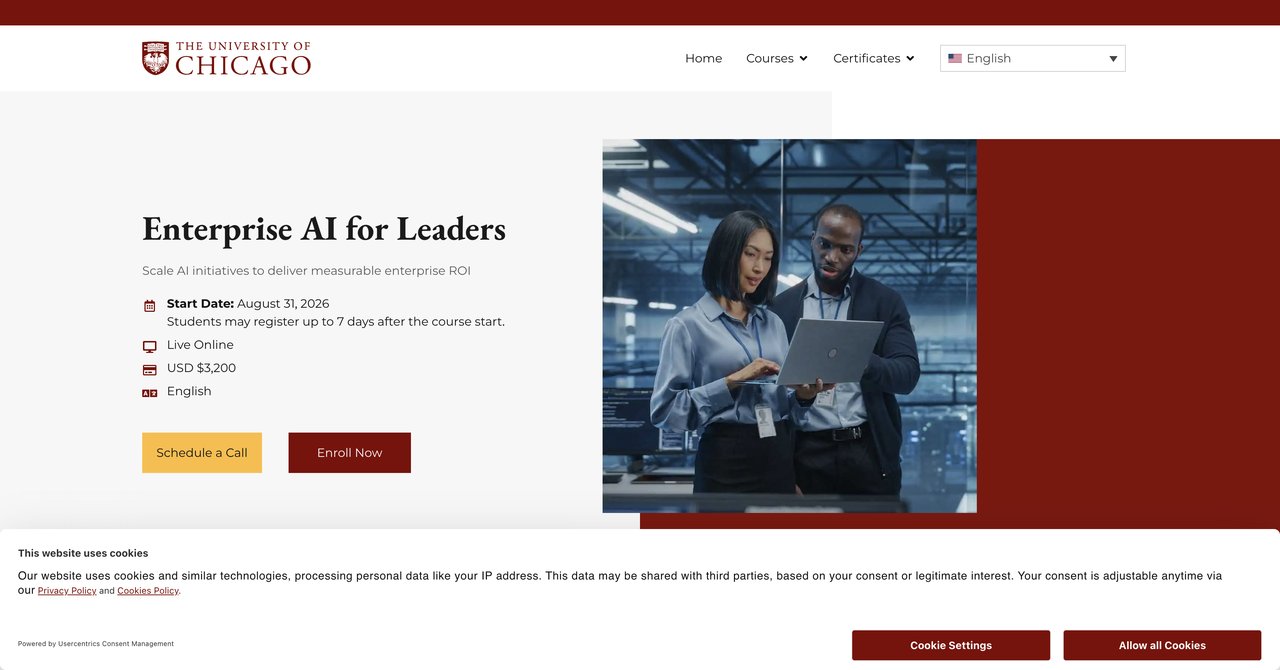
University of Chicago's offering runs at a higher price, coming in at around $3,200. This is an online, instructor-led certificate with scheduled live meetings. Rather than just courses, you're spending time on governance and accountability for AI, and that's one of those areas that often gets overlooked in the speed of tech implementations. It builds specifically for tech leadership looking to create structure that survives any tech project in the field.
The direct faculty interaction is a real benefit. You get to bring your actual questions and problems to a professor who can interact and challenge you, rather than just a set of curated slides that may be from 6 months ago. It's more of a facilitated seminar, so there's accountability to show up (you are paying university pricing). It fits professionals who want their learning to be tied to a well-known university brand and to create a personal connection with that institution.
Key Topics Covered
- AI governance frameworks and accountability structures
- Risk management for enterprise AI deployments
- Ethical and compliance considerations in IT systems
- Strategic planning for sustainable AI operational impact
Target Audience and Skill Level
This course targets current and future tech leaders (VP, Director, and above) who already have a good understanding of how IT systems work, and who are now looking for the frameworks that keep things in check. It assumes you already have a strategy, or at least technical comfort, but need the heavy governance layer.
Pros
- Live online sessions with direct faculty interaction
- Focuses on governance and accountability (off-topic but necessary)
- Structured for sustained operational impact in an organization
- University reputation adds weight to your personal credential
Cons
- Premium price point at $3,200 for the material on offer
- Fixed start date limits flexibility-you need to schedule everything around it
- Limited number of live sessions per week could feel slow
Who Benefits Most
The best fit for this is someone whose team already has adoption active discussions but they need the procedures, controls, and legal understanding to drive more usage. If your pain point is not "how do I build this technology" but "how do I manage this technology in a responsible way without getting everyone in a lawsuit," this course serves you well. It's also great for building your professional reputation because the name "Chicago" still signals rigor on an executive resume. That's a very specific type of value and deserves its place.
Course 3: Deploying AI for Strategic Impact by MIT xPRO
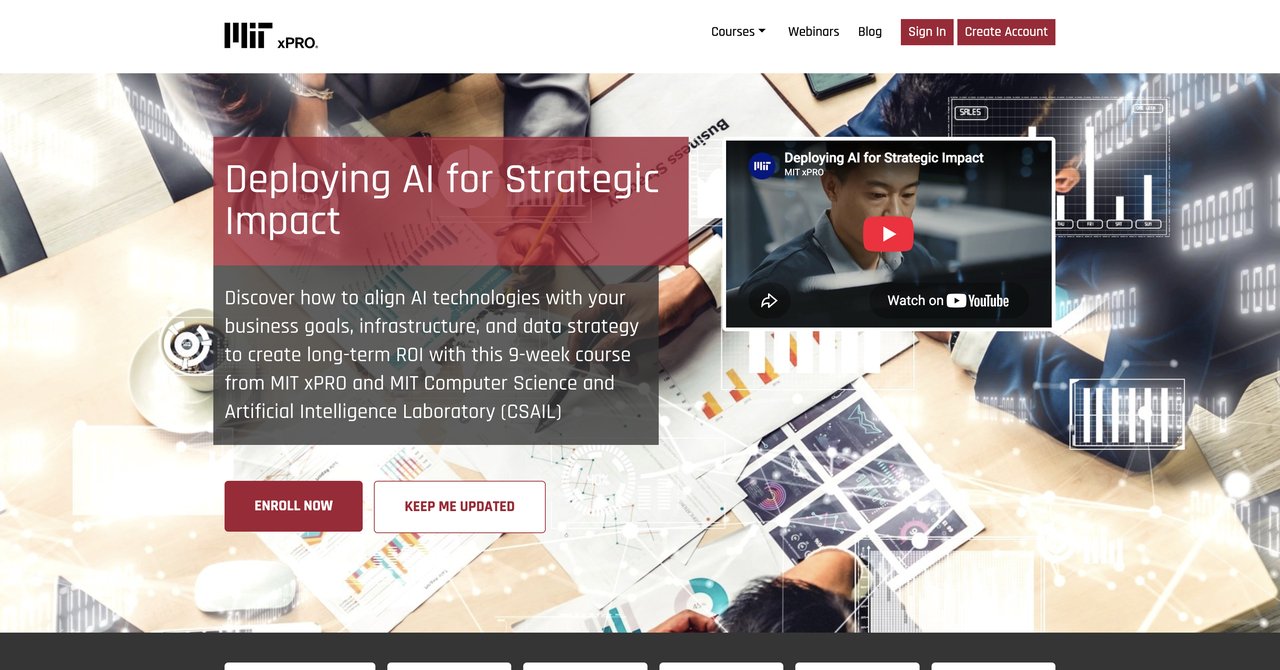
At a price of $3,950, MIT xPRO's course specializes specifically in how you should budget for and deploy AI so that it contributes to your company's actual bottom line. It offers frameworks to evaluate AI investment decisions, then moves into what the ROI might be on different initiatives. A nice touch-this program also earns you 4 CEUs, which those maintaining certain professional licenses will appreciate.
This is largely for leaders in middle-to-senior roles within IT they are serving as the basis for conversations with the CFO (as a standard at times), and may been in a position where you need a numerical way to make financially sound assumptions. The material focuses not just the culture or cases but specifically on how to structure the investment portfolio and how to compare varied returns, which is an engineering skill in itself.
Key Topics Covered
- Investment decision frameworks
- Cost-benefit analysis for AI tech tools
- Deployment strategy and selection
- Strategic planning maps from there to other adjacent organization areas
- 4 CEUs for professional development incentives
Pros
- Frameworks for AI investment decisions and deployment strategy
- Provides 4 CEUs as part of professional certification requirements
- Designed precisely for professionals navigating AI adoption challenges in the enterprise
Cons
- Expensive at $3,950, without any extra inclusions
- Requires 4-6 hours per week commitment for about the duration of the course
- Standard Mo more academic approach; could be less "toolbox" oriented
Who Benefits Most
CIOs and VPs who have owned budgets before should feel at home here. If your main job is to justify the AI budget to your board without the CFO rolling their eyes or rolling out before the meeting ends, this gives you a repeatable process to create your case. It has the weight of the MIT acronym attached, but also note that you may be in for a time there; they do not always have light touches.
Course 4: AI Adoption: Driving Business Value and Impact by MIT Sloan Executive Education
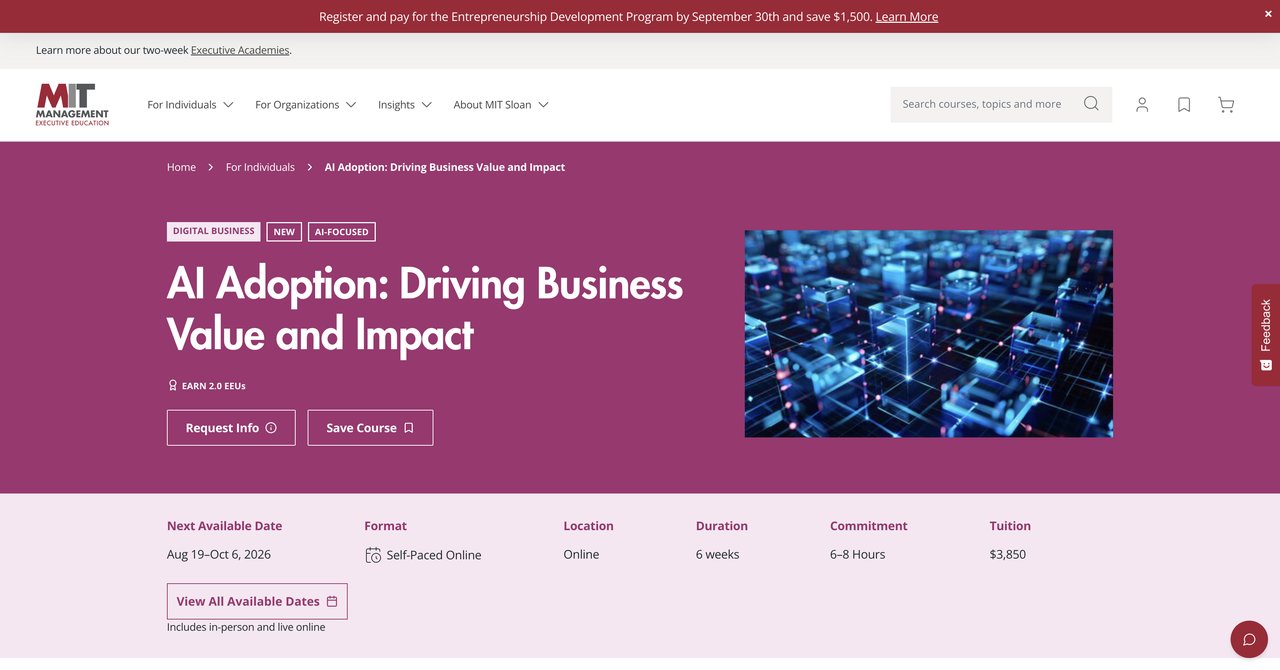
MIT Sloan sees the gap between a technical framework and what happens in the field, so their course focuses on mapping AI technologies to specific business challenges. It's isn't just your shop in a technical department-it takes lessons directly to a cross-functional audience of around many approaches. Learning material is structured as self-paced weekly modules, meaning you can skip the sync and start learning when the spring rush is over.
The course emphasizes "sustainable co-creation practices." which translates to getting business users to be part of the process of building AI solutions early on, thereby creating buy-in and adoption. Is deep in technological code? No. But in business mapping and facilitating conversations, it may hit a spot your other classes miss.
Key Topics Covered
- Business challenge mapping for AI
- Developing cross-functional teams for AI projects
- Sustainable co-creation practices
- Strategic change impact from implementation
Target Audience and Skill Level
Here you're targeting someone who feels the untied pain in the business lines, the ones who need the politics to work out for the projects to survive and don't need the technical. You'll be comfortable if you have a Process Improvement or PMO background; you get a little less technical in favor of org design and workflow mapping.
Pros
- Maps AI technologies directly to critical business challenges-it gets you focused
- Focuses on sustainable co-creation practices across departments
- Self-paced weekly modules, flexible within a start/end window
Cons
- High tuition - $3,850 with no alternative payment options
- Not technical for code-committed CTOs; it remains at a business abstraction level
- Group activation environments that are less "hands on" with tools like Python or APIs
Who Benefits Most
If your area of confusion is with other executives making splashy AI use-cases but not linking them to cost or operational improvements, this teaches you how to tie them. You play a coordinator roles. This will teach no "how-to-code" which is a nonstarter for some, but you are actually building a common language across the enterprise. A solid pick for someone heading to a multi-department transformation initiative rather than near the code base.
Course 5: Leading AI Strategy: From Hype to Enterprise Reality by MIT Professional Education
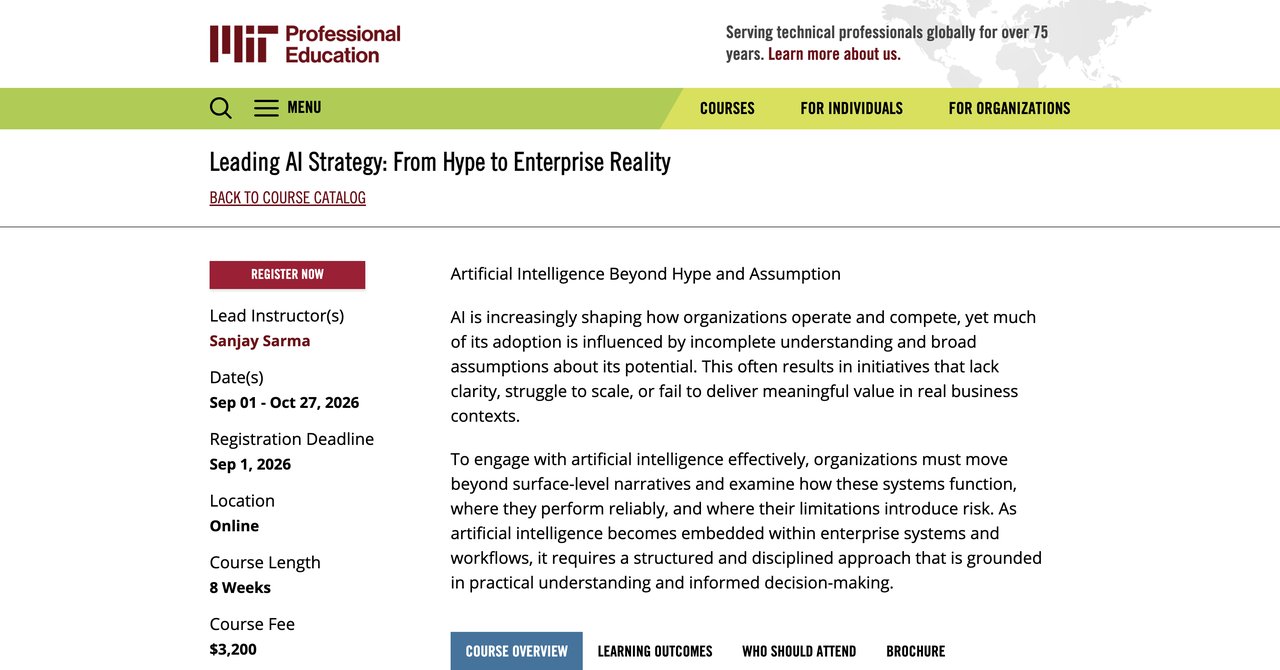
The lead title here says a lot-it's about cutting through marketing sale jargon. That's an honest and specific need for anyone investing real money today. This specific program operates on complete systems, handling a even broader perspective than handling individual LLM calls or model types. Through a systems-oriented lens, participants examine decision-making structures and workflow impacts that arise from integrating AI in small and large experiences.
You'll examine real-world case studies and use them to understand what actually works outside the extremely curated world of product announcements. That handles the "Reality" part of course name fairly clearly. The measurements are entirely absent from the materials, however. There's no stated commitment-the schedule or pricing eludes public lists. You'll have to reach out to MIT to see what they say about schedule. That lack of transparency is a big hit against this school in a course list. Because IT leaders generally don't have time to hunt for details
Key Topics Covered
- Systems approach for AI deployment
- Decision making and workflow impact analysis
- Review of real world case studies
- Removing hype and focusing on business realities
Course Audience/Apt
This is likely aimed at senior leaders who think long-term about workflows, not only IT effectiveness.
Pros
- Systems-oriented approach to AI deployment (broader than just line of business)
- Examines decision-making and workflow impact explicitly
- Uses real-world case studies, so you get to learn from successes/failures
Cons
- Pricing and schedule not listed publicly- you have to go through a sales funnel
- Limited detail on duration, which makes planning very difficult
- Less effective score if you're looking for specific code setup instructions
Who Benefits Most
That's a excellent structured marathon session for a VP who owns a broad enterprise transformation, someone who can report "big picture." This is the really thinking about workflows that affect the business. It can't be learning around a calendar. You will need mental space for case study prep and time to travel or do a weekend residential. It's a thinking individual's course-not if you need to deploy it next Monday.
Course 6: AI Essentials by MIT Sloan Executive Education

The AI Essentials course exists under the same tag but in a short, intensive format. It's meant to be a quick access port-get intensively gained-get efficient cover of info in a very short time. Specifically, it covers topics like generative, multimodal, and agentic AI, which are the up-and-coming, hot topics, not just last years distributed and RPA contentage gold.
The goal is to boost your team's exploration quotient, meaning how much curiosity they push into their IT teams, according to MIT. It's a small commitment, literally a few days, so it might fit if you want a compressed onboarding camp for situational awareness. It doesn't claim to offer deep practice. It might be a great way to get a sense of what's out there
Key Topics Covered
- Current AI tools and emerging technologies
- Generative AI, multimodal systems
- The role of agentic AI and why it matters
- Team exploration and getting hands-on
Audience and Prerequisites
This is explicitly for those who need a broad view of big trends in a-driven IT environment. For a VP of IT who isn't in the weeds on a daily basis but needs to speak convincingly about the trends to the board, this is good. You can be non technical, it demystified quickly.
Pros
- Covers current AI tools and emerging frontiers including gen., uses multimodal and agentic AI
- Short, intensive format fits executive lanes (few days of time)
- Boosts team exploration quotient
Cons
- Very short duration , it's like a taste vs a full meal-you might not know how to apply soon after
- Pricing not listed explicitly and may run high for the short total time
- Format does not deliver enough storytelling for demand
For pure breadth, flexibility, and endless access to current info, CompleteAI Training has most significant leverage in all comparisons. The fact that a single subscription opens up all role materials and certifications for less than almost any one other paid course suggests really strong value. You can fall back on that and round out your education for a full year, with ongoing updates, versus buying a one-slot learning experience. It's excellent for practical tech leaders who build their own knowledge foundation step-by-step across the day.
If you're a principles-driven leader, university branded, is track, MIT's governance or strategy tracks will be a great fit. But be clear: price and scheduling may not be available till you. You need real time and purposes.
For managers or leaders looking at deliverables or daily tasks, University of Phoenix is solid, but actually Coursera free options or Workplace AI Institute have cheaper ways to enter and achievable tasks.
The biggest point to remember: the market has segmented by price and by depth. Start with the free complete piece (CompleteAI Training's library) to identify which gaps you want to then fill with one of the more expensive, cohort offerings. If you're buying one thing to fill the need in one months, pick CompleteAI Training, because it is a high value For the real-work tactical delivery, Choose any from Workplace. For cohesive, main-topic focus at a star business school, get to MIT/Chicago. For an all-in-one available effective and regularly updated, start with complete AI first.