AI app for education · no coding needed
Rubric Feedback Drafting
Drafts cite specific evidence from each student's own text, so the feedback is grounded and personal rather than generic.
Made for: Heads of English or History in secondary schools
What it does for you
The problem
Teachers spend evenings typing repetitive comments into student work, so feedback shrinks to a few hurried lines.
What it gives you
Approved feedback comments with cited evidence and next actions
What you give it
Student submissionsa marking rubric
How it works, step by step
- Extract text from student submissions
- Map each submission against rubric criteria
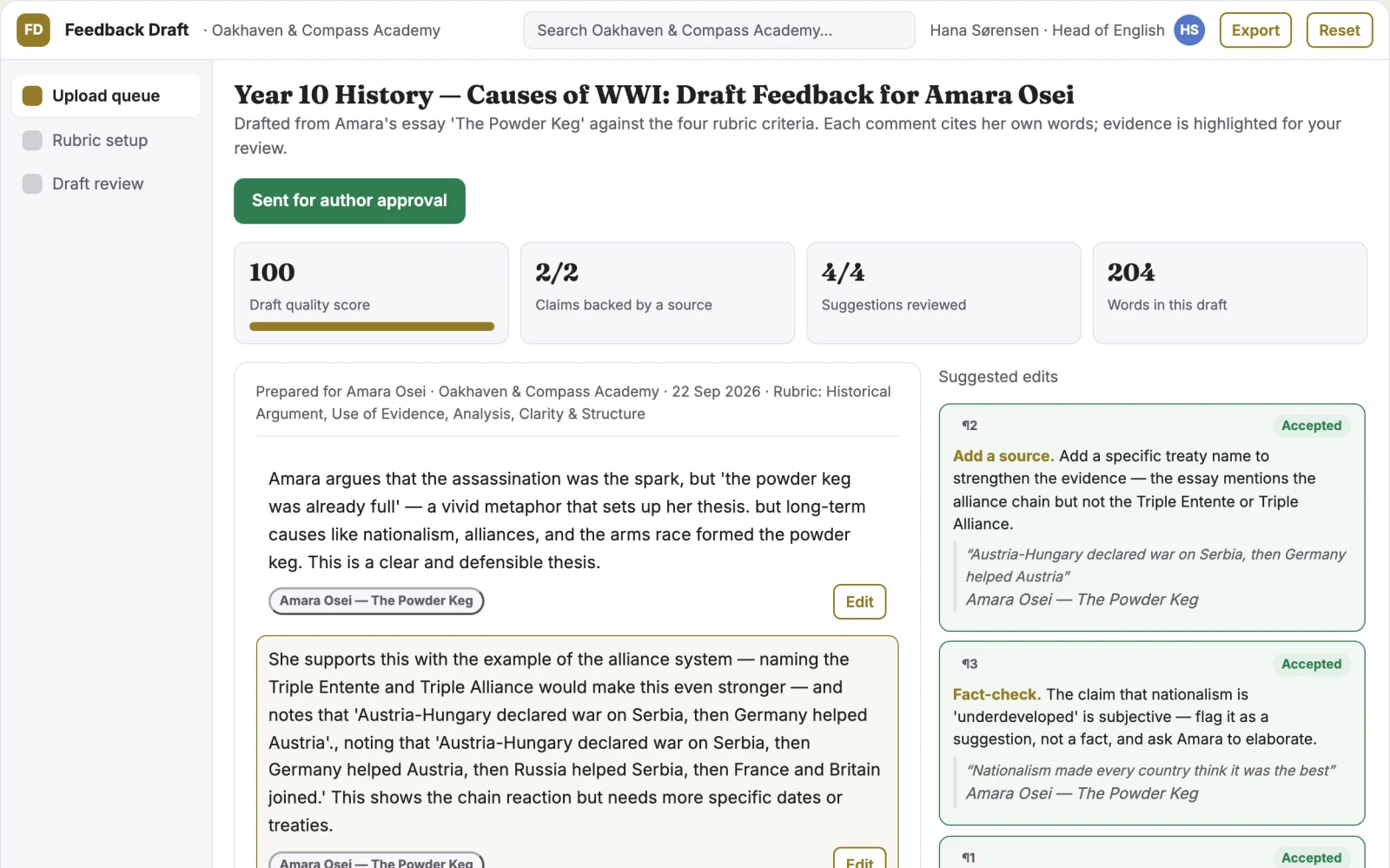
- Draft a three-sentence comment per criterion with evidence
- Flag contradictions or missing evidence
- Present drafts in a review queue for editing
- Export approved feedback to a spreadsheet or LMS-ready format
What you see on screen
- Upload queue
- rubric setup
- draft review
Jobs this app suits
Our AI checked this app against 500 jobs; these get the most out of it. Each job links to its learning path.
Build it yourself with your AI system
Build this app yourself, no coding needed
Start with a quick version you can try in a few minutes. Like it? Then build the full app by copying and pasting our step-by-step instructions: everything is prepared for you.
Sign in to see how to build it yourself
Build a quick version to try, or get the full app pack for Rubric Feedback Drafting with the step-by-step building instructions. You don't need any technical skills: you copy, paste and answer a few questions. Both are included in the membership.
4 Have it built for you days to a few weeks
Rather not do it yourself, or want it fully tailored to your data, your way of working and your brand? Nexibeo builds Rubric Feedback Drafting with you.
What's in the app pack
Included in the Complete AI Training membership.
- The building instructions your AI follows, step by step
- The questions your AI will ask you about your business before it starts
- A clickable demo you can open in your browser, to see how it should work
- A detailed blueprint of the screens, the information it keeps and the checks it runs
Become a member to get the app packAlready a member? Sign in
The files, for the technically curious
- START-HERE.mdHow to build it with your own AI (read first)3 KB
- README.mdOverview and links1 KB
- questions.mdQuestions to answer before you build2 KB
- prompt-cloudflare.mdThe full build prompt, hosted on Cloudflare22 KB
- prompt-vps.mdThe same build on your own server (Docker)22 KB
- spec.jsonData model, API, AI pipeline, acceptance criteria13 KB
- demo/index.htmlThe working demo on sample data196 KB
Questions
Do I need to know how to code?
No. You copy and paste the prompts on this page into ChatGPT or Claude, and the AI does the building. When it asks you something, you answer in your own words.
What does it cost?
The quick version, the app pack and the step-by-step instructions are for members: you pay the membership price, not a price per app (see the plans). Building the full app uses your own ChatGPT or Claude subscription. Putting it online is often cheap or no cost at the start, and your AI tells you before anything costs money.
How long does it take?
The quick version: about two minutes. The real app: an afternoon for a first version you can use, longer if you want every feature.
Can I change it to fit my business?
Yes. Tell your AI what to change in plain words, like “add a column for the price” or “use our logo and colours”. Or have Nexibeo build and customise it for you.
More detailsHow the AI works, safeguards and what to build first
For Heads of English or History in secondary schools, turn student submissions and a marking rubric into draft feedback comments with cited evidence and a next action. Address the recurring problem: teachers spend evenings typing repetitive comments, so detailed feedback shrinks to a few hurried lines. The value hypothesis is a faster, more consistent feedback process with teacher oversight; the pilot must establish whether teachers trust and adopt the drafts.
Upload student files, set rubric criteria, run the drafting process, review drafts in the queue, edit comments, approve the batch, and export feedback. Start with student submissions and a marking rubric and finish with approved feedback comments ready for the LMS.
How the AI works
Use language models to read each submission, extract evidence, and draft comments against rubric criteria. Flag logical inconsistencies or missing evidence automatically. A teacher reviews every draft and approves or edits before anything is released; no comment reaches a student without human sign-off.
Safeguards
Teachers must approve every comment before export. The system must not release feedback automatically, must not alter grades, and must flag any submission it cannot read clearly for manual review.
What to build first
A single-teacher pilot accepting Word documents and a plain-text rubric. First two modules: text extraction and draft generation. Manual review in a spreadsheet output.
What it can connect to
Start with CSV export for LMS import, then add Google Classroom and Moodle APIs.
The screens in detail
Use a batch upload screen for student files, a rubric mapping screen for criteria, and a review queue showing one student's draft comments per criterion with evidence highlights. Allow inline editing and a toggle to view the original submission. Provide an approve-all button with a confirmation step. In this product, the first view is upload queue, followed by rubric setup and draft review.