AI app for it and development · no coding needed
Local AI model runtime and analysis workbench
Run AI models locally with no per-token charges and keep data on your own machines.
Made for: IT teams and analysts who must run AI models on their own hardware without cloud services
What it does for you
The problem
Cloud AI services create per-token costs and send sensitive data outside the organization, while local runtimes are hard to set up, tune and validate.
What it gives you
Benchmarked, validated local model runs and statistical reports
What you give it
Local hardware profilesopen-weight modelsorganizational datavalidation settings
Build your own version of Ava PLS, BaseRT and more
One app with what these 5 AI tools do, yours to keep and change: Ava PLS, BaseRT, Local, Ollamac, AUM.
Everything these tools do, in one app
- Local on-device execution Runs AI models directly on your own machine so data stays private and no cloud service is needed.Found in BaseRT, Local, AUM
- No per-token costs Avoids ongoing per-token charges because inference happens locally instead of through a paid cloud API.Found in BaseRT, AUM
- Easy setup Gets you running with minimal configuration, such as a single command or a few clicks.Found in BaseRT, Local, AUM and 1 more
- Hardware auto-tuning Automatically optimizes the inference engine for your specific computer to improve speed.Found in Local
- Model recommendations Suggests which AI models your hardware can actually run.Found in Local
- Built-in model downloader Fetches open-weight models directly from the command line without manual file handling.Found in BaseRT
- Performance benchmarking Measures tokens per second for different models on your specific hardware.Found in BaseRT
- Apple Silicon optimization Uses Apple Silicon-specific optimizations, such as the Metal 4 tensor API, for faster prompt processing.Found in BaseRT
- Office Mode Lets one powerful office machine run AI while other laptops connect to it over the network.Found in Local
- No accounts required Runs without creating or signing into an online account.Found in Local
- AI-powered local file search Searches local files and folders using AI.Found in AUM
- Private team testing Lets teams test models privately before committing to a cloud-based model.Found in AUM
- Multiple model support Runs a wide range of large language models locally.Found in AUM
- AI content generation Generates written content tailored to different writing styles.Found in Ollamac
- Multiple content types Supports creating articles, emails, social media posts, and similar formats.Found in Ollamac
- Grammar and readability suggestions Provides real-time suggestions to improve grammar and readability.Found in Ollamac
- Automated PLS model building Builds partial least squares models through guided steps.Found in Ava PLS
- Model validation Validates models using methods such as bootstrapping and cross-validation.Found in Ava PLS
- Interactive visualizations Shows interactive visualizations of path models and loadings.Found in Ava PLS
- Data import and export Supports multiple data formats and makes importing and exporting data easy.Found in Ava PLS
- Detailed statistical reports Produces reports with statistical metrics and interpretation aids.Found in Ava PLS
How it works, step by step
- Run AI models directly on the local machine
- Avoid per-token charges by keeping inference local
- Set up with a single command or a few clicks
- Auto-tune the inference engine for the detected hardware
- Recommend models the hardware can run
- Download open-weight models from the command line
- Benchmark tokens per second per model and machine
- Apply Apple Silicon optimizations such as the Metal 4 tensor API
- Run Office Mode so one machine serves other laptops over the network
- Operate without online accounts
- Search local files and folders with AI
- Let teams test models privately before cloud commitment
- Support a wide range of local large language models
- Generate written content in different styles
- Produce articles, emails and social posts
- Suggest grammar and readability improvements
- Build partial least squares models through guided steps
- Validate models with bootstrapping and cross-validation
- Show interactive path model and loading visualizations
- Import and export multiple data formats
- Produce statistical reports with interpretation aids
- Compare the reviewed result with the recorded baseline and value assumptions
- Capture corrections and named-owner approval before consequential use
- Export a versioned benchmarked, validated local model runs and statistical reports with source references and unresolved questions
Jobs this app suits
Our AI checked this app against 500 jobs; these get the most out of it. Each job links to its learning path.
Build it yourself with your AI system
Build this app yourself, no coding needed
Start with a quick version you can try in a few minutes. Like it? Then build the full app by copying and pasting our step-by-step instructions: everything is prepared for you.
Sign in to see how to build it yourself
Build a quick version to try, or get the full app pack for Local AI model runtime and analysis workbench with the step-by-step building instructions. You don't need any technical skills: you copy, paste and answer a few questions. Both are included in the membership.
4 Have it built for you days to a few weeks
Rather not do it yourself, or want it fully tailored to your data, your way of working and your brand? Nexibeo builds Local AI model runtime and analysis workbench with you.
What's in the app pack
Included in the Complete AI Training membership.
- The building instructions your AI follows, step by step
- The questions your AI will ask you about your business before it starts
- A clickable demo you can open in your browser, to see how it should work
- A detailed blueprint of the screens, the information it keeps and the checks it runs
Become a member to get the app packAlready a member? Sign in
The files, for the technically curious
- START-HERE.mdHow to build it with your own AI (read first)3 KB
- README.mdOverview and links4 KB
- questions.mdQuestions to answer before you build2 KB
- prompt-cloudflare.mdThe full build prompt, hosted on Cloudflare25 KB
- prompt-vps.mdThe same build on your own server (Docker)25 KB
- spec.jsonData model, API, AI pipeline, acceptance criteria12 KB
- demo/index.htmlThe working demo on sample data200 KB
Questions
Do I need to know how to code?
No. You copy and paste the prompts on this page into ChatGPT or Claude, and the AI does the building. When it asks you something, you answer in your own words.
What does it cost?
The quick version, the app pack and the step-by-step instructions are for members: you pay the membership price, not a price per app (see the plans). Building the full app uses your own ChatGPT or Claude subscription. Putting it online is often cheap or no cost at the start, and your AI tells you before anything costs money.
How long does it take?
The quick version: about two minutes. The real app: an afternoon for a first version you can use, longer if you want every feature.
Can I change it to fit my business?
Yes. Tell your AI what to change in plain words, like “add a column for the price” or “use our logo and colours”. Or have Nexibeo build and customise it for you.
More detailsHow the AI works, safeguards and what to build first
Run AI models locally with no per-token charges and keep data on your own machines. For IT teams and analysts who must run AI models on their own hardware without cloud services, convert local hardware, open-weight models and organizational data into benchmarked, validated local model runs and statistical reports. The benefit is a testable hypothesis, measured through tokens per second on target hardware and accepted local runs per analyst hour; do not assume that AI output alone produces business value.
Confirm the buyer's problem and scope, collect local hardware profiles, open-weight models, organizational data and validation settings, then follow this sequence: 1. Run AI models directly on the local machine. 2. Auto-tune the inference engine for the detected hardware. 3. Benchmark tokens per second per model and machine. 4. Validate models with bootstrapping and cross-validation. 5. Produce statistical reports with interpretation aids. Resolve uncertain cases with qualified reviewers, approve benchmarked, validated local model runs and statistical reports, and measure tokens per second on target hardware and accepted local runs per analyst hour against a documented baseline.
How the AI works
Use AI to interpret permitted inputs, suggest structured mappings and generate candidate outputs for the stated task modules. Use deterministic code for arithmetic, schema validation, hard constraints and reproducible tests. Review source-linked explanations and uncertainty before accepting results. Local execution only; model quality and statistical validity checks remain with qualified reviewers. A model suggestion is never a verified fact, professional decision or authorization to act.
Safeguards
Preserve data ownership, source attribution, statistical accuracy and usage permissions. Named owners approve substantive changes and external sharing. One supported operating system and one hardware class; final statistical validity and model quality checks remain with qualified reviewers. Keep all consequential actions under authorized human control and do not fabricate missing inputs, permissions, professional judgments or market evidence.
What to build first
Pilot scope: One supported operating system and one hardware class; final statistical validity and model quality checks remain with qualified reviewers. Implement one approved input format, a bounded representative case set and the first two task modules: run AI models directly on the local machine; auto-tune the inference engine for the detected hardware. Support the remaining modules with operator review: benchmark tokens per second; validate models with bootstrapping and cross-validation; produce statistical reports. Include source references, corrections, basic organization access, approval states, export and value measurement. Use managed operator assistance for unresolved exceptions. The cost estimate covers this narrow prototype, not unrestricted multi-tenant scale, complex production integrations, specialist certification or physical operations.
What it can connect to
Organization-owned data sources, permitted local file systems and approved model repositories. Local storage, design-file import/export and reporting destinations. Start with file exchange and validate destination specifications before promising direct publishing. Start with authorized file exchange. Validate current provider access, usage rights and schema behavior before promising a connector.
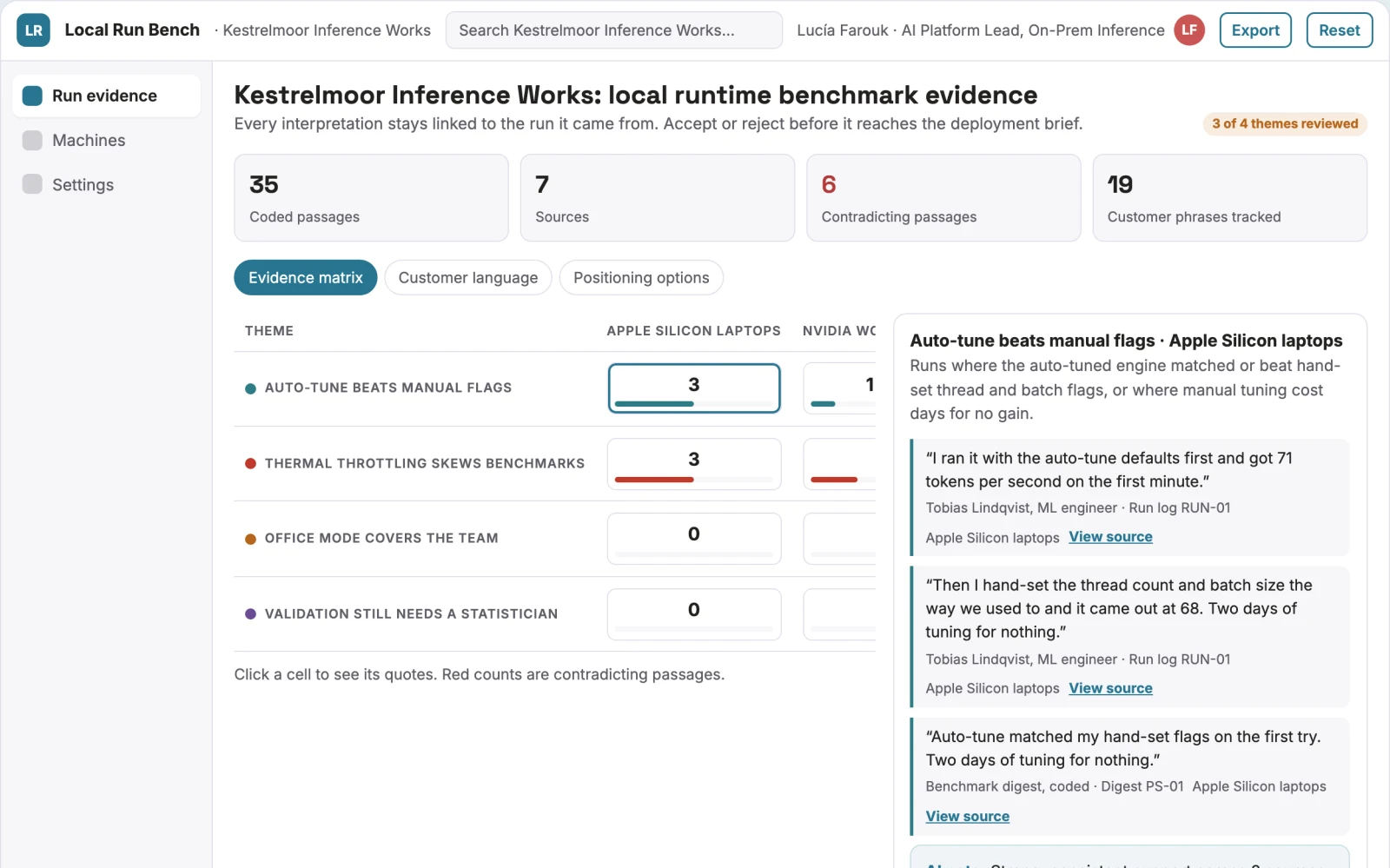
The screens in detail
Primary screens: Hardware and model setup, Local run and benchmark console, Analysis and report workspace. Use a machine list with detected hardware, a central run view with live tokens per second and resource use, and a right-hand panel for model files, validation settings and comments. Let users compare models and runs side by side. Display draft, validated and approved states. Provide a client preview link with comments anchored to the relevant run or report. Make the task-specific outcome benchmarked, validated local model runs and statistical reports visible beside its evidence, review state and value baseline.