AI app for product development · no coding needed
Assumption-driven planning and decision workspace
Reduce decision rework while keeping assumptions and evidence visible.
Made for: Product teams and innovation leads turning ideas and project information into organized, shared visual work
What it does for you
The problem
Assumptions stay hidden in scattered notes and tools, so decisions lack visible evidence and shared context.
What it gives you
Reviewed decision workspace with scored assumptions and source-linked evidence
What you give it
Notesproject dataclient conversationslinked AI services
Build your own version of Miro 2.0 The Innovation Workspace, siift and more
One app with what these 3 AI tools do, yours to keep and change: Miro 2.0 The Innovation Workspace, siift, Graphis.
Everything these tools do, in one app
- Shared visual canvas Gives teams one visual space to arrange and view project information together.Found in Miro 2.0 The Innovation Workspace, siift, Graphis
- Real-time collaborative editing Lets multiple people work on the same canvas at the same time.Found in Graphis
- Tables and timelines Shows project data in tables and timelines to track progress and organize tasks.Found in Miro 2.0 The Innovation Workspace
- Automated document creation Turns unstructured notes into formatted documents such as briefs and reports.Found in Miro 2.0 The Innovation Workspace
- AI-powered prototyping Converts sticky note ideas into interactive prototypes for faster feedback.Found in Miro 2.0 The Innovation Workspace
- Assumption risk scoring Flags assumptions as risky until enough evidence supports them.Found in siift
- Independent evidence evaluation Uses a separate AI service to evaluate evidence independently from the AI that generated the assumption.Found in siift
- Decision intelligence engine Surfaces evidence behind suggestions, key metrics, progress scores, and risks.Found in siift
- Framework grounding References established methodologies such as Lean Canvas and MBM.Found in siift
- Proprietary memory system Uses a patent-pending AI memory layer designed to learn and evolve without context degradation.Found in siift
- Client communication Integrates client conversations into the workspace.Found in Graphis
- Role-based permissions Controls access and feedback through role-based permissions.Found in Graphis
- AI generative media support Supports AI generative media alongside digital whiteboards.Found in Graphis
- Cloud infrastructure visualization Connects to AWS accounts to generate visual representations of cloud setups and estimate costs.Found in Miro 2.0 The Innovation Workspace
- Adobe Express integration Allows creating and editing images and videos directly within the workspace.Found in Miro 2.0 The Innovation Workspace
- Custom AI model support Links preferred AI services such as OpenAI and Azure.Found in Miro 2.0 The Innovation Workspace
- Project-level token budgeting Planned feature to budget tokens at the project level.Found in Graphis
How it works, step by step
- Arrange project information on a shared visual canvas
- Edit the same canvas with multiple people in real time
- Track project data in tables and timelines
- Turn unstructured notes into formatted briefs and reports
- Convert sticky note ideas into interactive prototypes
- Flag assumptions as risky until enough evidence supports them
- Evaluate evidence with a separate AI service from the one that generated the assumption
- Surface evidence, key metrics, progress scores and risks behind each suggestion
- Ground frameworks in established methodologies such as Lean Canvas and MBM
- Maintain a proprietary memory layer that learns without context degradation
- Integrate client conversations into the workspace
- Control access and feedback through role-based permissions
- Support AI generative media alongside digital whiteboards
- Connect to cloud accounts to visualize setups and estimate costs
- Create and edit images and videos inside the workspace
- Link preferred AI services such as OpenAI and Azure
- Budget tokens at the project level
- Compare the reviewed result with the recorded baseline and value assumptions
- Capture corrections and named-owner approval before consequential use
- Export a versioned reviewed decision workspace with source references and unresolved questions
Jobs this app suits
Our AI checked this app against 500 jobs; these get the most out of it. Each job links to its learning path.
Build it yourself with your AI system
Build this app yourself, no coding needed
Start with a quick version you can try in a few minutes. Like it? Then build the full app by copying and pasting our step-by-step instructions: everything is prepared for you.
Sign in to see how to build it yourself
Build a quick version to try, or get the full app pack for Assumption-driven planning and decision workspace with the step-by-step building instructions. You don't need any technical skills: you copy, paste and answer a few questions. Both are included in the membership.
4 Have it built for you days to a few weeks
Rather not do it yourself, or want it fully tailored to your data, your way of working and your brand? Nexibeo builds Assumption-driven planning and decision workspace with you.
What's in the app pack
Included in the Complete AI Training membership.
- The building instructions your AI follows, step by step
- The questions your AI will ask you about your business before it starts
- A clickable demo you can open in your browser, to see how it should work
- A detailed blueprint of the screens, the information it keeps and the checks it runs
Become a member to get the app packAlready a member? Sign in
The files, for the technically curious
- START-HERE.mdHow to build it with your own AI (read first)3 KB
- README.mdOverview and links4 KB
- questions.mdQuestions to answer before you build2 KB
- prompt-cloudflare.mdThe full build prompt, hosted on Cloudflare26 KB
- prompt-vps.mdThe same build on your own server (Docker)26 KB
- spec.jsonData model, API, AI pipeline, acceptance criteria12 KB
- demo/index.htmlThe working demo on sample data197 KB
Questions
Do I need to know how to code?
No. You copy and paste the prompts on this page into ChatGPT or Claude, and the AI does the building. When it asks you something, you answer in your own words.
What does it cost?
The quick version, the app pack and the step-by-step instructions are for members: you pay the membership price, not a price per app (see the plans). Building the full app uses your own ChatGPT or Claude subscription. Putting it online is often cheap or no cost at the start, and your AI tells you before anything costs money.
How long does it take?
The quick version: about two minutes. The real app: an afternoon for a first version you can use, longer if you want every feature.
Can I change it to fit my business?
Yes. Tell your AI what to change in plain words, like “add a column for the price” or “use our logo and colours”. Or have Nexibeo build and customise it for you.
More detailsHow the AI works, safeguards and what to build first
Reduce decision rework while keeping assumptions and evidence visible. For product teams and innovation leads turning ideas and project information into organized, shared visual work, convert notes, project data, client conversations and linked AI services into a reviewed decision workspace with scored assumptions and source-linked evidence. The benefit is a testable hypothesis, measured through decisions closed per planning cycle and assumptions retired with evidence; do not assume that AI output alone produces business value.
Confirm the buyer's problem and scope, collect notes, project data, client conversations and linked AI services, then follow this sequence: 1. Arrange project information on a shared visual canvas. 2. Edit the same canvas with multiple people in real time. 3. Track project data in tables and timelines. 4. Turn unstructured notes into formatted briefs and reports. 5. Convert sticky note ideas into interactive prototypes. 6. Flag assumptions as risky until enough evidence supports them. 7. Evaluate evidence with a separate AI service from the one that generated the assumption. 8. Surface evidence, key metrics, progress scores and risks behind each suggestion. Resolve uncertain cases with qualified reviewers, approve reviewed decision workspace with scored assumptions and source-linked evidence, and measure decisions closed per planning cycle and assumptions retired with evidence against a documented baseline.
How the AI works
Use AI to interpret permitted inputs, suggest structured mappings and generate candidate outputs for the stated task modules. Use a separate AI service to evaluate evidence independently from the AI that generated the assumption. Use deterministic code for arithmetic, schema validation, hard constraints and reproducible tests. Review source-linked explanations and uncertainty before accepting results. One fixed workspace schema and linked AI services; final decision and evidence checks remain human. A model suggestion is never a verified fact, professional decision or authorization to act.
Safeguards
Preserve source attribution, quotation accuracy and usage permissions. Named owners approve substantive changes and decision scope. One fixed workspace schema and linked AI services; final decision and evidence checks remain human. Keep all consequential actions under authorized human control and do not fabricate missing inputs, permissions, professional judgments or market evidence.
What to build first
Pilot scope: One fixed workspace schema and linked AI services; final decision and evidence checks remain human. Implement one approved input format, a bounded representative case set and the first two task modules: arrange project information on a shared visual canvas; edit the same canvas with multiple people in real time. Support the remaining modules with operator review: track project data in tables and timelines; turn unstructured notes into formatted briefs and reports; convert sticky note ideas into interactive prototypes; flag assumptions as risky until enough evidence supports them; evaluate evidence with a separate AI service; surface evidence, key metrics, progress scores and risks. Include source references, corrections, basic organization access, approval states, export and value measurement. Use managed operator assistance for unresolved exceptions. The cost estimate covers this narrow prototype, not unrestricted multi-tenant scale, complex production integrations, specialist certification or physical operations.
What it can connect to
Customer-owned notes, project data and client conversations. Cloud asset storage, design-file import/export, cloud account connections and preferred AI services such as OpenAI and Azure. Start with file exchange and validate destination specifications before promising direct publishing. Start with authorized file exchange. Validate current provider access, usage rights and schema behavior before promising a connector.
The screens in detail
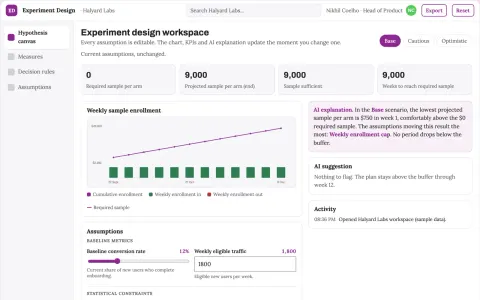
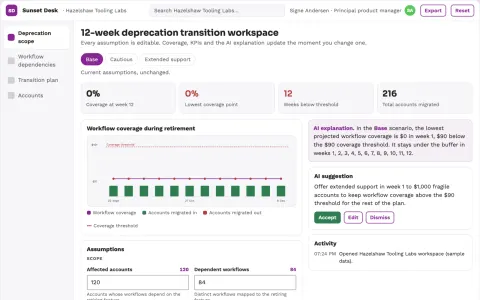
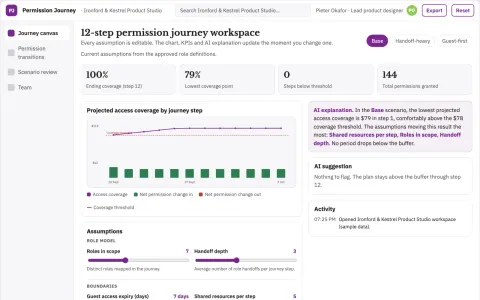
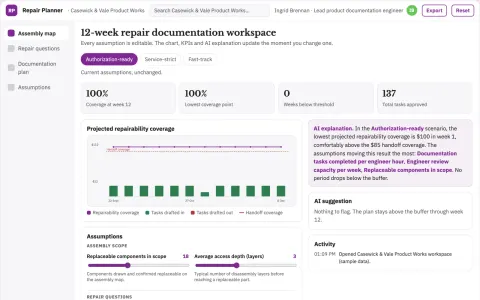
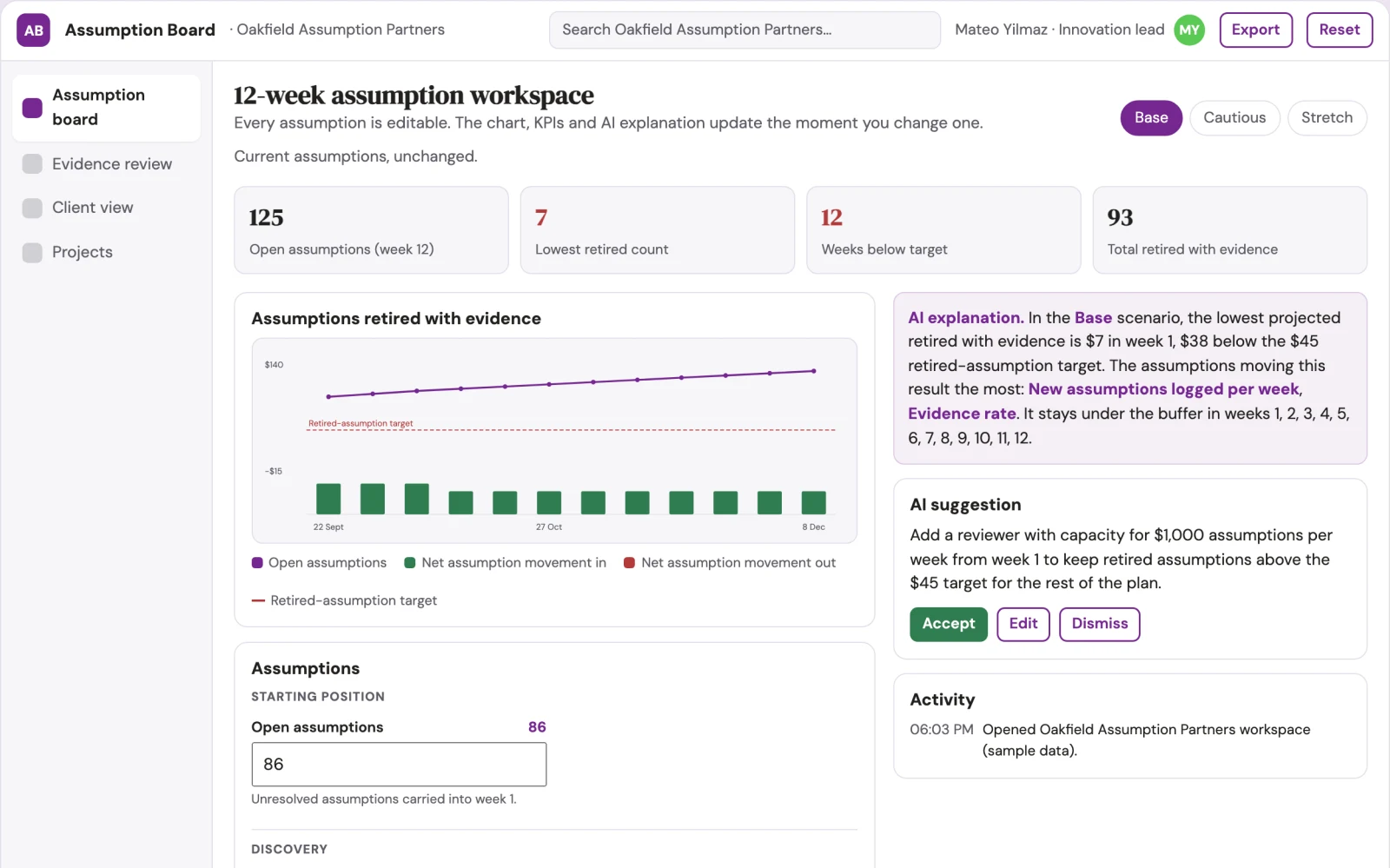
Primary screens: Assumption board and canvas, Evidence and decision review, Client and delivery view. Use a thumbnail gallery for projects, a large central canvas with tables and timelines, and a right-hand panel for assumptions, evidence, risks and comments. Let users compare versions side by side. Display draft, changes requested and approved states. Provide a client preview link with comments anchored to the relevant assumption or asset. Make the task-specific outcome reviewed decision workspace with scored assumptions and source-linked evidence visible beside its evidence, review state and value baseline.