
Certification
Certification: Applying AI in Strategic Human Resource Management (SHRM)
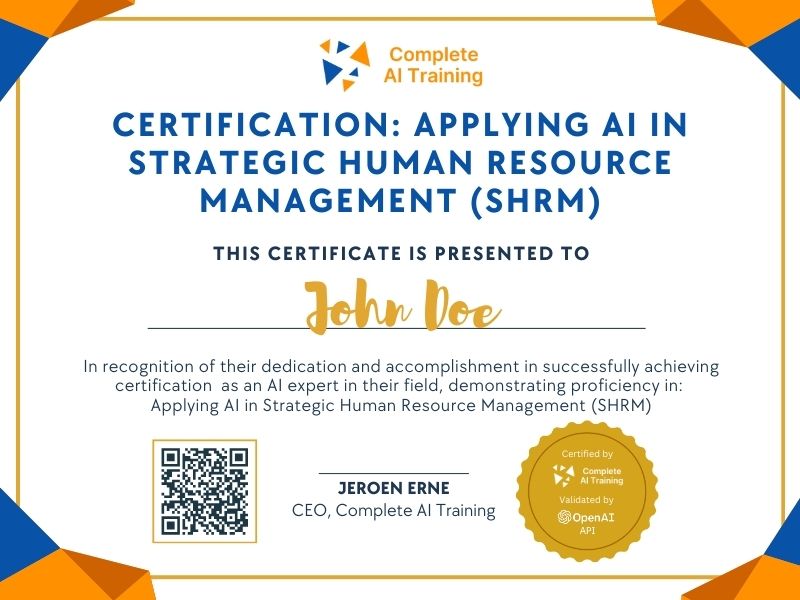
Show you know how to use AI in HR with this certification. Gain practical expertise in integrating AI tools for smarter talent management, decision-making, and workforce planning—giving your career a competitive, future-ready advantage.
The exam
Take the certification exam
Multiple-choice questions about the course. Pass with 70% or more and your certificate is issued at once, with a public page and an "Add to LinkedIn" button.
What the exam covers
2 questions from each of the 15 chapters of the course
20 multiple-choice questions, drawn fresh for every attempt. Pass with 70% or more.
- 01Introduction and defining SHRM3:02
- 02Importance of SHRM3:59
- 03Traditional HRM approaches4:00
- 04Traditional HRM objectives2:23
- 05Modern SHRM defined3:44
- 06Objectives and implementation3:43
- 07Benefits and comparison3:16
- 08Technology in HR practices1:49
- 09AI in the SHRM landscape3:33
- 10Benefits of AI in SHRM2:12
- 11AI implementation challenges4:54
- 12Enhancing employee experience2:26
- 13Future directions3:51
- 14Key AI tools for HR4:25
- 15Conclusion1:47
The Certification: Applying AI in Strategic Human Resource Management (SHRM) empowers HR professionals to integrate artificial intelligence into strategic HR practices. By completing this certification, you will gain enhanced decision-making abilities, a competitive advantage, and adaptability for future HR trends. Enroll today to elevate your expertise and drive innovation within your organization.
This certification covers the following topics:
- Modern Strategic Human Resource Management (SHRM) - An Advanced Approach
- Overview of AI in SHRM
- Benefits of AI in SHRM
- Challenges in Implementing AI in SHRM
- AI Tools Used in SHRM
- Enhancing Employee Experiences with AI
- Future Directions in SHRM
- How AI Transforms Recruitment Processes in SHRM
- The Role of AI in HR Analytics within SHRM
- AI’s Impact on Talent Management and Organisational Agility
- How AI Supports Diversity, Inclusion, and Employee Wellbeing
Jobs this certification suits
Our AI checked this certification against 500 jobs; these get the most out of it. Each job links to its learning path.