
Certification
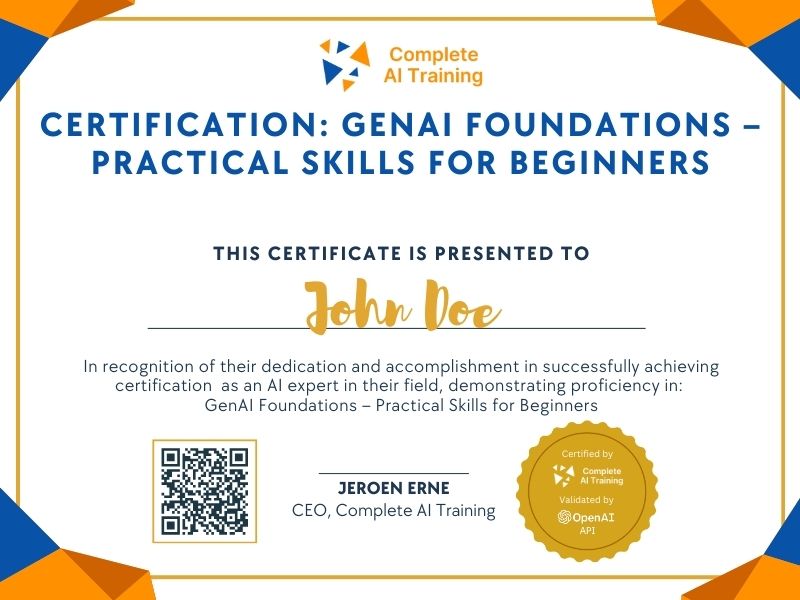
Certification: GenAI Foundations – Practical Skills for Beginners
Show the world you have AI skills. Build practical experience with Generative AI through hands-on projects and concepts—perfect for beginners ready to enhance their CV and take the next step in their technology journey.
The exam
Take the certification exam
Multiple-choice questions about the course. Pass with 70% or more and your certificate is issued at once, with a public page and an "Add to LinkedIn" button.
What the exam covers
2 questions from each of the 15 chapters of the course
20 multiple-choice questions, drawn fresh for every attempt. Pass with 70% or more.
- 01Introduction, roadmap and fundamentals103:59
- 02Local deployment, prompting and agents72:06
- 03Hardware, architecture and data science46:42
- 04Benchmarks, cloud platforms and APIs68:28
- 05Assistant workflows and real apps58:00
- 06Data mining, evaluation and search82:12
- 07Agentic prototyping and platform comparison76:57
- 08Azure AI Foundry, serving and compression59:57
- 09Real-time apps and orchestration96:51
- 10Structured JSON, Replicate, RAG prompting, CoT83:37
- 11Assistant design, FastHTML and ReAct95:16
- 12Cloud dev platforms and IaC83:50
- 13Data modelling and AI careers52:57
- 14Assistant tools, agentic workflows and RAG111:33
- 15Conclusion and next steps281:30
The Certification: GenAI Foundations – Practical Skills for Beginners provides a comprehensive starting point for those looking to build real-world skills in Generative AI. By mastering essential concepts like large language models, optimization techniques, and practical development tools, you can gain a competitive advantage and future-proof your career in AI-driven industries. Enroll now to unlock new opportunities and maximize your potential with foundational GenAI expertise.
This certification covers the following topics:
- Understanding Large Language Models (LLMs)
- Model Optimization and Distillation
- Understanding Machine Learning Fundamentals
- Exploring Development Environments
- Utilizing External Libraries and APIs
- Local vs. Cloud Development
- Quantization for Model Efficiency
- Serving Large Language Models
- Vector Stores and Semantic Search
- Library Management and Troubleshooting
Jobs this certification suits
Our AI checked this certification against 500 jobs; these get the most out of it. Each job links to its learning path.