
AI news ·
60% of healthcare firms use AI chatbots, survey finds
Sixty percent of healthcare firms use AI for customer service chatbots, sector's most adopted AI task, reflecting focus on targeted relief where staff strain meets demand.
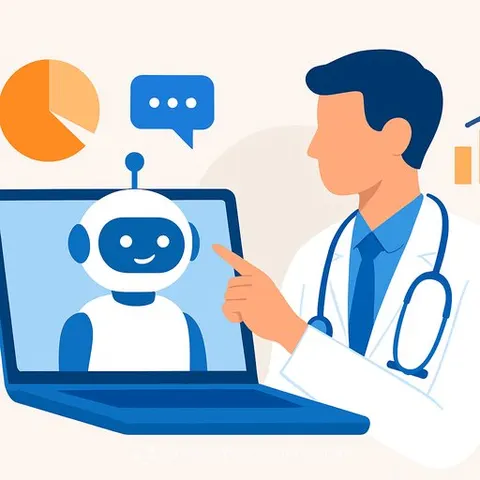
Sixty percent of healthcare and medical firms now use AI for customer service chatbots and virtual agents, making it the sector's most adopted AI task. The finding, from a March survey of 60 senior technology executives at U.S. enterprises with at least $1 billion in annual revenue, signals that healthcare AI is starting where staff strain and patient demand collide - not with sweeping automation, but with targeted operational relief.
The data comes from PYMNTS Intelligence's Enterprise AI Benchmark Report, which examined AI use across 75 tasks in financial services and insurance, healthcare and medical, and media and advertising. Healthcare trails financial services in the number of tasks reaching high adoption - 10 compared with 27 - yet that narrower footprint reflects a deliberate focus on reducing friction now while building toward broader transformation as data and system integration improve.
Where healthcare AI is gaining ground
Beyond chatbots, two other use cases have crossed the 50% adoption threshold. Workforce planning and skills gap analysis sits at 55%. The sector's labor challenge is not simply about staffing levels. It is about matching the right people to the right work. AI helps organizations spot gaps, plan coverage, and identify where training is needed. Logistics routing and delivery optimization follows at 53%, addressing the reality that supplies, medications, samples, and equipment move across complex networks with little room for delay.
These three tasks share a common thread. Each one absorbs routine cognitive load from human teams. A chatbot fields refill requests and appointment questions. A workforce model flags coverage gaps before a shift starts. A routing algorithm adjusts delivery sequences when a critical shipment changes priority. None of these replace clinical judgment. They reduce the operational noise that pulls staff away from higher-skill work. For organizations building out AI for Healthcare capabilities, the pattern is clear: start with tasks that have immediate, measurable relief for overstretched teams.
Where the foundations are still catching up
Several areas show how much runway remains. Customer journey orchestration sits at 5% adoption. Most organizations have not yet connected AI across the full patient experience from scheduling through follow-up. Regulatory compliance monitoring is at 30%, a surprisingly low figure given how central compliance is to healthcare operations. Data labeling and feature engineering, the work that makes AI models reliable, sits at 25%. Without clean, well-labeled data, even well-intentioned AI projects underperform.
These numbers suggest that many firms are running AI on top of legacy data environments. The chatbot can answer a question, but it may not have access to the patient's full record. The workforce model can flag a gap, but it may not integrate with scheduling software. The next phase of adoption will depend less on buying more AI tools and more on connecting the systems those tools need to function.
The spending signal
Over the next 12 months, 60% of healthcare firms expect to increase AI spending. An equal share cite pilot funding with no formal ROI requirement as a reason for investment, while half point to productivity and efficiency gains. The mix reveals a sector that is still learning where AI pays off but is not waiting for perfect clarity before committing resources. Leaders are funding experiments, watching what works, and preparing to scale.
Customer service remains a natural starting point. With 60% of firms already using AI for Customer Support chatbots, the question is no longer whether to deploy but how to move from answering simple queries to handling more complex patient interactions without losing accuracy or trust. That progression requires better data integration, stronger compliance guardrails, and workflows designed around AI from the start rather than bolted on after the fact.
Why this matters for healthcare professionals
Healthcare does not need AI to replace judgment. It needs AI to help staff work faster, see patterns earlier, and make complex systems easier to manage. For professionals on the ground - clinicians, operations leads, department heads - these adoption patterns are a preview of where resources will flow. Chatbots may absorb the calls you field at 2 a.m. about office hours. Workforce AI may reshape how your unit gets staffed next quarter. The firms that connect their data, modernize their workflows, and scale from narrow use cases to coordinated operations will set the pace. The pressure valve opening now could become the operating model soon after.