
AI news ·
70% of Hong Kong white-collar workers use AI - but top executives lag behind
70% of Hong Kong's white-collar workers already use AI and say it boosts productivity. Yet under 15% of execs do-set goals, pick tools, train, and lead by example.
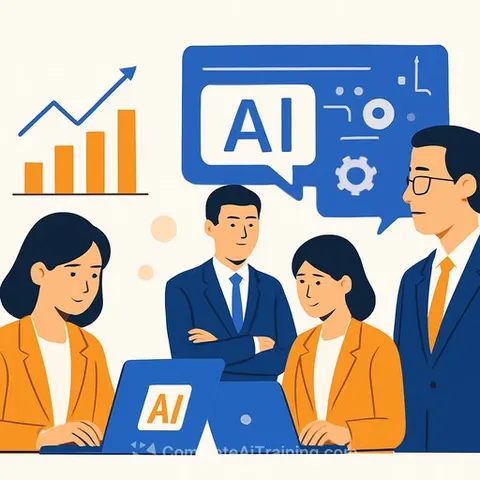
70% of Hong Kong's white-collar staff use AI. Leadership still lags.
A December survey of 4,500 professionals and tertiary students found that over 70% of white-collar workers in Hong Kong already use AI on the job. Nearly 90% say it makes them more productive, and over 90% engage with AI daily.
The outlier: less than 15% of founders and executives use AI themselves. That gap slows integration and sends a mixed signal to teams.
As McKinsey partner Jackey Yu put it, "Senior management needs to be onboard…and act as a role model." Managing partner Arthur Shek added that companies need clear AI goals and real investment in skills.
What this means for managers
- Your people are already using AI. Without direction, they'll create their own playbooks-good or bad.
- Executive hesitation blocks budgets, tooling, policy, and measurable outcomes.
- Teams want clarity: which tools, for which workflows, with what standards and guardrails.
The 90-day plan to align AI with outcomes
- Define 3 business wins: e.g., reduce report prep time 40%, cut customer response time 30%, ship proposals 2x faster.
- Pick 3 priority workflows per function (sales emails, research summaries, meeting notes to tasks).
- Standardize tool access: approve 1-2 AI assistants and data-safe extensions; document when to use them.
- Write a one-page policy: data handling, confidentiality, human review, citation standards, and banned use cases.
- Name champions in each team to collect prompts, patterns, and pitfalls; share wins weekly.
- Upskill fast: short courses, prompt patterns, and role-based playbooks tied to OKRs.
- Instrument the work: baseline current time/cost, then track deltas on cycle time, quality, and error rates.
- Lead by example: executives demo AI use in meetings and reviews; model the behavior you want.
Starter use cases by function
- Sales: draft outreach, qualify leads, summarize calls, create account plans.
- Marketing: brief creation, content outlines, repurposing assets, SEO ideas with human edit.
- Operations: SOP drafting, variance analysis summaries, vendor email routing.
- Finance: commentary on variances, plain-English budget notes, policy Q&A.
- HR: JD drafts, interview guides, policy summarization, learning paths.
- Product: user story drafts, test-case generation, meeting notes to action items.
Students are ready. Are you?
Over 70% of tertiary students prefer AI-enabled careers, and 90% are actively building relevant skills. Yu summed it up: "Embrace AI, no-brainer… think more about how to partner with AI to do more and better."
- Update job descriptions with clear AI expectations and tools used.
- Add practical AI tasks to interviews (e.g., summarize a brief, improve a prompt, design a workflow).
- Offer internships or sprint projects that pair students with team AI champions.
Governance without the drag
- Set data rules: what can/can't be pasted, how to mask PII, and approved connectors.
- Keep a human-in-the-loop for external content, financials, legal, and safety-critical decisions.
- Log prompts for QA and learning; periodically review outputs for bias and accuracy.
How to measure impact (simple and defensible)
- Cycle time per task (before/after), error rate, and satisfaction score from end users.
- Adoption rate by team, prompts/playbooks reused, and cost per deliverable.
- Quarterly review: retire low-value use cases, double down on proven ones.
Further reading and training
See broader research and benchmarks at McKinsey.
If you need structured, role-based upskilling, explore the AI Learning Path for Business Unit Managers to help leaders align outcomes, and the AI Learning Path for Training & Development Managers to scale manager-led upskilling and playbooks.
Bottom line
Your teams already use AI daily. Close the leadership gap, set clear targets, invest in skills, and make AI a visible part of how management works. The companies that do this will move faster with fewer meetings and cleaner handoffs-and that shows up in the P&L.