
AI news ·
A broccoli farmer in Japan builds his own farm management tools with AI, bypassing commercial software subscriptions
A Japanese broccoli farmer built a complete farm management system using ChatGPT and Codex — replicating software that commercial subscriptions charge for — without any vendor tools.
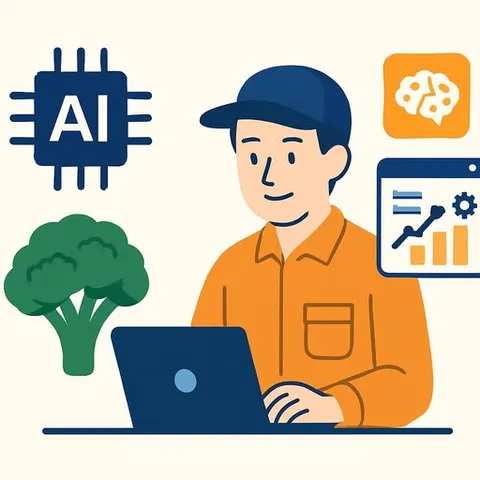
Controlled environment agriculture has built an entire software sector on a simple premise: growing indoors generates more data than any farmer can manage manually. CEA farm management software companies sell subscriptions to handle it - climate dashboards, irrigation schedulers, crop monitoring platforms, task management tools - each solving one piece of the data problem, charging a recurring fee, and leaving growers to bridge the gaps between systems that were never designed to talk to each other. That arrangement is now under pressure from a direction most software companies did not see coming.
A broccoli farmer built what software companies sell
The most striking example came from Hiroki Tomiyasu, a broccoli farmer in Hokkaido, Japan. Growing across roughly 100 hectares, with no CTO, no R&D budget, and no venture-backed platform, Tomiyasu built a system that monitors greenhouse temperatures via connected sensors, controls roll-up vents remotely through a messaging bot, pulls satellite NDVI data to overlay on field maps, tracks seeding records from group chat history, and manages task scheduling across his team - all without a single commercial precision agriculture subscription. He used ChatGPT and Codex. He documented the process publicly. He did it in his spare time.
It was covered as a human-interest story about a switched-on farmer. The harder implication: Tomiyasu assembled the core functionality that CEA farm management software companies charge recurring subscription fees to provide. He did not build it because he wanted to write software. He built it because the commercial alternatives were fragmented - each tool covered one part of the problem, none connected cleanly to the others - and AI tools filled the gap.
The integration pressure is already building
For growers currently paying for multiple disconnected subscriptions, the Tomiyasu example reflects a pressure that is already building. The fragmentation problem - where irrigation data, climate data, crop records, and task management live in separate systems with no clean integration - was previously something growers had to either pay a platform to solve or manage manually. That is changing. Coding with AI tools have reduced the time required to build standard agricultural software features from months to weeks.
At a small family-scale operation, a DIY integration layer is a practical option with manageable risk. The same approach at a 50-hectare commercial facility carrying a high-value crop is a different risk profile - a system failure during a critical photoperiod is not a setback, it is a crop loss event. Not every grower will build their own tools. But the pressure toward integration has grown strong enough that individual farmers are attempting it when the market does not offer it cleanly, and some are succeeding.
What this means for CEA software companies
For CEA farm management software companies selling standalone subscriptions, the risk is real. A scheduling tool, a single-purpose climate dashboard, or a crop monitoring SaaS without a broader integration story is now competing not just against other software products, but against any grower with a few hours, a general-purpose AI subscription, and a specific problem to solve. The marginal cost of replicating a mid-tier precision ag SaaS product is approaching zero for any well-resourced competitor.
Features alone do not protect a product anymore. What remains defensible is the network of hardware integrations, the proprietary data accumulated across growing seasons, and the ecosystem relationships that make switching genuinely costly. Software companies in CEA that understood this early are either embedding their product inside equipment relationships - so the software ships with the greenhouse - or building toward a full-stack delivery model where they design and operate the intelligence layer as part of a complete project. Those still selling point-solution subscriptions to operators who could build the equivalent themselves face the same question that equipment-only operators faced three years ago.
Why this matters for management
For managers overseeing CEA operations, the shift changes the procurement calculus. The question is no longer which software subscription to buy - it is whether the software layer brings proprietary data, hardware integration depth, or switching costs that justify the recurring fee. When individual growers can assemble core functionality using general-purpose AI for Management tools, standalone dashboards and scheduling apps become line items worth scrutinizing. The defensible position in CEA farm management software is no longer the feature set. It is the data, the hardware ties, and the ecosystem relationships that make leaving expensive.