
AI news ·
AI and flexible work erode the 100-year-old 9-to-5 model
Henry Ford's 1926 five-day, eight-hour workweek is collapsing as hybrid work, Gen Z multi-job portfolios, and 24/7 AI agents reshape labor. Studies show generative AI lifts productivity 5-25%, with less-skilled workers improving 34%, forcing HR to measure output over hours.
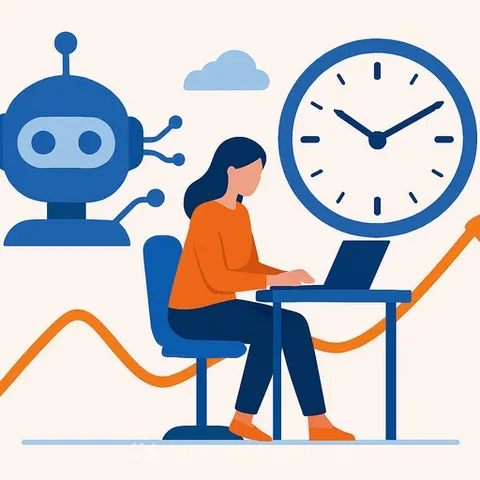
Henry Ford introduced the five-day, eight-hour workweek at his factories in 1926. A century later, that model is being dismantled from multiple directions at once: hybrid work has blurred the boundary between office and home, Gen Z workers are building portfolios of multiple jobs, and AI agents now keep working after employees log off.
The result is a labor market where the question is no longer just when and where people work, but how much of the work needs a person at all. For HR professionals, that shift raises practical questions about hiring, performance measurement, and the legal framework that still assumes a human worker punching a clock.
The end of fixed hours
The workday is breaking into "micro-shifts" - short blocks of work spread throughout the day, tailored to the task, family needs, and the hours when an employee is most focused. That flexibility cuts both ways: workers gain freedom to fit work around their lives, but the boundary between the two keeps dissolving.
Sharon Steiner, chief human resources officer at Fiverr, has watched this evolution over a career that started at IBM and moved through startups before joining Fiverr in 2012. She said the shift away from 9-to-5 is real but uneven.
"The change doesn't happen in a day. It sounds as if 9-to-5 has given way to something very amorphous because of technology and after COVID. First of all, there are still many places that keep those working hours, and beyond that, a lot of young people even work fewer hours a day and tend to create several jobs for themselves."
Steiner said the rise in multiple jobs stems from insecurity in today's labor market. "People are looking for employment stability. The world today is very unstable, not only in high tech." Workers arrange their hours around global collaboration, family obligations, and side projects. She described the result as "life blend" rather than work-life balance: "You have to reach the goal, and the employer cares less about when and how that happens."
AI agents as the new workforce
The bigger change now underway is the arrival of a new type of "employee" that never sleeps. Steiner said she has started calling herself a chief resource officer rather than a chief human resources officer.
"Now there is the agent, and suddenly an employee has someone working for them 24/7. AI never rests, and for developers, the person has become the weak link because they need to eat, sleep and take time off, but the agent keeps working. The developer or analyst can go home and the agents keep working all night. What remains for the person is to manage and coordinate those resources."
Research is beginning to quantify the productivity impact. A 2025 OECD review of experimental studies on generative AI at work found average productivity gains ranging from 5% to more than 25% in customer service, software development, and consulting. The biggest gains went to less experienced workers: in one study, AI increased customer service output by an average of 14%, while new and less-skilled workers improved by 34%.
Fiverr has built this thinking into a working tool. Its Hiring Intelligence Platform (HIP) gives managers a way to break any process, project, or position into components and decide the optimal mix of permanent employees, freelancers, and AI tools - with cost estimates attached. "The platform was developed with Fiverr's recruiting team together with external freelancers and AI systems," Steiner said.
For HR professionals, this raises a strategic question: how do you manage a workforce that now includes machines? Steiner's answer is that experienced employees become more important, not less. "It is important to have very experienced company employees, very strong 10x performers - people who are significantly more effective or productive than the average employee." She said what matters now is output, not hours: "If an employee decides to hire freelancers or use agents to reach the goal, I have no problem with that."
The legal gap
Employment contracts and regulation are still built around human working time, even as companies shift toward measuring output. Attorney Hadas Raccah-Dvir, head of the Labor and Employment practice at Shibolet & Co., said the law has repeatedly had to catch up to changes in how people work.
"Usually, the market changes first and the law has to catch up. That is especially clear today, when technology, particularly AI tools, is advancing faster than regulation."
The European Union's AI Act, enacted in early August 2026, provides the first comprehensive regulatory framework for AI systems. It classifies AI used for hiring, promotion, dismissal, task allocation, monitoring, and performance assessment as high-risk because of the potential impact on careers and workers' rights.
Raccah-Dvir said the legal questions have broadened. "The legal questions in the new labor market are no longer limited to how many hours a person works, but also who - or what - makes decisions about them, how much an employer may monitor them, what information may be collected about them and how equality, fairness and privacy are preserved in a rapidly changing work environment."
Generation Z and the new career path
Steiner said Gen Z workers bring a fundamentally different view of careers. "They are an incredibly talented generation that grew up in a technological world. They very much want to have an impact and be part of contributing, and they are not satisfied with one job."
This generation cares less about titles and upward management moves, and more about lateral movement and self-directed learning. "Degrees and formal studies will matter less. They are self-taught and academia is not closing the gap."
Steiner acknowledged that flexibility has a downside: "Once there is too much flexibility, a lot of people lose focus and that causes harm." She said she prefers employees come into the office, work, and then go about their lives - while accepting that many will open the computer again in the evening to finish tasks.
Why this matters for HR professionals
The practical takeaway for HR teams is that workforce planning now means designing a mix of humans, freelancers, and AI tools for each role - and being honest that the playbook is still being written. Steiner put it directly: "There is no playbook for this. We are writing the playbook now."
HR leaders who adapt will focus on measuring output rather than hours, build hiring processes that can evaluate AI-augmented candidates, and develop managers who can coordinate human and machine resources. Those who wait for regulation to catch up will find themselves making it up as they go, with less control over the outcome.
For those looking to build these skills, resources like the AI Learning Path for CHROs and broader AI for Human Resources content can help HR professionals understand how to apply these tools in their own organizations.