
AI news ·
AI Co-Pilot Accelerates Cancer Diagnosis at Leeds Hospitals
Leeds Teaching Hospitals NHS Trust uses AI to speed up lung cancer diagnosis by detecting abnormalities in chest X-rays. The AI supports doctors without replacing them.
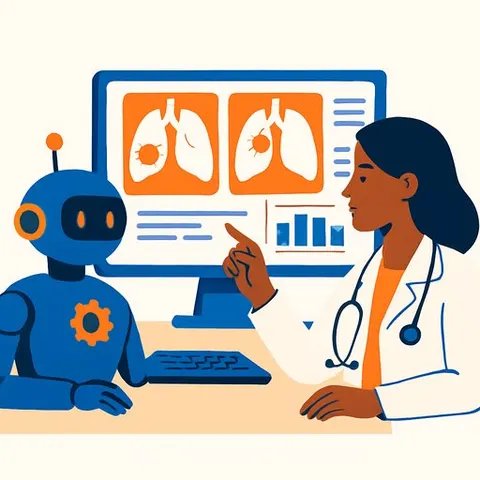
AI 'Co-Pilot' Speeds Up Cancer Diagnosis at West Yorkshire NHS Trust
The Leeds Teaching Hospitals NHS Trust in West Yorkshire has introduced AI software to accelerate the diagnosis of lung cancer and infections by assisting doctors in interpreting chest X-rays. This technology aims to help patients receive treatment more quickly while enhancing patient safety.
Serving as a "co-pilot," the AI can identify up to 85 different abnormalities within minutes. According to Dr Fahmid Chowdhury, project clinical lead and consultant radiologist, the AI will flag abnormal X-rays, allowing healthcare professionals to prioritize and report these cases faster. This efficiency can lead to quicker decision-making and earlier interventions.
How the AI Co-Pilot Supports Clinicians
- The AI highlights abnormalities that might be missed on initial review.
- It provides reassurance for cases where no issues are detected, benefiting both patients and clinicians.
- The software assists but does not replace healthcare professionals, maintaining human oversight in clinical decisions.
Dr Chowdhury emphasized that the AI is a support tool rather than a replacement for doctors. "It's still the doctor or the healthcare worker who is making the call," he said. The AI sits alongside clinicians, helping them work more efficiently without taking over responsibility.
Project Scope and Backing
The trust conducts at least 135,000 chest X-rays annually, making timely interpretation crucial. This pilot project is part of the Yorkshire Imaging Collaborative, a network connecting imaging services across the region. It is funded by the NHS AI Diagnostic Fund, which has allocated £21 million to 11 imaging networks nationwide.
Since its launch last month, the pilot has already demonstrated practical benefits. Dr Chowdhury shared an example where the AI immediately flagged an abnormality missed during the first review, illustrating its potential to improve diagnostic accuracy.
Looking Ahead
For healthcare professionals interested in AI applications in medicine, ongoing training and knowledge in this area will be increasingly valuable. Resources such as Complete AI Training's healthcare-related courses offer practical skills to integrate AI tools effectively in clinical settings.
As AI tools like this continue to develop, their role as clinical aids will expand, supporting faster and safer patient care without compromising the essential role of medical expertise.