
AI news ·
AI expands rural healthcare access but training gaps worry doctors
71% of surveyed Indian healthcare professionals said AI let them see more patients, a median of 10 extra per week, but 45% report inconsistent training. Doctors warn AI must stay a decision-support tool, with 86% insisting human oversight remains essential.
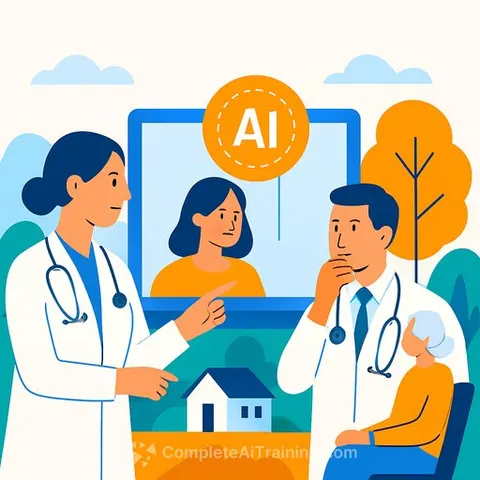
India's rural healthcare gap isn't only about doctor numbers - it's about distance from specialists. For patients in underserved areas, seeing a neurologist, surgeon, or other specialist can still mean traveling to a larger city, waiting weeks, or relying on limited local support. Artificial intelligence is now being tested as a way to shrink that distance, but doctors warn the technology will only work if training and oversight keep pace.
The Philips Future Health Index 2026 India findings show early signs of progress: 71% of surveyed healthcare professionals said AI enabled them to see more patients, with a median increase of 10 patients per week. More importantly for rural access, 80% believe AI can improve healthcare quality in underserved communities, and 82% report greater workflow efficiency.
Those numbers come with a caveat. While AI is already helping doctors analyze medical records and scans, support diagnosis, and reduce administrative work, 45% of doctors report limited or inconsistent AI training. And 86% insist human oversight remains essential.
Beyond patient volume: quality over throughput
Dr Tushar Tayal, Associate Director of Internal Medicine at CK Birla Hospital, Gurugram, argues that AI's value shouldn't be measured by additional consultations alone.
"The real value of AI lies in how it supports clinical decision-making, not simply how many patients it allows a doctor to process," Tayal says.
In rural settings, AI could help local doctors review records, spot red flags, and support follow-up care alongside telemedicine. But Tayal cautions against efficiency becoming a race to increase consultation volume. "If AI is used primarily to increase consultation volume, there is a possibility that healthcare delivery becomes more about throughput than meaningful clinical interaction," he said.
Dr Atul Sardana, Consultant in Robotic, Laparoscopic, Bariatric & Metabolic Surgery at Apollo Spectra Hospital, Delhi, makes a similar point from surgery. AI can help surgeons analyze reports and plan pre-surgery steps, but it "should remain a clinical decision-support system, rather than a substitute for the surgeon's judgement."
Rural India: The biggest need, and the largest risk
Dr Sudhir Srivastava, Founder and CEO of SS Innovations International, says AI can analyze medical images, synthesize patient information, and reduce administrative workloads. In places where specialists aren't physically available, telemedicine and AI-assisted decision support could strengthen local teams - and technologies like telesurgery could extend specialist access further. But AI must never become the final authority.
"A technically correct AI interpretation can still produce an inappropriate clinical decision if a patient's symptoms, medical history, physical examination or other investigations are not taken into account," Srivastava said. "The final decision must remain with a trained doctor."
For professionals exploring AI applications in their workflows, training programs like AI for Medical Billers show how structured education can bridge the gap between tool access and effective use - the same gap rural clinicians now face.
India has tried technology-assisted solutions before. The World Health Organization has documented telemedicine initiatives like eSanjeevani, which were designed to connect patients at the primary-care level with higher-level services.
Time-sensitive care: Neurology and stroke response
Neurology offers the clearest example. AI could help frontline clinicians identify stroke risk and triaging patients who need urgent specialist intervention. But as Dr Nandini Mittal, Consultant Neurologist at SPARSH Hospital, Yelahanka, points out, the rural shortage extends beyond neurologists - it also includes diagnostic centers, stroke units, and neuro-rehabilitation services.
Mittal stresses that AI's efficiency gains shouldn't become pressure on doctors to see even more patients within the same working hours. "In my opinion, AI should act as a multiplier of the capacity of neurologists," she said.
Neurology depends heavily on detailed patient histories and observing changes in speech, cognition, movement, and behavior - elements that can't be automated. The realistic model is not replacing the specialist but extending their reach.
Why this matters for healthcare professionals
For clinicians, the practical takeaway is that AI adoption will probably increase regardless of individual comfort levels. The risk is that rural facilities receive AI tools without the infrastructure and training that urban hospitals take for granted. Doctors need to know not only how to use AI systems but also how to question their outputs, identify errors, and verify decisions before acting on them. Patient privacy and data security matter more as more medical information flows through digital systems.
Fail to train doctors adequately, and the technology could increase capacity without increasing quality care. Train them well, and AI could genuinely help specialist expertise travel where specialists can't. The Philips report identifies training, integration, and governance as key requirements - the same principles apply at both hospital executives level and the individual clinician. For those navigating AI adoption in clinical settings, resources like AI for Healthcare offer practical guidance on closing training gaps and integrating these tools responsibly.