
AI news ·
AI-generated ads match human-made creatives in video completion rates, data shows
AI-generated ads now match human-made ones on delivery, with CTV completion rates at 92% versus 90%.
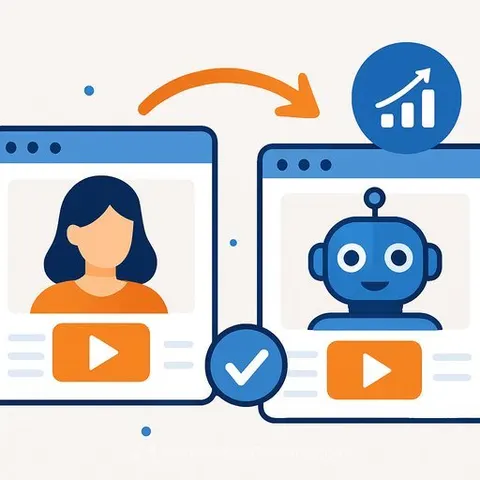
AI-generated ads now match or slightly exceed human-made creatives on key delivery metrics, according to new data from global advertising technology platform VDO.AI. On connected TV, AI-led ads recorded a 92% video completion rate against 90% for non-AI spots, while online video showed a 71% completion rate for AI creatives compared to 70% for traditional ones. The numbers signal a shift in how brands and agencies evaluate machine-produced content, moving the conversation from experimentation to scaled deployment.
Where AI is closing the gap fastest
Completion rates tell part of the story, but industry executives point to broader adoption patterns. "AI-guided creative assets can match the effectiveness of traditional human-made spots, provided the message is clear, the format fits and the audience targeting is on point," one executive said. The technology's strongest traction appears in markets with high cultural and language diversity. India's multi-language environment, which historically created production bottlenecks for national campaigns, now sees agencies using dynamic creative tools to translate hooks, voiceovers, and contextual details into regional languages simultaneously.
"Advertising in India has evolved alongside changing consumer behaviour, and today that evolution is being shaped by data and AI," said Anil Goel, global chief technology officer at Nielsen. "Across the advertising value chain, AI is helping advertisers derive audience insights, optimize media planning, personalize campaigns, and enhance measurement." Goel added that the focus is shifting from automation alone to improving relevance, transparency, and decision-making.
Creative production and media buying shift
On the creative side, brands use generative AI to produce multiple versions of ad copy, images, and generative video, cutting production timelines and enabling rapid testing. Vishal Agrahari, vice-president of paid media at BC Web Wise, said AI helps brands localize campaigns into multiple Indian languages at scale. "A film shot once can ship across a dozen languages without a dozen recording sessions," said Parminder Singh, co-founder at Redscope AI.
In media buying, AI powers bidding strategies, audience segmentation, predictive targeting, and budget allocation across Google, Meta, and programmatic ecosystems. But adoption remains uneven. Digital-first businesses - e-commerce, fintech, gaming, and D2C brands - have moved faster because they already operate on rapid experimentation cycles, according to Rajiv Dingra, founder and CEO of ReBid. Regulated sectors like banking, insurance, and healthcare are adopting AI more cautiously, with stronger human review processes.
Relevance over authorship
Metrics like completion rates can improve while trust or purchase intent falls if audiences sense the creative isn't authentic. "Consumers don't consume advertising through the lens of technology. They can sense if it's relevant or not. If it's not relevant, it doesn't matter how polished it is," said Sanjay Sachdeva, co-founder of VDO.AI. Ruchira More, VP of analytics and performance marketing at Only Much Louder, said audiences care more about relevance than authorship, though they're getting better at spotting when AI-generated content feels artificial.
Brands are also experimenting with dynamic, context-aware advertising. Preetesh Chouhan, co-founder and CTO of Vibetheory.AI, pointed to Hyundai pairing live AQI data with custom messaging for the Creta EV on connected digital screens, making the sustainability pitch feel immediate and locally relevant.
Jobs, skills, and celebrity likeness
AI's impact on creative roles is already visible. Harshit Arora, founder and CEO of Growster, said graphic designers and copywriters are likely the first to feel that impact before the industry finds a new balance. Dr. Kiran Sharma, professor at K.J. Somaiya Institute of Management, noted that writing copy variations, editing images, executing standard graphic designs, creating subtitles, and editing videos have become automated in routine production environments. Siddharth Kelkar, managing director of India/MENA and performance business at AnyMind Group, said AI fluency is becoming a baseline skill, and people who combine sector expertise with strong AI skills will do best.
Celebrities face a different challenge. "Their likeness, voice, and personality are integral to their professional identity. As AI-generated content becomes more sophisticated, issues of consent, rights, ethics, and digital identity become increasingly important," said Madhurima Nandy, creative director at Dynamic Design Co. Divyesh Kothari, founder of TALL Creative Studios, said celebrities are treating their likeness as IP that needs protection similar to a trademark or patent. Regulation is arriving: MeitY amended the IT Rules to cover synthetically generated information, and ASCI followed with draft labelling guidelines specifying consent for using a person's likeness.
Why this matters for creatives
The completion rate data removes a psychological barrier. AI-generated work now performs at parity on delivery metrics, which means the conversation inside agencies and brand teams will shift from "can AI do this?" to "how do we integrate it into our workflow?" For AI for creatives, the practical takeaway is that routine production tasks - copy variations, basic image editing, subtitling, localization - are being automated now. The value moves upstream to concept, strategy, and the judgment calls about what makes something feel relevant rather than artificial. Fluency with AI tools is becoming table stakes, but the differentiator remains taste and sector knowledge that machines cannot replicate.