
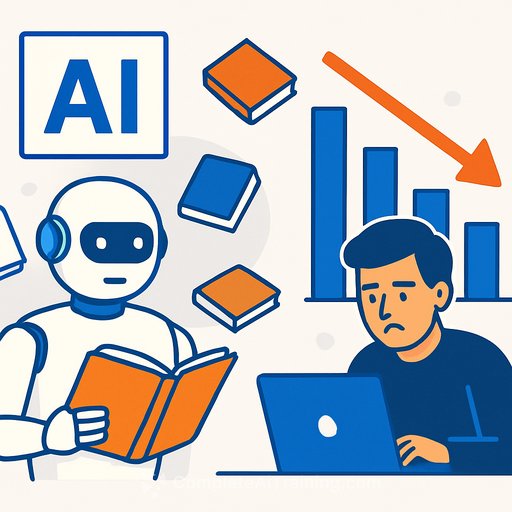
AI-generated books are flooding Amazon, and human authors are losing money
AI-written books now make up a measurable share of Amazon's catalog, and new research suggests they are cutting into revenue for human authors. A Stony Brook University-led study of 14,419 self-published genre-fiction books sold on Amazon between 2023 and 2026 found that 2,880 titles - about 20% - had more than a quarter of their prose flagged as AI-generated by detection software Pangram. Nearly 1,000 novels were more than 90% AI-generated.
The stakes became public in March, when Hachette pulled the horror novel "Shy Girl" from its U.S. release schedule after allegations that author Mia Ballard used AI to write it. Ballard denied the claim, but the publisher removed the book from Amazon, its own website, and U.K. shelves. The episode forced a question the industry has yet to answer: what should booksellers do about AI-generated books as they spread across marketplaces?
The scale of the problem
An Originality.AI report published last month found that of more than 2,000 books on religion published on Amazon over the past 12 months, 1,272 titles - 63% - were likely written by large language models. The Stony Brook study, which has not yet been peer-reviewed, found 2,168 books with more than 50% AI-generated prose.
The financial effect is clear. Over three years, the number of books with observed sales in a quarter increased 19.2-fold, but quarterly revenue increased only 8.9-fold. That means less revenue per book sold. Paramveer Dhillon, an associate professor of information at the University of Michigan and the study's coauthor, described the mechanism to Fortune: "The crowding-out effect generated by these books-most of which are low quality, but some of which are still good enough that they lead to higher ranks-due to this increased competition, they're likely to get squeezed, and their revenues are reduced."
How the marketplace shifts
Amazon requires self-published authors to disclose AI use and limits uploads to three titles per day. An Amazon spokesperson told Fortune: "Our content guidelines govern which books can be listed for sale, and we take proactive and reactive measures to prevent, detect, and remove content that violates those guidelines, whether AI-generated or not."
Tuhin Chakrabarty, an assistant professor of computer science at Stony Brook and the study's coauthor, said the "algorithmic bubble" of online marketplaces compounds the problem. More AI books increase the likelihood that customers click on AI-generated titles, which pushes those titles higher in Amazon's ranking and recommendation systems. "If there is an author who is not a very big name, very famous, and they have completely written a book with their you know sweat and tears, now that book might not even show in the related books listing because there is so many AI-generated books that are surfacing based on the keyword and the search terms associated with them," Chakrabarty said.
Booksellers and publishers respond
Barnes & Noble CEO James Daunt said earlier this year that the retailer would not outright ban AI-generated books, provided they are clearly labeled. But he acknowledged the practical reality: major publishers are unlikely to release AI-generated books, so the retailer is unlikely to stock them. "Our position is that we do not sell AI books, as far as we are aware; we take active measures to exclude all AI-generated books from our online catalogue and never knowingly order any for stocking in our stores; and we demand that publishers label any books that are AI-generated," Daunt said in May.
Authors have pursued legal action against AI companies over copyright. In July, a federal judge approved a $1.5 billion copyright settlement ordering Anthropic to pay thousands of authors after the company downloaded and stored millions of pirated books to train its chatbot Claude. Similar suits target OpenAI, Meta, and xAI.
Why this matters for writers
Human authors face a bifurcating market. Chakrabarty predicts two tracks: one for formulaic, AI-generated genre fiction that sells at volume, and another for literary fiction where the quality of human writing remains the product. "There will be some literature which won't be encroached by AI, and maybe that will just become more popular," he said. "There could also be this kind of market which is very formulaic AI-generated works, which will be very profitable. So I guess human authors will find which clan they want to belong to."
For working writers, the immediate risk is discoverability. If AI-generated titles crowd search results and recommendation feeds, books written by humans - especially midlist and debut authors - become harder to find. The revenue data from the Stony Brook study quantifies that risk. Writers who rely on self-publishing income should assume the competition is not just other humans, but a growing volume of machine-generated prose priced to undercut them.