
AI news ·
AI-generated health insurance fraud escalates as fake records and bot calls become harder to detect
Up to $480 billion is lost annually to healthcare fraud, and insurers now face generative AI that can fabricate medical records and flood call centers with 15,000 synthetic-voice calls in months.
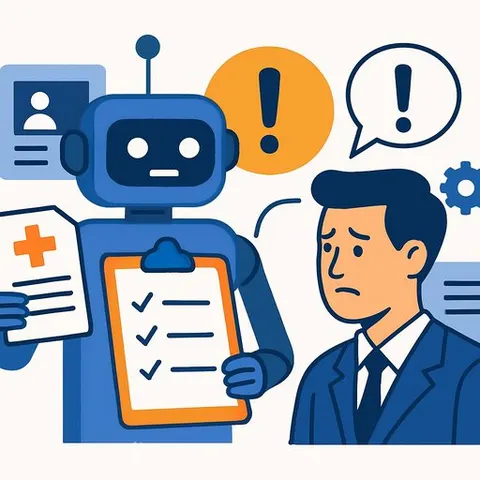
Health insurers are confronting a new wave of fraud enabled by generative AI - one that can fabricate medical records, impersonate doctors, and flood call centers with thousands of synthetic voices in a single day. The technology has erased traditional barriers to entry for criminals, who no longer need specialized knowledge of billing codes or the willingness to pick up a phone themselves. Up to $480 billion is lost annually to healthcare fraud, according to the National Health Care Anti-Fraud Association, and the speed and scale of AI-driven schemes threaten to widen those losses across both commercial plans and government programs like Medicare and Medicaid.
"We believed (AI) was something that was going to be leveraged against us as an insurance industry for fraud, and now we're starting to see that," said Kurt Spear, vice president of financial investigation and provider review at Highmark.
How AI removes old barriers to fraud
Before large language models became widely accessible, fabricating a health record required working knowledge of medical terminology and procedural codes. A scam involving a call center meant a human being had to stay on the line and pose as a patient or physician. Now, a single prompt in a tool like ChatGPT can produce documentation for a procedure that never occurred. AI agents can be instructed to dial an insurer repeatedly without any human involvement - and they are.
"We have customers that have seen 15,000 bot calls in just a couple months," said Jason Barr, vice president of healthcare for Pindrop. The Atlanta-based firm provides voice-analysis technology to some of the nation's largest health insurers, parsing human voices from AI-generated ones. Its detection system runs in the background during calls, analyzing cadence, behavior, carrier signals, and the devices used to place the call. About two years ago, many synthetic voices were obviously fake. Today they are far more realistic, though flaws remain - Barr said customers have reported robocallers switching accents or even adopting the agent's voice mid-call.
A 2025 report from the National Health Care Anti-Fraud Association warned that AI can falsify medical records, create synthetic patient identities, impersonate providers, and scan coverage policies for exploitable gaps. The sheer volume at which these tools operate is what worries insurers and cybersecurity firms most. A UPMC spokesperson said the organization has not seen a significant number of AI-generated fraud attempts. The Pennsylvania Department of Human Services, which administers the state's Medicaid program, also has not reported a surge, though agency spokeswoman Ali Fogarty said staff do occasionally receive fake calls.
Spotting deepfakes in images, text, and voice
Insurers are layering detection tools on top of existing systems. Highmark is adding technology that can flag anomalies in medical imaging down to the pixel level. The human eye may no longer be enough. A study published in the journal Radiology found that radiologists correctly distinguished real X-rays from deepfakes only 75% of the time. AI-generated writing carries its own tells. Researchers at the University at Buffalo built a tool to detect synthetic radiology reports. They found that large language models favor polished, elaborate phrasing, while doctors write in a more concise style.
For professionals in healthcare, understanding these detection methods is becoming part of the job. AI for Healthcare Courses now cover how AI is reshaping medical diagnostics and data analysis, including the tools used to identify fraudulent records. On the insurance side, AI for Insurance Courses address claims processing, underwriting, and risk assessment in an environment where synthetic claims are on the rise.
Pindrop's system focuses on voice. It analyzes the speaker's audio stream for signs of generation, cross-referencing with data from the call's carrier signal and the device in use. The technology does not rely on a single tell - it builds a composite picture. Still, the cat-and-mouse dynamic continues. As synthetic voices improve, detection models must retrain on new patterns. The same dynamic applies to text-based fraud, where models that generate fake reports can also be used to train detectors that spot them.
The human layer of defense
For all the high-tech systems being deployed, ordinary patients remain one of the strongest fraud detection mechanisms. If a member receives an explanation of benefits or a bill for care they never received, that is often the first signal something is wrong. "Some of the best referrals come from members," Spear said. Insurers rely on those reports to trigger investigations that automated scans might miss.
Criminal investigations are the only path to recovering lost funds, and recovery typically yields only cents on the dollar. That makes prevention and early detection the primary focus for payers. The combination of member vigilance, AI-powered detection tools, and traditional investigative work forms the current defense strategy - one that is being stress-tested by the volume and sophistication of AI-generated schemes.
Why this matters for healthcare professionals
AI-generated fraud directly affects the integrity of patient records, the accuracy of claims, and the financial stability of the plans that pay for care. For anyone working in healthcare - whether in clinical practice, administration, or revenue cycle - the same AI tools that can forge a radiology report or mimic a patient's voice are now in play against the systems you rely on. Knowing how detection works, what synthetic content looks like, and when to flag suspicious documentation is no longer a niche skill. It is becoming a core part of protecting both patients and the organizations that serve them.