
AI news ·
AI in Relationship and Family Therapy: New Study Explores Challenges, Ethics, and Promising Opportunities
AI offers promising support for relationship and family therapy by personalizing interventions and predicting treatment success. Challenges include ethical concerns, behavior complexity, and ensuring accuracy.
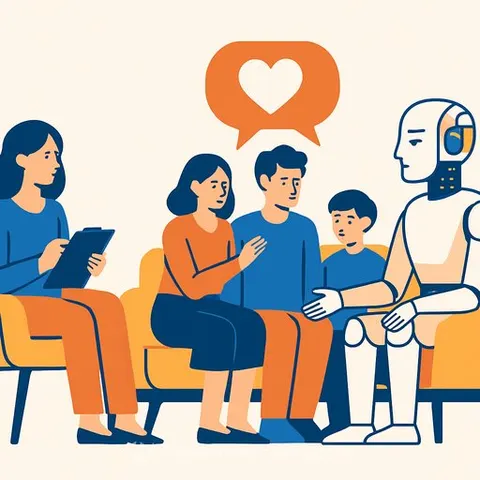
AI in Relationship and Family Therapy: Challenges and Opportunities
A recent study from the University of Maine examines how artificial intelligence (AI) can be used to support relationship and family therapy. The paper, titled "Challenges and opportunities in using interpretable AI to develop relationship interventions", was published in Family Relations. It explores both the potential benefits and the hurdles faced by researchers and practitioners integrating AI into this field.
Potential Benefits of AI in Therapy
AI is still emerging in therapeutic contexts but offers promising possibilities. For example, it could provide personalized support to couples and families, helping them strengthen bonds and work through conflicts. One scenario highlighted is couples undergoing separation, where emotions and tensions run high. Here, AI’s ability to interpret complex situations and suggest interventions may offer a safer and more effective approach.
As AI technologies become more familiar, their integration into family life and relationships is growing. Machine learning, a key area of AI, enables computers to learn from data and make predictions or decisions, which can be particularly valuable for analyzing behavioral patterns in therapy.
Key Challenges in Applying AI to Therapy
- Complexity of Human Behavior: Human interactions are dynamic and unpredictable, making it difficult to apply AI models that rely on structured data.
- Diverse Therapy Methods: Different therapeutic approaches work in different situations. Training AI to recognize which method to use and when adds complexity.
- Ethical and Privacy Concerns: Protecting client privacy and addressing AI bias are critical issues that need thorough attention.
- Accuracy and Trustworthiness: AI must provide reliable information to avoid misleading clients or practitioners.
The study also notes that most current AI tools in therapy focus on individual support rather than couples or families. Common uses include summarizing session notes rather than delivering direct interventions.
Opportunities to Advance AI in Therapy
The paper identifies four main areas where AI could significantly contribute:
- Diagnosing Relationship Issues: Machine learning can help detect patterns and identify problems early.
- Autonomous Treatment: AI-driven chatbots and programs could provide support to underserved populations.
- Predicting Treatment Success: AI can analyze data to estimate which interventions may work best for specific clients.
- Using Biomarkers: Monitoring physiological responses could give therapists real-time insights into client reactions.
Examples include researchers using AI to study parenting dynamics and diagnose relationship challenges. While challenges remain, these technologies have the potential to enhance therapy outcomes.
Final Thoughts
Integrating AI into relationship and family therapy requires careful balancing of technology with human expertise. Approaches like the human-in-the-loop technique, where AI systems incorporate ongoing human feedback, are essential to improve accuracy and ethical standards.
For those interested in AI applications within health and social sciences, understanding these challenges and opportunities is crucial. Further research and development will help refine AI tools to better serve families and couples in need.
More details can be found in the original publication: Challenges and opportunities in using interpretable AI to develop relationship interventions, Family Relations (2025).