
AI news ·
AI infrastructure build-out and tariff volatility reshape U.S. freight and customs operations
U.S. logistics is facing a triple reset this summer: AI data-center build-out is pulling warehouse space and airfreight away from consumer goods, freight rates lifted C.H. Robinson's Q2 net profit to $186.8 million, and customs automation is accelerating on tariff volatility.
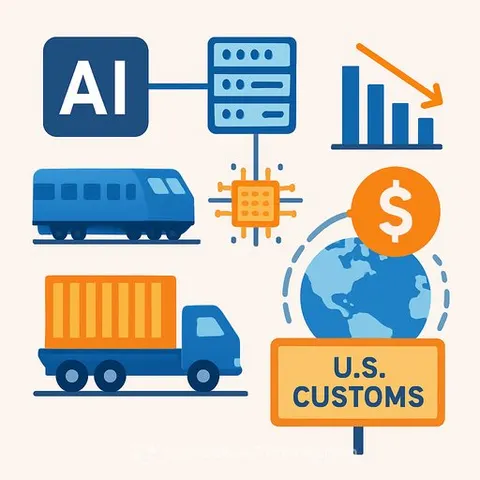
Three separate forces are hitting U.S. logistics operations at once this summer, and they are not unrelated. The AI infrastructure build-out is pulling warehouse space and airfreight capacity away from traditional retail supply chains, freight pricing is rising fast enough to lift broker profits sharply, and trade policy volatility is pushing companies to automate customs workflows they once handled manually. Together, they represent a reset in the cost and complexity of moving goods across the country and across borders.
Warehouses and airfreight are following data-center dollars
Industrial real estate under construction in the U.S. rose 18% in the second quarter of 2026, according to the Wall Street Journal, and the primary driver was not e-commerce. Suppliers of data-center equipment, from power distribution units to cooling infrastructure, are the tenants pushing developers back into the ground. That is a meaningful shift for procurement and real estate teams that sized their footprint around retail replenishment cycles.
The same dynamic is playing out in the air. Server racks and semiconductors needed for the AI build-out are displacing the low-value apparel and consumer goods that once filled cargo plane bellies, the Wall Street Journal reported. High-value, weight-sensitive tech hardware commands premium rates, and carriers are allocating capacity accordingly. Shippers of traditional goods who assumed stable airfreight availability are now competing for space against a structurally better-paying customer.
Port of Los Angeles leadership told the Wall Street Journal on August 7 that peak shipping season has persisted longer than typical seasonal patterns would suggest, with China continuing to export a high volume of high-value manufactured goods. For import operations teams, that means extended lead times and elevated port congestion are not easing on a normal seasonal schedule.
Freight pricing is up, and broker margins show it
C.H. Robinson, the largest freight brokerage in North America, reported second-quarter 2026 net profit of $186.8 million, up from $152.5 million a year earlier, according to the Wall Street Journal's Elias Schisgall. Higher prices drove the revenue gain. For shippers in or approaching contract negotiations, that number is a baseline: the brokerage market is pricing tighter, and spot rate relief is not in the immediate forecast.
The margin recovery at a firm of Robinson's scale reflects a broader freight market repricing after years of overcapacity. Maintained long-term rates from the soft market of 2023 and 2024 have protected some operators, but those contracts are rolling. Teams that relied on spot markets to absorb overflow will face a more expensive environment for the foreseeable term.
Customs complexity is accelerating AI adoption
Trade tech company Altana acquired Cervo AI, an artificial intelligence platform built to automate customs brokerage tasks, in July 2026. The Wall Street Journal reported that Altana said the tool can speed up classification, entry preparation, and related brokerage work at a time when tariff and trade policy shifts are creating significant unpredictability in cross-border flows. For trade compliance and customs teams still relying on manual workflows, that combination of more SKUs, more tariff codes, and faster policy changes is a capacity problem that AI is increasingly being positioned to solve. Professionals managing these changes can build practical skills through the AI for Supply Chain Managers learning path, which addresses exactly these automation decisions.
The acquisition is one signal in a bigger pattern. As tariff environments grow more volatile and the cost of misclassification climbs, the business case for automating customs work has strengthened. Procurement teams evaluating trade compliance platforms should expect AI-assisted entry filing and classification to become a standard capability in major vendor offerings within the next 12 to 18 months. Transportation and logistics teams facing similar capacity shifts can find structured guidance in the AI for Transportation Managers learning path.
Carrier consolidation adds another variable
ArcBest, the Arkansas-based logistics and less-than-truckload carrier, announced plans in July 2026 to consolidate its brand portfolio and eliminate approximately 2% of total positions through layoffs and the removal of certain open roles, according to the Wall Street Journal. Consolidation moves at carriers of this size typically signal a shift toward simpler, more integrated service offerings, which can affect routing options and pricing structures for shippers who relied on individual brand relationships within the same parent company.
Why this matters for operations teams
Capacity is moving toward AI hardware and away from consumer goods. Brokerage margins are recovering. Customs automation is accelerating. And carriers are rationalizing their structures. Each of these forces individually is manageable. Together, they compound. Operations leaders should re-forecast freight budgets against higher broker rates, re-evaluate existing contracts before they roll, and plan for customs delays that are no longer following seasonal patterns. The teams that treat this as a single reconfiguration rather than four separate problems will have the advantage in the next contract cycle.