
AI news ·
AI learns to build custom materials atom by atom at Oak Ridge lab
Oak Ridge National Laboratory built an AI system that assembled 37 molecules into a graphene-like honeycomb lattice over 25 hours without human control. The reinforcement-learning setup guided a microscope tip molecule by molecule, producing a material with graphene's Dirac point signature.
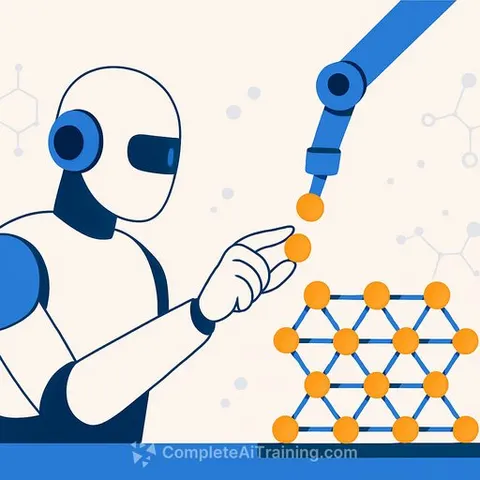
A team at the Department of Energy's Oak Ridge National Laboratory (ORNL) has built an AI system that can autonomously construct materials one molecule at a time, working for more than 25 hours without human intervention. The advance, published in ACS Nano, shifts atomic-scale fabrication from a painstaking manual process to one where machine learning models act as both the eyes and the decision-maker, opening a practical route to engineer custom electronic materials that do not exist in nature.
The system combines a computer vision model with reinforcement learning to guide an ultra-sharp microscope tip, pushing individual molecules across a copper surface into precise, predetermined patterns. The AI receives a numerical reward based on how close each molecule lands to its target, learning over time which combinations of electrical current, bias, and manipulation speed produce successful moves without damaging the delicate tip.
How the AI learned to see and move molecules
The researchers used YOLO ("You Only Look Once"), a real-time object detection model, to identify molecules on the copper substrate. A reinforcement learning agent then evaluated different movement strategies, maximizing a reward signal that peaked when a molecule reached its intended site and dropped sharply for misses. This closed-loop approach allowed the system to refine its technique across hundreds of iterations without human guidance.
Ganesh Narasimha, who prepared the core automation software, said the collective effort enables "atomically precise fabrication, with significantly reduced human input." He added that the work shifts the research focus from discovering materials in nature to engineering specific artificial lattices with tailored electronic behaviors.
Proof in a honeycomb pattern
To validate the system, the team built an artificial graphene lattice - 37 molecules arranged in a perfect honeycomb structure. Spectroscopic measurements confirmed the presence of a Dirac point, the distinctive electronic signature of graphene, proving the man-made material functioned like its natural counterpart. In a separate demonstration of precision control, the AI spelled out "ORNL" using individual molecules.
The process remains semi-automated. A human operator must occasionally condition or repair the microscope tip if it becomes unstable, and construction is time-intensive. Building the 37-molecule lattice took roughly 900 iterations over 25 hours, with each molecular manipulation averaging one minute.
Toward inverse design and quantum materials
The team sees this as a foundation for "inverse design," where scientists specify a desired electronic property and the AI determines and builds the required atomic structure. That capability would mark a direct path toward engineering topological qubits, the building blocks for ultra-stable quantum computers. Narasimha said, "We expect this approach will accelerate realization and lead to new breakthroughs in our understanding of quantum states and future technology."
For research scientists tracking the convergence of AI and experimental physics, this work represents a concrete shift from theory to automated execution. The experimental portion was primarily supported by the DOE Office of Basic Energy Sciences, with algorithmic development backed by the Center for Nanophase Materials Sciences, a DOE Office of Science User Facility at ORNL. Professionals looking to build the skills needed for this kind of cross-disciplinary work can explore an AI Learning Path for Research Scientists that covers the machine learning techniques increasingly deployed in laboratory settings.
Why this matters for science and research professionals
Atom-by-atom assembly has long been a bottleneck in quantum materials research - precise but painfully slow and prone to human error. Automating it with reinforcement learning and computer vision removes a major barrier to prototyping structures that cannot be synthesized through conventional chemistry. For researchers in condensed matter physics, materials science, and quantum information, this means experimental cycles that once took weeks of manual labor can now run overnight, with the AI improving its own success rate as it works. The immediate takeaway is that AI-driven fabrication tools are moving from proof-of-concept to operational platforms, and the labs that integrate them will be positioned to test custom electronic materials at a pace that manual methods cannot match. Stay current with developments at this intersection through AI for Science & Research coverage.