
AI news ·
AI moves beyond property search to reshape real estate planning, construction and management
AI now helps real estate pros screen land, monitor construction, and extract clauses from hundred-page documents. Its value depends on data quality and keeping human judgment central.
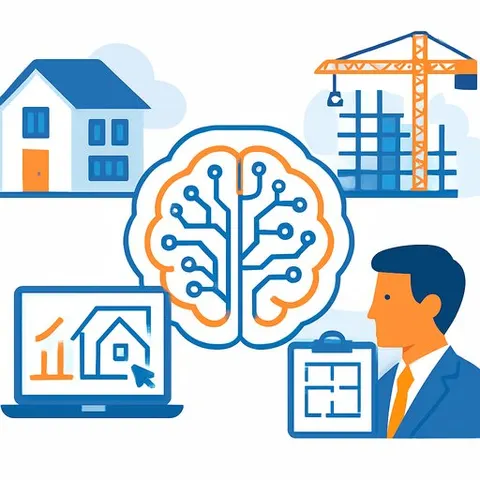
Artificial intelligence is being used across the real estate lifecycle, from initial land evaluation and project design through to construction monitoring, building operations and investment analysis. The shift means professionals in development, construction, facility management and asset management now have tools that can process large datasets, automate repetitive tasks and surface patterns that inform earlier, faster decisions.
Land evaluation and project design
AI can combine data on infrastructure, population, accessibility, competing projects and market conditions to assess the potential of different locations. It also supports feasibility studies by analysing development costs, potential revenues and different project scenarios. Developers can use AI as an initial screening and feasibility tool before moving shortlisted sites into detailed professional due diligence. AI does not replace title checks, planning approvals or technical due diligence.
In design, AI-powered tools can generate layouts, space planning alternatives and visualisations based on specified requirements. Architects can test multiple possibilities at an early stage rather than developing every variation manually. The resulting designs still require review for regulations, engineering requirements, costs and other technical issues.
Construction and building operations
Image analysis can process construction data to track progress and identify certain potential challenges, comparing what is happening on site with planned schedules and project information. Construction teams can use AI-assisted monitoring to supplement inspections, document progress and flag areas that need human attention.
Once buildings are operational, AI analyses data from HVAC equipment, pumps and other mechanical infrastructure to support a shift from reactive maintenance towards a more data-driven approach. Facility managers can use AI to monitor equipment performance and prioritise maintenance before failures occur. Its effectiveness depends on the quality and availability of building data. AI can also analyse energy use alongside factors such as occupancy, weather and equipment performance, helping building owners identify energy inefficiencies and support more responsive operation of building systems.
Documents, tenants and investment decisions
Real estate transactions involve leases, contracts, approvals, due-diligence reports and financial documents that can run into hundreds of pages. AI tools can search these documents, summarise information and extract specific clauses. Legal and asset-management teams can use AI for preliminary document review and information extraction.
Property managers dealing with large volumes of tenant enquiries, maintenance requests and routine communications can deploy AI assistants to handle many routine processes and connect requests with relevant workflows. Complex requests, sensitive issues and operational decisions should still be handled by people. For investment teams, AI can help shape market data, financial models and operational data, identifying patterns and highlighting information for further investigation. Investors and asset managers can use AI to analyse portfolio information and prepare decision-support material more efficiently. Professionals looking to build these capabilities can explore structured AI for Real Estate & Construction resources or training such as AI for Real Estate Brokers.
Why this matters for real estate and construction professionals
The technology can help professionals process information faster, automate repetitive work and explore more possibilities before making decisions. But the quality of AI's output depends on the quality of the underlying data and how the system is used. The opportunity is not just to adopt AI, but to identify the specific workflows where it can deliver real value while keeping human expertise and accountability at the centre.