
AI news ·
AI moves China's medical breakthroughs from lab to bedside
Across China, AI is moving from pilots to daily care to lift productivity and support health goals. Hospitals can move fast with strong data, clear safety, and smooth workflow.
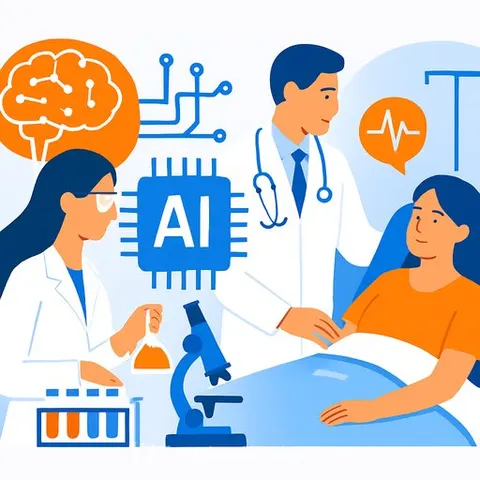
AI is driving healthcare innovation in China: practical takeaways for providers
Across China, AI is moving from pilot projects to daily clinical work. Experts at a recent medical technology conference highlighted how AI now supports national health goals and improves productivity in care delivery.
"AI has a far-reaching impact on technological progress and human life, with medicine likely to become its most widely used and valuable application," said Fan Xianqun, dean of the School of Medicine at Shanghai Jiao Tong University.
Where progress is accelerating
The Global Convergence Platform of Healthcare Ecosystem (CPHE) introduced new solutions built around urgent clinical needs. The focus spans:
- Blood-related diagnostics and health solutions
- Cell and gene therapies
- Diagnosis and treatment for rare diseases
- Prevention and control of major brain disorders
- AI-enabled approaches to prevent and treat major diseases
"Through deeper cross-disciplinary integration, including AI and medtech engineering, we have addressed many key bottlenecks in clinical application," said Chang Zikui, head of the Tianjin Institute of Health Science under the Chinese Academy of Medical Sciences.
Why this matters for hospitals and health systems
- Faster translation from lab to bedside: AI tools are maturing and entering regulated pathways for clinical use.
- Precision and scale: Imaging, pathology, and multi-omics pipelines benefit from algorithmic support across large cohorts.
- Workforce leverage: Decision support, triage, and automation reduce repetitive tasks and free clinicians for complex care - see AI Productivity Courses.
- National priorities: Progress supports the Healthy China Initiative and higher-quality growth in the health sector.
Implementation playbook for clinical leaders
1) Data foundation- Standardize data (HL7 FHIR, DICOM) across EHR, LIS, PACS, and registries.
- Improve data quality with clear labels, audit trails, and de-identification.
- Plan for privacy-preserving data sharing (federated learning, secure enclaves) to reduce silos across institutions.
- Validate on local, multi-site cohorts; check generalization across age, sex, and regions - guidance and study design resources are available in AI Research Courses.
- Run prospective utility studies tied to concrete endpoints (diagnostic yield, time-to-diagnosis, adverse events).
- Set up post-deployment monitoring for drift, false alerts, and clinician override rates.
- Embed into existing systems (HIS, PACS, LIS) with low click burden and clear handoffs.
- Keep clinicians in the loop; show explanations where useful and log decision rationale.
- Define alert thresholds, escalation paths, and downtime procedures.
- Establish an AI oversight group (clinical, data, IT, legal, ethics) with clear approval gates.
- Classify risk using SaMD frameworks, document intended use, and manage algorithm updates.
- Align with ethical guidance such as WHO's principles for AI in health (WHO resource).
- Provide short, case-based training for clinicians, nurses, and pharmacists, and consider an AI Learning Path for Training & Development Managers to structure upskilling.
- Support IT/biostat teams on MLOps, data stewardship, and model monitoring.
- Communicate early with departments about new workflows and accountability.
Collaboration is the force multiplier
He Zhenxi, president of the Chinese Research Hospital Association, called for open collaboration and removal of barriers across data, disciplines, and institutions so innovation resources can move more freely. National platforms like CPHE, academic centers, and research hospitals can co-develop shared datasets, reference benchmarks, and evaluation protocols.
For background on national research capabilities, see the Chinese Academy of Medical Sciences (CAMS).
Metrics that matter
- Clinical: time-to-diagnosis, diagnostic accuracy, complication rates, readmissions, length of stay
- Operational: throughput, turnaround time, queue length, bed utilization
- Financial: cost per case, avoided procedures, ROI by service line
- Human factors: clinician time saved, alert quality, trust and adoption rates
- Safety: drift detection, incident reports, equity metrics across subgroups
Key risks to manage
- Data leakage and privacy breaches-tighten access, logging, and encryption.
- Bias and uneven performance-test across demographics and care settings.
- Over-reliance-require human oversight and fail-safes for critical decisions.
- Regulatory gaps-track evolving guidance for AI medical devices and clinical use.
The bottom line
China's health system is moving AI into practical, clinic-facing tools-especially in blood health, rare disease, brain disorders, and advanced therapeutics. The winners will pair strong data foundations and rigorous evaluation with collaborative development and clear governance.
If your team is planning AI upskilling for clinical workflows and health operations, explore focused learning paths such as the AI Learning Path for Training & Development Managers.