
AI news ·
AI pushes data centers into a supercycle: triple-density racks, liquid cooling, and the race for power
AI is rewiring data centers: secure megawatts first as rents rise, racks densify, and liquid cooling plus on-site generation take hold. Digital twins and GPU lead times now rule.
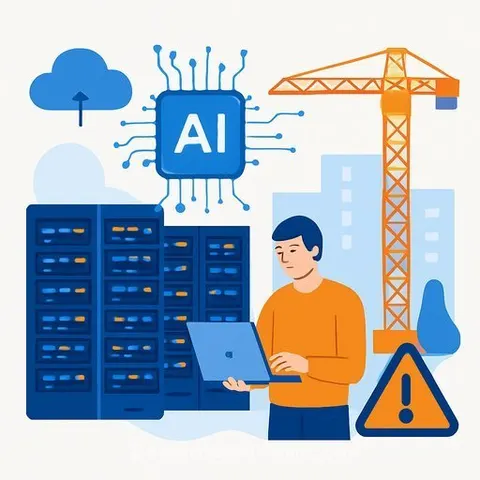
AI is forcing a rethink of data center operations
JLL's 2026 global data center outlook points to an infrastructure investment supercycle. Nearly 100 GW of capacity is expected to be added between 2026 and 2030, creating an estimated $1.2 trillion in global real estate asset value. The Americas remain the center of gravity, with roughly half of global capacity.
Site selection now starts with electrons, not addresses
Multi-year queues for grid interconnections are reshuffling priorities. Available electrical capacity and speed to energization outrank location and cost. Market leaders are also prioritizing community support and latency, but the gating factor is clear: secure megawatts first, everything else follows.
Rents keep climbing as supply hits limits
In the Americas, wholesale and hyperscale rents are projected to rise at a 7% CAGR through 2030. Demand from aggressive AI buildouts and grid constraints are the drivers. The main brake on rent growth: developers competing hard to land new tenants.
Bridging the gap: on-site generation and storage
With long waits for grid connections, operators are leaning on behind-the-meter arrangements, colocated battery storage, and natural gas for interim and permanent on-site generation. Softer pricing for battery energy storage systems (BESS) makes them attractive to smooth load spikes and improve availability. AI currently accounts for about a quarter of data center workloads, with training as the biggest source of spikes. Expect a shift toward inference workloads as deployments mature.
- Plan for hybrid energy stacks: grid + BESS + on-site thermal or gas.
- Model load volatility from AI training vs. inference and size storage accordingly.
- Negotiate utility timelines early; secure interim energy contracts as a hedge.
From "hosting AI" to "AI factories"
Data centers are evolving from facilities that simply run AI jobs to "AI factories" built to continuously train, fine-tune, and infer at scale-where intelligence becomes a core output. This shift pulls in AI-driven robotics and autonomous systems, increasing the need for high-density, low-latency environments with new performance thresholds.
Density, cooling, and cost realities
Average rack density is set to triple to around 45 kW. JLL expects roughly 80% liquid cooling adoption across new builds as densities climb and thermal envelopes tighten. Some designs are reaching 100 kW per rack and beyond, which makes facility layout, fluid distribution, and serviceability mission-critical.
AI chips run nearly 10x the cost of traditional CPUs. Shell-and-core and tech fit-out budgets are rising, with AI infrastructure already reaching up to $30 million per MW. By 2030, tenants may spend $1-$2 trillion on GPUs and networking alone.
Design and delivery are consolidating
Rising complexity and capital needs are pushing consolidation across developers and operators. Teams need deeper expertise across electrical engineering, thermals, fluid systems, and AI networking to bring dense sites online predictably.
Digital twins move from nice-to-have to standard
Developers are adopting digital twins to validate 240 kW-plus rack densities and simulate thermal behavior, energy loads, and system stress before build. This shortens commissioning cycles and reduces rework as liquid cooling, renewable strategies, and adaptive retrofits become mainstream.
- Use high-fidelity CFD and electrical models to pressure-test peak AI loads.
- Model fluid loops end-to-end: CDU placement, leak detection, maintenance access.
- Benchmark against multiple failure scenarios and ambient extremes.
Operations playbook: what to do next
- Rewrite site scoring: prioritize available megawatts, interconnection timelines, and upgrade pathways over land cost.
- Stand up an energy stack strategy: BESS sizing, gas peakers, curtailment plans, and demand response participation.
- Plan for liquid cooling now: facility water strategy, redundancy (N+1 loops), containment, and service procedures.
- Engineer for density: 45 kW average with hot spots beyond 100 kW; tighten airflow management and containment.
- Lock procurement early: GPUs, high-speed networking, CDUs, heat exchangers, and switchgear with long lead times.
- Instrument everything: granular metering, wUE/PUE tracking, and AI-driven DCIM for anomaly detection.
- Prepare for inference growth: capacity planning that shifts from big-bang training peaks to steady, distributed loads.
- Strengthen community engagement: align with municipalities and utilities to secure long-term access to electrons.
- Upskill the team: liquid cooling maintenance, safety, and AI workload profiling for capacity forecasts.
Metrics to watch
- Grid queue duration vs. project critical path
- Effective kW per rack and liquid-to-air heat rejection efficiency
- BESS cycle life, state-of-charge management, and demand-charge avoidance
- GPU utilization, job mix (training vs. inference), and load volatility
- PUE and wUE under peak AI loads and failure simulations
Why this matters for operations leaders
The next four years will be defined by constraints on electricity supply, densification, and the shift to liquid cooling. The teams that win will secure electrons early, design for density, and simulate before they build. The rest will chase delays, thermal issues, and blown budgets.
For deeper context on storage strategy, see the U.S. Department of Energy's overview of energy storage systems: DOE Energy Storage. For macro trends on data centers and energy use, the IEA maintains an up-to-date analysis: IEA: Data Centres and Energy.
If your ops team needs practical AI upskilling to align with infrastructure planning and AI workload management, explore our curated programs by role: AI Learning Path for CIOs, AI Learning Path for Technology Managers, and AI Learning Path for Software Engineers.