
AI news ·
AI shifts localisation from translation to language operations
AI is shifting localisation from human-only translation to AI-assisted workflows, with neural machine translation and LLMs handling repetitive tasks while humans oversee quality.
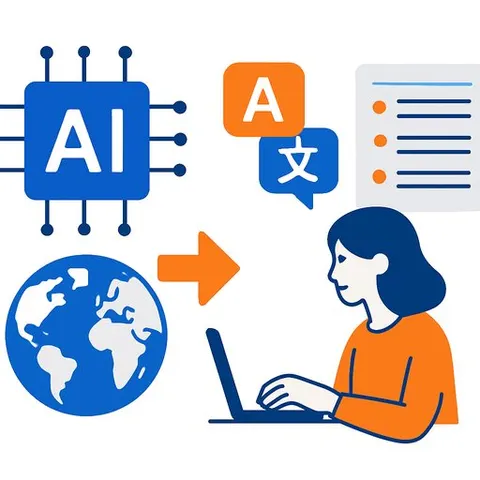
Artificial intelligence is already reshaping the localisation industry, and the main question is no longer whether it will affect the field, but how far the change will go. The volume of content requiring localisation has grown sharply as digital platforms and international trade expand, and traditional methods that depend mainly on human translators are struggling to keep pace.
Neural machine translation now produces results close to human translation in some cases, while quality estimation and automatic post-editing tools are further improving speed and efficiency. AI is also pushing localisation beyond written text, into images, audio, video and interactive content. Boundaries between translation, content creation and multimedia production are becoming less clear.
Some specialists describe this as a move toward a "post-localisation" era. New terms such as "Language Data for AI" and "Language Operations" reflect the growing role of language throughout content creation and distribution. In the past, content was often produced in one language and then translated for other markets. Today, multilingual content may be created from the start, sometimes with AI assistance.
How AI is changing workflows
AI now touches nearly every stage of the localisation process. Large language models can analyse source text and produce reports about its style, tone and discourse features, which can then be fed into translation instructions or prompts. This helps address one of machine translation's traditional weaknesses: producing correct but flat language that loses the original style and voice.
Content classification is also simpler now. AI can determine whether a text should be translated automatically, post-edited by a human, or handled entirely by a professional translator. This allows human translators to focus on complex, important texts where their expertise matters most.
Cost is another factor, though lower cost does not always mean better performance. Language bias remains a significant obstacle. Many large language models are trained primarily on internet data, where English dominates. Their performance in other languages can be weaker, a real problem for companies working in multilingual environments.
New roles and new tools The work of localisation professionals is changing, too. AI Translation Courses cover the kind of skills now emerging: computer-assisted translation tools combine translation memories, terminology databases and AI models in a single working environment, offering suggestions based on context, not just individual sentences.
Project managers now use AI to plan projects, classify content and automate administrative work, freeing them for client communication and strategy. Localisation engineers are handling: content segmentation, quality assurance and workflow automation. Because large language models are new, engineers increasingly need skills in prompt engineering, natural language processing and workflow design, on top of programming.
Language service providers are also receiving more requests for data collection, annotation and validation. AI Productivity Courses for workflow optimisation have grown in relevance as language companies become involved in providing the linguistic resources needed to train and improve AI systems.
AI in practice and the human element
Large companies already show how AI and humans can work together. Duolingo uses AI to create learning content and analyse learner progress, but keeps human learning designers in the loop to check and improve the material. Baidu has developed systems that produce initial translations by machine, then send them to appropriate translators who can correct, refine, and have the system learn from their corrections.
Despite rapid AI development, specialists do not see fully automated localisation replacing all human work. AI handles repetitive tasks and processes large amounts of information, but localisation still needs creativity, cultural understanding and careful judgment. A translation can be linguistically correct and culturally unsuitable; AI can still fail to grasp irony, humour or the tone expectations of a particular audience.
The practical approach is cooperation, not competition and judgement. Localisation professionals are becoming managers of AI-human workflows who know how to use tools effectively, write better prompts, but critically, with good spirit, understand how to evaluate AI-generated results. Human judgment remains the final filter.
The idea is gradually moving from "human in the loop" to "human at the core," according to research in the field. Human professionals should not only correct AI mistakes after they occur but should also guide AI use, set standards and make final decisions about the quality and cultural appropriateness of a translation.
Why this matters for product development
Product teams should expect multilingual delivery to become parallel, not sequential. AI makes it possible to build localisation into the product pipeline from day one, rather than bolting it on after launch. In practice, this means product managers, developers and localisation engineers must work together early-with the three-way tension of cost, speed and quality in mind-to choose which approaches work best for each content type. This is a core product decision, not an optional extra to leave to the translation department.
Organisations that keep language siloed from production will fall behind on speed and cultural fitally. The teams that treat language data and human review as part of the product itself will find themselves adapting more quickly to the changing competitive pressures-and they will use AI as a partner, not a substitute.