
AI news ·
AI won't replace trial lawyers because trials are human performances, not information arrangements
AI now handles document review and discovery faster than humans, compressing billable hours for routine litigation support roles. Trial lawyers who can read a jury and pivot in real time remain irreplaceable, as verdicts depend on trust and human experience no machine can replicate.
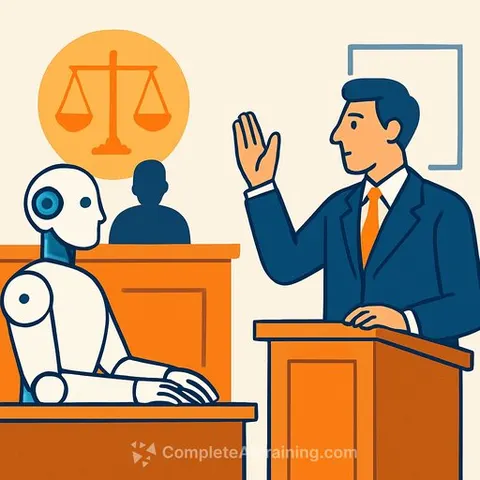
For lawyers weighing their career options, the rise of AI makes trial work a uniquely durable and practical choice. While machine learning tools are already transforming the back-office machinery of litigation - document review, timeline generation, deposition prep - the courtroom itself remains a stubbornly human arena. The skills that define a trial lawyer's value are not easily automated.
What AI handles well in litigation
AI tools now perform many routine litigation tasks faster and cheaper than most lawyers. These systems can digest terabytes of discovery, monitor live deposition transcripts, and generate real-time questions from expert reports. They can synthesize sprawling information into chronological narratives and spot logical inconsistencies in arguments. For work that consists of absorbing large volumes of data and arranging it into coherent structures, AI has already outpaced human capacity.
This shift threatens the apparatus of litigation - the endless combing through docket entries and document mountains. But that loss may not be worth mourning. As the saying goes, many lawyers charge for the search, not the result. They bill for the haystack, not the needle, and clients rarely know upfront whether gleaming needles even exist inside the barn.
The courtroom demands a pulse
Trials are not arguments delivered from a script. They are performances that must live and breathe moment to moment. AI can describe what a pulse is, but it has no pulse itself. It cannot take the pulse of a courtroom. It cannot hear a juror's sharp intake of breath when a cross-examination elicits an unexpected concession. It cannot see when an opposing witness's testimony has lost the jury and decide it is wiser to dismiss the witness than to keep engaging.
Justice Oliver Wendell Holmes wrote that "the life of the law hasn't been logic, but experience." That distinction cuts to the core of why trial lawyers will persist. AI excels at logic - at linear thinking and pattern recognition across data. But law has life, drawn from and reflecting human experience, which logic may influence but never fully capture. The experience of law is the experience of humans who suffer, struggle, and strive.
Writing the ending together
A trial done well invites the jury to become part of the story. The lawyers, witnesses, judge, and jurors bring their uniquely human lived experiences into the room and interact in ways no algorithm can predict. AI can produce a solid script, but then the people must bring it to life and write the ending together.
For legal professionals building their careers, this is the practical reality beneath the romance of the courtroom. The exhilaration of a good cross-examination, the camaraderie of a trial team, and the electric moment when a jury takes the journey with you - these are not merely sentimental perks. They are the durable, irreplaceable core of a profession that machines cannot replicate. As AI absorbs more of the routine work that has defined junior and mid-level litigation roles for decades, the trial lawyer who can read a room, pivot in real time, and connect with twelve strangers will only become more valuable.
Those looking to understand how AI is reshaping legal workflows can explore the AI for Legal resources, which cover the tools already changing document review and case preparation. For paralegals and support staff whose roles are being redefined by automation, the AI Learning Path for Paralegals offers practical training on the systems now handling discovery and research tasks.
Why this matters for legal professionals
The career calculus is straightforward: AI will compress the labor hours once billed for discovery, document review, and routine motion practice. That compression will reshape demand for certain litigation support roles. But it will not replace the lawyer who stands before a jury. If you are choosing a path in law, trial work offers a moat that logic machines cannot cross - because juries do not render verdicts based on data synthesis alone. They decide based on trust, story, and the living experience of the courtroom. That remains a human business.