
AI news ·
AI's next healthcare opportunity in India lies in remote monitoring and chronic disease management, report finds
Indian hospitals are moving AI from pilots into real operations, yet connected clinical care is held back by a 35% electronic medical record adoption rate.
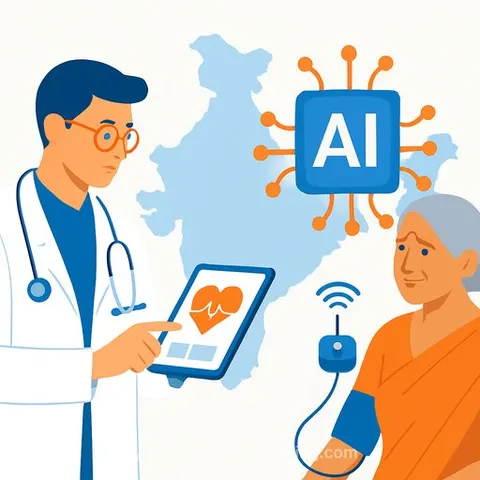
Indian healthcare providers are moving artificial intelligence from pilot projects into real clinical and operational settings, with the next major opportunity concentrated in remote patient monitoring, OT/ICU optimisation, and post-discharge chronic disease management, according to a joint report by Bain & Company and HealthQuad released Tuesday.
The report, titled 'AI in Indian Healthcare Delivery', found that providers are deploying AI to reduce administrative burdens on clinicians. Connected clinical care emerged as the most significant forward-looking opportunity, though its growth remains constrained by a 35% electronic medical record adoption rate across the sector.
Where AI is landing first
Hospitals and clinics are applying AI to tasks that sit outside direct diagnosis. Administrative workflows - documentation, billing, scheduling - are absorbing the bulk of early deployments. This pattern mirrors what the report describes as a shift from experimental testing to real-world applications, with providers focusing on measurable operational returns rather than clinical decision support alone.
The report also identified significant whitespaces in ICU optimisation and chronic disease management. These areas, where continuous monitoring and early intervention can prevent costly deterioration, remain underserved by current technology deployments. For hospitals that build the necessary data foundations now, the gap between early movers and the rest of the industry will widen quickly, the authors warned.
The economics of AI are tilting fast
Two data points in the report underscore how quickly the underlying economics are changing. The amount of expert-level work AI can complete autonomously has doubled every six to nine months since 2023. Over the same period, the cost of frontier models has dropped by roughly 92%.
These shifts mean that smaller providers and startups face a fundamentally different cost equation than they did even 18 months ago. "The next phase of adoption will be shaped by providers' ability to bring value, deployability and trust together - not simply by access to more advanced AI models," said Dhruv Sukhrani, Head of Bain & Company's Healthcare & Life Sciences practice in India.
India's healthcare infrastructure is positioned for faster AI scale than earlier digital waves, the report noted, citing government initiatives, rising EMR penetration, and a startup ecosystem that has grown more specialised in healthcare delivery.
Startups and the integrated platform play
For startups, providers without strong in-house technology capabilities represent a major opportunity. Rather than selling point solutions, the report points toward integrated platforms that bundle multiple capabilities - monitoring, documentation, analytics - into a single deployment.
Namit Chugh, Director at HealthQuad, framed AI's role as structural rather than incremental. "AI can potentially change that equation by being not just an efficiency lever, but a capacity multiplier," he said. The distinction matters: efficiency levers reduce cost per task; capacity multipliers let the same clinical workforce manage more patients without adding hours.
HealthQuad, a healthcare investment platform with over $500 million in assets under management, focuses on new-age healthcare models and technology. Bain & Company is a global consultancy working across industries on strategy and operational challenges.
Why this matters for healthcare professionals
The report's core signal for clinicians and hospital administrators is that the AI adoption curve is steepening, and the window for building foundational data infrastructure - particularly AI for Healthcare systems that feed on structured electronic records - is narrowing. Providers still operating on paper or fragmented digital systems will find themselves locked out of the next wave of tools, including remote monitoring platforms and ICU decision-support systems that require clean, longitudinal patient data. For administrators, the 35% EMR adoption figure is not just a technology gap; it is the ceiling on what AI can deliver in connected clinical care. The professionals who close that gap first will determine how quickly their institutions can deploy the AI for Medical Billers and administrative tools that free clinical staff for higher-acuity work.