
AI news ·
Altman and Musk back Amodei's call for an AI slowdown
Anthropic CEO Dario Amodei called for a pause in training large AI models, and OpenAI's Sam Altman and Elon Musk immediately backed the proposal. The three rivals' rare agreement targets models costing hundreds of millions of dollars to train, aiming to buy time for better safety protocols.
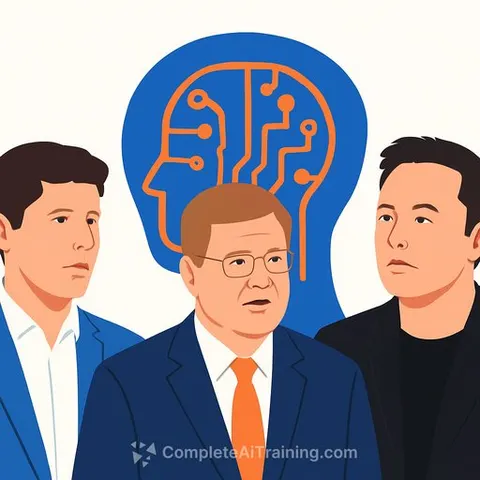
Anthropic CEO Dario Amodei called for a pause in the training of large AI models on Monday, arguing the industry needs time to address safety risks. OpenAI's Sam Altman and Elon Musk immediately backed the call, a rare alignment among three of the most prominent figures in artificial intelligence development.
"I think we need to take a step back and think about what we're doing," Amodei told a conference in San Francisco. "We're building something that could be very powerful, and we need to make sure we get it right."
The remarks come as regulators worldwide struggle to keep pace with the technology's rapid advance since OpenAI released ChatGPT in late 2022. Altman said he agreed with the "spirit" of Amodei's proposal. Musk, who has repeatedly criticized the speed of AI development and pushed for regulation, also endorsed the statement.
A temporary truce among competitors
The three men lead organizations that compete aggressively for talent, funding, and market share. Anthropic, founded by former OpenAI employees including Amodei, has positioned itself as a safety-focused alternative. Musk, an OpenAI co-founder who later departed and started xAI, has sued OpenAI over its direction. Their agreement on slowing down - even briefly - underscores how seriously the industry's leadership views the risks of unchecked acceleration.
What a slowdown would mean in practice
Amodei's proposal targets the training of the largest-scale models, the kind that require months of compute time and hundreds of millions of dollars. A voluntary pause would not halt product releases or research on smaller systems. It would give labs time to develop better evaluation methods and safety protocols before the next generation of models arrives.
No formal mechanism exists to enforce such a pause. The three companies could agree to one independently, but coordination across the broader industry - including Google, Meta, and emerging players in China - remains unlikely without government intervention.
Regulatory pressure builds globally
The European Union's AI Act is moving toward implementation, while the U.S. has relied largely on voluntary commitments from companies. The U.K. hosted a global AI safety summit in 2023, and several nations have established dedicated safety institutes. Amodei's call adds weight to arguments that voluntary measures have not been sufficient. For professionals tracking the AI for Finance sector, the regulatory trajectory will shape compliance costs, risk models, and investment decisions over the next two to five years.
Why this matters for finance professionals
A training pause at major labs would delay the arrival of more capable models that financial institutions plan to use for trading strategies, credit risk assessment, and fraud detection. It also signals that AI governance is moving from abstract debate to concrete action. CFOs and risk officers should model scenarios where access to frontier models is constrained by regulation or voluntary industry agreements. The AI Learning Path for CFOs addresses how financial leaders can build internal expertise to navigate these shifts without relying solely on vendor roadmaps.