
AI news ·
Archbishop calls for just economy as AI threatens worker dignity
Archbishop Shelton Fabre warns AI could drive unemployment and relies on hidden low-wage workers in exploitative supply chains. 72% of low-wage U.S. workers lack stable employment, and over 70% of Americans now say having children is unaffordable.
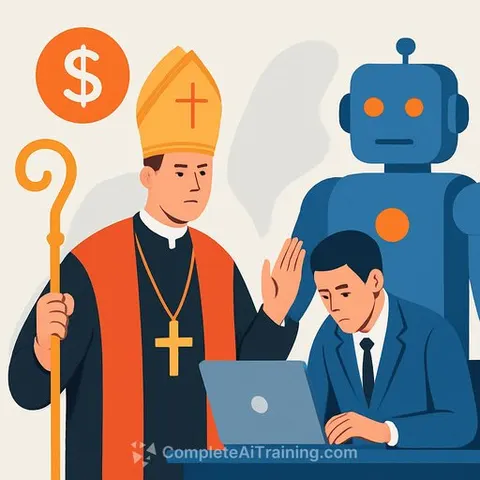
Archbishop Shelton Fabre of Louisville, Kentucky, is urging U.S. Catholics to help build an economy that protects workers, families, and vulnerable communities as artificial intelligence reshapes the labor market. In a statement released ahead of Labor Day, Fabre, chairman of the U.S. Conference of Catholic Bishops' Committee on Domestic Justice and Human Development, framed the church's commitment to human dignity as a counterweight to economic forces that often leave the most vulnerable behind.
"We must listen to the experiences of workers, families, young people, and communities of color as they struggle to find stability," Fabre said. The call comes amid growing anxiety over AI-driven job displacement, particularly among younger workers. "There is widespread concern that artificial intelligence (AI) will lead to higher unemployment and to fewer jobs that can support a family. Young people have been the most impacted so far and also experience the most anxiety about AI's impact on their work."
The risks AI poses to workers
Fabre drew on Magnifica Humanitas, Pope Leo XIV's recent encyclical on artificial intelligence, to outline specific dangers. The document warns of job insecurity, mass unemployment, reduced worker agency, and widening inequalities. Fabre also highlighted a less visible cost: the low-wage labor that powers AI systems. "Furthermore, AI relies on low-wage workers, who are often hidden and who endure harsh conditions, caught in an exploitative supply chain," he said.
While acknowledging that AI offers new opportunities, Fabre cautioned against uncritical adoption. AI systems "can imitate but never replace human intelligence," he said. "AI cannot feel, love, discern, or receive God's grace and wisdom. It is not morally neutral and risks creating new forms of exclusion." The archbishop argued that dignified work "is not merely about productivity, but also participation in God's creation."
Economic data tells a mixed story
Traditional indicators point to a growing economy, but Fabre cited figures that show hiring has slowed, especially for unemployed workers. Unemployment remains high for Black workers, according to an analysis by the Joint Center for Political and Economic Studies. Roughly one-quarter of the U.S. labor force holds low-wage jobs, and 72% of those workers lack stable, secure employment, based on data from Washington University in St. Louis's Center for Social Development. More than half of low-wage workers are people of color.
Affordability pressures extend beyond the workplace. A Brigham Young University study found that more than 70% of Americans now believe having children is unaffordable - a 13-point increase in a single year.
Historical foundations for a modern challenge
Fabre stressed that the church has navigated similar upheavals before. He pointed to Rerum Novarum, Pope Leo XIII's 1891 encyclical on labor and capital, which Fabre said "has brought the sacredness of the human person to the questions of work and labor for these last 135 years." The 40th anniversary of "Economic Justice for All," the U.S. bishops' 1986 document on the economy, also served as a touchstone. Much of its teaching, Fabre said, remains relevant to today's technological shifts.
Ensuring just development of AI for Government systems, protecting good jobs, and correcting power imbalances exacerbated by technology will require broad cooperation. "As we confront this latest challenge, we invite all to be partners in this work," Fabre said. "The Church, the government, labor unions, civil society groups, corporations, and others all have a shared responsibility to protect the human person and the dignity of work."
Why this matters for HR, government, and general professionals
Fabre's statement lands at a moment when workforce planners and public administrators are grappling with AI's real-world effects on hiring, retention, and equity. For HR leaders, the data on low-wage job instability and the hidden labor behind AI supply chains raises practical questions about vendor due diligence and internal upskilling strategies. Government professionals must weigh regulatory frameworks that address both innovation and worker protection - a balance Fabre explicitly called for. General professionals across sectors will encounter these pressures as organizations adapt AI for Human Resources tools and policies. The archbishop's challenge is not merely moral. It points to concrete economic fault lines that will shape labor markets, compliance requirements, and organizational culture in the years ahead.