
AI news ·
Army health center uses ambient listening to cut documentation time and improve patient focus
A Kansas Army health center is testing AI-powered ambient listening that drafts clinical notes from patient visits, with provider review before signing. Physician assistant Mikaela Altis says the tool cuts documentation time in half for complex visits and is used in 75-80% of her appointments.
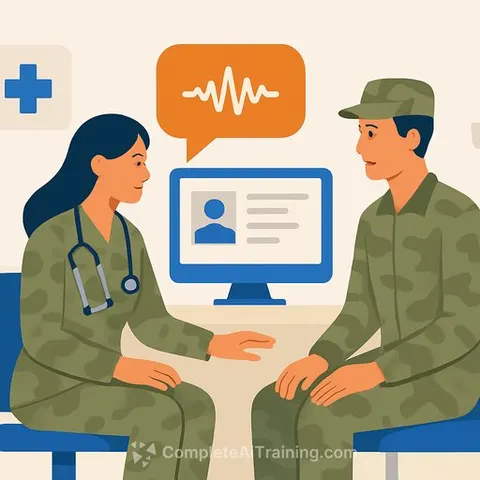
FORT LEAVENWORTH, Kansas - At Munson Army Health Center, physicians are testing ambient listening technology to handle clinical documentation, giving them more time to focus on patients instead of screens. The AI-powered tool captures patient-provider conversations, then drafts a clinical note the provider reviews and signs.
Mikaela Altis, a physician assistant in the hospital's Department of Primary Care, said the change has been immediate and practical: more eye contact, better follow-up questions, and fewer hours spent on paperwork after work.
A tool that listens, documents, then steps aside
"It really lets us focus more on the patient during the visit," Altis said. "A lot of times, you go into the room, and the provider is staring at the screen because they're taking notes and clicking on things. With the ambient listening tool taking notes for us, it lets me sit, face the patient and make eye contact."
Use is voluntary. The provider explains how the tool works and asks for permission before activating the recording. If the patient declines, the visit proceeds normally.
"It is definitely the patient's choice," Altis said. "If they say yes, we start the recording. If they say no, we don't, and we complete the visit as usual."
Several safeguards protect patient information. Providers access the system with unique military credentials, recordings are tied to the provider's schedule and login, and each recording auto-deletes after 24 hours.
The AI filters out small talk
The tool separates medically relevant details from casual conversation. Altis said she initially worried that personal exchanges-such as questions about a patient's family, pet, or recent move-could end up in the medical record.
"It is very good at not pulling in the private conversation," she said. "It only pulls in the medical conversation."
The system doesn't provide diagnoses or treatment plans. It drafts what was discussed in the visit for the provider to review and correct. The clinical judgment is still the provider's.
"The thinking is still completely mine," Altis said. "It is not adding things to the note that I didn't say, and it is not trying to dictate what medical care I should give."
For professionals exploring generative tools in clinical settings, this kind of feature aligns with the practical applications covered in AI for Healthcare discussions. The recorded conversation is converted to text for review, similar to existing speech-to-text technology used in clinical settings.
Fewer hours spent on notes after work
For complex visits, the time savings are substantial. Altis estimates the tool cuts her documentation time in half when a patient brings five or six concerns to one appointment.
"When I'm addressing five or six things during a visit, it is saving me a ton of time," she said. "When I'm done, I read through the note, make any corrections I need to make and sign it, rather than trying to type out the five or six things we just discussed."
That efficiency supports other patient needs. Fewer hours on the note means more time for urgent refill requests, test-result calls, and follow-up appointments.
The tool also improves accuracy when a provider can't write the note immediately after the visit. Reviewing a real-time capture of the conversation is more precise than trying to recall a specific discussion hours later.
"I can go back to finish a chart later and it helps me more accurately complete it rather than trying to recall what a patient said six hours earlier," Altis said. "I can see what we talked about and what I said for the plan of care. It makes me feel like I'm giving the patient the care they deserve."
Altis estimates she uses ambient listening in about 75 to 80 percent of her visits. She said she learned the system in about a day.
She finishes the workday on time more often, and carries less stress from unfinished charts into the evening.
Why this matters for healthcare professionals
Ambient listening won't replace clinical judgment or empathy, but it removes a burdensome part of the job: the note. For providers juggling a full schedule, that means more focus on the patient in the room and less transcription to take home at the end of the day. It also points to a practical pattern for AI in medicine: use the tool to draft, review carefully, and sign off with final authority.