
AI news ·
AI detection tools fuel controversy over race and authenticity in publishing
Jerry Falade's crime novel drew six- and seven-figure offers before agents withdrew it over AI questions he calls racially motivated. The cases of three other authors of colour highlight how unreliable detection scores can derail careers.
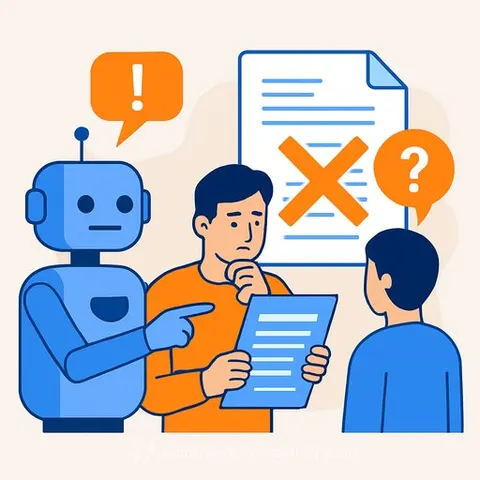
A string of recent AI-related controversies involving authors of colour has raised questions about bias, unreliable detection tools, and who gets to define "authentic" writing in publishing.
In recent months, several high-profile books have been withdrawn or questioned. Mia Ballard's novel *Shy Girl* was pulled from shelves by Hachette. Jamir Nazir, winner of the 2026 Commonwealth Short Story Prize, faced speculation over his story *The Serpent in the Grove*. Black American author HM Wolfe was questioned over *Daggermouth* after the AI-detection tool Pangram returned a 60% score; Wolfe has denied using AI.
The most prominent case involves Nigerian author Jerry Falade. His crime novel *Call Me, I'll Hide the Body* had attracted six- and seven-figure offers in the UK and US, plus film and television interest, before his agents withdrew it from sale after questions about AI use emerged. Falade has rejected the allegations and argued the scrutiny was racially motivated, questioning whether Black writers can receive major industry attention without their authorship being subjected to unusual suspicion.
Why AI detection is causing concern
The difficulty lies partly in the technology. AI-detection tools try to identify patterns associated with machine-generated writing, but their results are not a definitive test of authorship. A score indicating that text resembles AI-generated material does not, by itself, establish that an author used generative AI.
That creates a serious problem when such assessments are tied to publishing contracts, literary prizes, or an author's reputation. The debate has also spread beyond individual books. Writers and commentators have begun asking whether authors of colour are being judged differently when their writing contains distinctive rhythms, structures, or linguistic traditions.
For writers from countries shaped by colonial histories, English may reflect local literary traditions that differ from the styles most familiar to Western publishing. Repetition, metaphor, fragmented sentences, and unusual rhythms can be deliberate elements of a writer's voice. Critics of heavy reliance on AI detectors fear that unfamiliar writing could be mistaken for machine-generated prose simply because it does not conform to an expected style. Writers facing these questions can find practical guidance in the AI for Writers section at Complete AI Training.
The question of racial bias remains unresolved
There is not enough evidence to establish that authors of colour are being systematically targeted for AI investigations. The recent cases, however, have prompted writers and publishing figures to question whether the industry's emerging approach to AI could reproduce existing inequalities.
One concern is the burden of proof. If an automated system raises doubts about a manuscript, an author may find themselves having to demonstrate that they wrote their own work - despite the lack of a universally reliable way to prove human authorship. That becomes particularly complicated when an accusation spreads publicly. A disputed AI score can affect a publishing deal, prize recognition, professional relationships, and reputation before the underlying evidence has been properly examined.
There is also a concern that readers and publishers could begin routinely putting books through multiple AI detectors. Different systems may produce different results, making the process harder to interpret. The broader debate over AI and creative authenticity is covered in the AI for Creatives section.
Publishing faces a difficult AI dilemma
The industry has a legitimate reason to set boundaries around generative AI. Publishers need to know whether manuscripts have been substantially generated by artificial intelligence, particularly where contracts or competition rules require disclosure. But determining that reliably is the difficult part.
Rather than treating an automated detection score as conclusive, publishers could need a more transparent process for investigating allegations. That could include showing authors the evidence behind a concern, allowing them to respond, and establishing a clear appeals mechanism before a contract or literary honour is withdrawn.
The growing controversy also raises a broader question about the future of literary gatekeeping. If algorithms become part of the process used to decide which writing is considered authentic, their limitations could have consequences beyond individual AI disputes.
Why this matters for writers
For writers, the practical takeaway is that an AI-detection score is not proof of misconduct. If your work is questioned, ask to see the evidence and insist on a transparent review process before any contract or prize is withdrawn. The recent cases show that reputations can be damaged before the underlying facts are examined - and the industry has not yet agreed on a fair way to handle that.
As generative AI becomes increasingly embedded in publishing, the industry will have to work out not only what constitutes unacceptable AI use, but how accusations can be investigated without allowing an uncertain technology to determine an author's future.