
AI news ·
Artificial intelligence chatbots provide accessible mental health screening but lack empathy
Patients find AI mental health chatbots judgmental due to three empathy deficits, limiting treatment. They still handle front-end screening and triage at almost no cost.
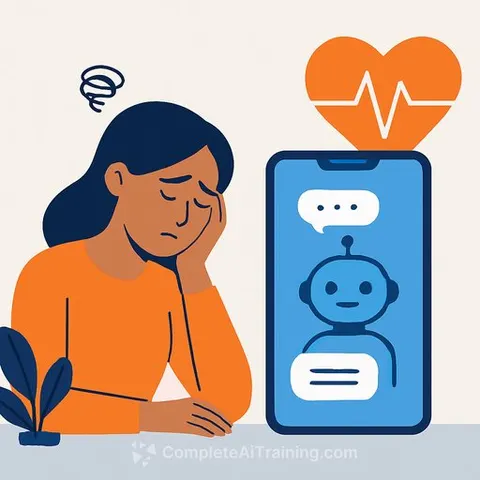
AI chatbots are broadening access to healthcare, but their role in mental health treatment remains limited by a perception problem: patients often find them more judgmental than human providers. Research from Dr. Ryan Raimi at the University of Texas at Dallas, published July 9, 2026, identifies the reasons behind this barrier and clarifies where the technology can still deliver practical value.
Why patients feel judged by chatbots
Raimi's work points to three factors that drive the perception of judgmentalness in AI mental health tools. "First of all, the AI agents lack real-world experience," he said. The second factor involves what Raimi calls a deep understanding deficit - one that spans both social and emotional comprehension.
"You know what it means to be isolated and lonely as a human being, whereas an AI has absolutely no comprehension of what that actually means," Raimi said. The third issue is structural: many people seeking mental healthcare are not looking for solutions at all. "They're not looking for a solution per se," he said. "They just want to be heard."
Screening and triage: the practical use case
Despite the limitations in therapeutic settings, Raimi sees substantial promise for chatbots in front-end clinical workflows. "When it comes to triage and screening, it's a pretty straightforward structure," he said. "It's accessible around the clock at negligible costs." The technology is particularly relevant in regions where traditional mental health services are thin or nonexistent.
Raimi's findings contribute to a growing body of work in AI for Healthcare that examines how automated systems can supplement overburdened clinical staff. "A lot of clinics may be understaffed, they don't have enough personnel to do the screening and triage," he said. "These agents can be scalable and you can run at almost no cost."
The limits of machine empathy
Creating meaningful therapeutic interactions remains a much harder problem. Raimi's research has examined both screening and treatment scenarios, and the empathy gap is persistent. "It's very tricky when it comes to empathizing with the subject, with the client," he said.
The challenge is not just technical but situational. "Sometimes you have to let the machine act like a machine, and other times it needs to emulate human behavior, so it's very intricate and nuanced," Raimi said. For now, the strongest use case is helping patients navigate the front end of the care system. Screening tools, he noted, are "getting pretty close to being deployed globally."
Why this matters for healthcare professionals
For clinic directors and healthcare administrators facing staffing shortages, AI screening tools offer a way to manage patient intake without adding headcount. The technology is not a replacement for human therapists - Raimi's research makes clear that chatbots cannot replicate the lived experience or emotional presence patients need - but it can handle structured triage tasks at scale. Prioritizing deployment in screening workflows, rather than direct treatment, aligns with the evidence on where these tools perform reliably.