
AI news ·
Artists Demand Fair Compensation as AI Threatens Creative Livelihoods
Artists warn AI uses their work without pay, risking creativity and fair compensation. Calls grow for laws protecting creators’ rights in the digital era.
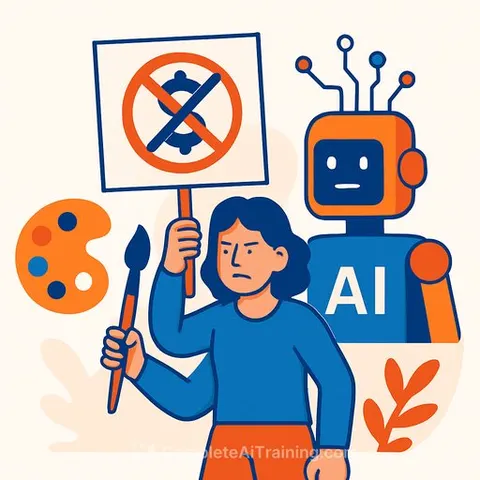
Artists Sound the Alarm on AI Using Their Talents Without Pay
For many creatives, the human voice is the ultimate instrument. Lily Dooner, a composer and singer known professionally as Lily Maestra, fears the day AI might replicate her unique vocals without permission. "What really scares me is the idea that one day I might be watching a film, and hear a voice created out of snippets of mine," she says.
At 28 and based in Leominster, Lily is among a growing number of artists concerned AI could threaten their livelihoods. Generative AI systems create new content—whether text, images, music, or speech—by learning from vast datasets that include existing creative works. While AI can generate material quickly and cheaply, Lily points out the difference in effort: "AI can give you something passable in seconds… for me to give you something it's going to be hours of my time."
AI Produces Fast but Lacks True Creativity
Despite AI’s speed, Lily believes its reliance on mimicry limits its creative potential. "The difference is AI can't give you something incredible. I can." Still, the concern remains that AI-generated content could homogenize creative output, leading to less diversity and originality in music and other arts.
Copyright and Compensation Challenges
The government's recent proposals have sparked debate. A consultation suggested AI developers could have access to all content unless creators explicitly opt out. This sparked criticism from established musicians like Sir Elton John, who called it “thievery on a high scale.”
Attempts in the House of Lords to require transparency from AI companies were overturned. Officials insist the Data (Use and Access) Bill does not change copyright law, and they continue to review thousands of public responses before deciding next steps.
When AI Meets Theatre: A Personal Story
Tim Evans, artistic director of Powerhouse theatre in Herefordshire, embraces AI but highlights the need for fair pay. After his brother Alex passed away in 2017, Tim used AI to recreate Alex’s voice for a play by training a model on recordings. "The genie is out of the bottle," he says, acknowledging AI cannot exist without harvesting huge amounts of data.
He sees AI as a democratizing tool for creativity but stresses that the question of compensation for artists whose work powers AI remains unanswered.
Calls for Rights Fit for the Digital Age
Science and Technology Secretary Peter Kyle has promised to work with creative industries to develop rights that reflect today’s digital environment. "I will give them the rights that they have in the analogue age… fit for the digital age," he said. A wide-ranging report and economic impact assessment are expected soon.
Local Creatives Demand Fair Remuneration
Artists in Herefordshire say reforms mean little unless they secure fair pay. Visual artist and animator Rebecca Farkas emphasizes the risk: AI could imitate her style exactly, simply by analyzing her work.
"AI could look at my animations, and then it could copy it in exactly my style… you could put a prompt in to say 'make an animation like Rebecca Farkas,'" she explains. The creative industries contribute approximately £126 billion annually to the UK economy, yet benefits may be unevenly distributed if AI content scraping goes unchecked.
What Creatives Need to Know
- AI systems learn from existing creative works, often without explicit permission.
- Current proposals place the burden on artists to opt out of having their work used.
- There’s a growing push for transparency and fair compensation as AI use expands.
- Artists can use AI as a tool, but protecting intellectual property remains critical.
- Ongoing government consultations will shape future copyright and data use laws.
For creatives looking to understand AI’s impact on their work and explore practical ways to engage with AI tools responsibly, Complete AI Training offers courses tailored to different creative roles.
Staying informed about your rights and how AI might affect your craft is the first step in securing fair treatment as technology evolves.