
AI news ·
Autodesk CEO says AI job losses in VFX are a more immediate threat than human extinction
Autodesk's CEO says AI-driven efficiency means "fewer FX artists per film," not extinction. He warned that software now lets small teams do work that once required hundreds, directly threatening headcount.
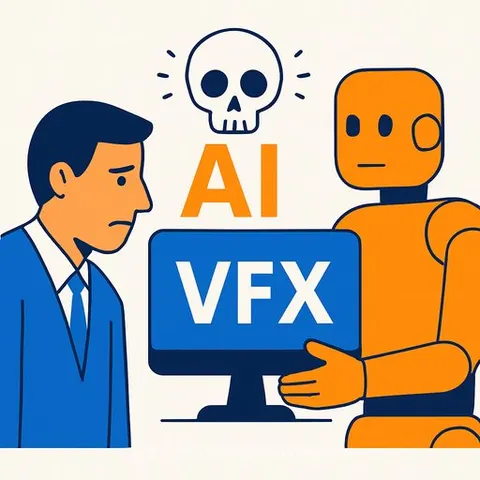
Autodesk CEO Andrew Anagnost believes the more immediate threat from AI for creative professionals isn't extinction-it's headcount. Speaking at Autodesk University 2026, he addressed the recent claim from Anthropic's Evan Hubinger that AI has a greater than 10% chance of killing all humans within a decade, but quickly pivoted to the practical disruption already reshaping animation and VFX studios.
The "political theatre" of AI doom
Anagnost dismissed the most dramatic AI warnings as partly self-serving. "The idea that any of these companies are going to self-regulate themselves at this point is ridiculous. I think some of this is a little bit of political theatre, you know, designed to pump themselves up, 'look at how great our tech is' - it's so good, it's so dangerous, there's a 10% chance that we'll kill everybody," he said.
He was careful not to call the technology harmless. "There really is a real need to start putting guardrails on this technology. It's a potentially dangerous technology that can be used in dangerous ways." But for the people building software used by film and game studios every day, the conversation has already moved to a much more concrete problem.
Fewer artists per film
Autodesk is embedding AI across its tools. Maya is getting automation for repetitive animation tasks. Flow Studio is expanding into AI-assisted characters, assets, and production workflows. MotionMaker can generate character movement from simple inputs. And Anagnost is direct about what that means for crews.
"There's nothing we can do about the fact that these tools are getting more efficient, and because they're getting more efficient, there are fewer FX artists per film," he said. The hope, from his perspective, is that studios channel those savings into producing more content rather than simply making the same number of projects with smaller teams.
The script-to-screen future
Anagnost described two tracks. Maya stays the high-fidelity professional tool, with AI handling grunt work while artists stay in control. Flow Studio is the second track, aimed at small teams who want to assemble an entire production using automated tools. He sees the destination as a script-to-screen system where artists direct much more of the process themselves, something he believes platforms like Netflix will eventually have to accept.
The math is straightforward: if a small group can do what once required hundreds of people, some jobs vanish from individual projects. Whether overall content volume rises enough to absorb those artists remains an open question. The VFX industry is already navigating tight budgets, shifting streaming economics, and a difficult production market. There is no guarantee that money saved through AI returns as more work.
For scriptwriters and video editors watching these tools evolve, understanding where AI fits into production pipelines is becoming essential. The AI Learning Path for Scriptwriters explores how automated workflows are changing pre-production, while the AI Learning Path for Video Editors covers the post-production tools that are already shifting what small teams can accomplish.
Why this matters for creatives
Anagnost's comments make explicit what many in animation and VFX already sense: the headcount question is not theoretical. Studios that once needed 500 artists for a film are facing software that could reduce that number to 300 or 50. The extinction debate grabs headlines, but the practical disruption is already here. The difference between surviving that shift and being sidelined by it comes down to who learns to direct these automated workflows rather than compete against them.