
AI news ·
Balancing Innovation and Caution: Maximizing AI’s Industrial Benefits While Managing Risks
AI can boost industrial efficiency and predict failures to reduce costly downtime. Success requires clear data governance, model transparency, and smooth integration with workflows.
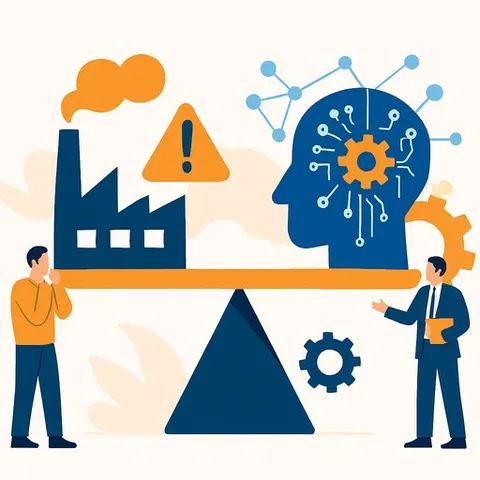
How to Unlock AI's Industrial Value While Managing Its Risks
Artificial intelligence offers great potential to improve efficiency, streamline operations, and increase profitability in industrial settings. Yet many organizations struggle to capture its full benefits due to challenges like unstructured data, uncertain model accuracy, and governance gaps.
For companies running large-scale, continuous operations, the stakes are high. Downtime or unexpected failures can cost millions, disrupt supply chains, and erode competitiveness. According to Aberdeen Research, unplanned downtime in manufacturing can cost as much as US$260,000 per hour.
AI can help predict problems before they occur, enabling proactive maintenance and minimizing downtime. Still, concerns remain about data reliability, algorithmic bias, and whether AI recommendations are transparent and safe. A thoughtful, well-planned approach is essential to turn AI into a genuine value driver in industry.
Identifying Key Risks and Overcoming Them
When deploying new assets, companies often lack historical data. They can address this by combining first principles models with simulations to generate balanced datasets, including rare scenarios, allowing predictions in new operating conditions. Field data then refines these models, closing the gap between simulation and reality.
Predictive maintenance models can detect abnormalities by learning normal operation patterns. To support this, organizations must establish strong governance around data labeling, storage, and updates. While this requires upfront investment, well-organized data leads to accurate models that deliver meaningful insights.
Explainability is another challenge. Complex AI models, like neural networks, may feel like a “black box” to operators who need to trust and understand AI-driven decisions. Including interpretable features and highlighting key decision factors builds that trust. Clear dashboards that map inputs to outputs help, but they’re not enough alone.
Choosing the right model complexity matters. Complex models suit nonlinear behaviors but can reduce explainability, increase data needs, and risk overfitting. Generally, the simplest model that solves the problem is best. Incorporating first principles as guardrails adds confidence and shows a cautious approach to AI.
Bias in historical data is a real concern. If outdated or inconsistent data is used unchecked, AI models may perpetuate biases. Regular performance audits, diverse datasets, and expert feedback reduce this risk. Staying proactive about data strategy and regulatory changes helps maintain compliance and fairness.
Integrating AI into existing workflows is critical. Advanced algorithms won't deliver value if operators must juggle multiple tools or can’t act quickly on AI alerts. Seamless integration, intuitive visualization of AI insights, operator training, and ensuring IT systems handle increased data loads are key factors for success.
Practical Steps to Harness Industrial AI
Start with a clear roadmap that targets use cases with strong ROI. Predictive maintenance often shows early success by identifying potential failures in advance. Hybrid models that blend data-driven and first principles approaches speed up model development and improve design optimization, supporting efficiency and sustainability.
Combining automation with human expertise adds value. AI can analyze large datasets to spot trends or anomalies, but experienced operators understand the nuances of plant operations. Collaboration between humans and AI leads to decisions that blend intuition with data-driven insights, reducing failures and maintaining workforce trust.
Securing management buy-in requires pilot projects that deliver quick, measurable benefits. For example, using AI in quality control to reduce scrap can demonstrate cost savings and improve customer satisfaction. Documenting these results and calculating ROI helps justify broader AI adoption across sites, which often involves more complex budgeting and approvals.
As AI use expands, governance becomes vital. Models must be monitored for “drift” as conditions change. Self-adapting AI or regular reviews with engineering and data science teams ensure consistent performance. Some organizations establish review boards to vet AI solutions, verify regulatory compliance, and align efforts with corporate goals like safety and sustainability.
Building internal AI expertise supports long-term success. AI adoption is an ongoing process of refinement and learning. Training employees to understand AI fundamentals, interpret analytics, and collaborate with data scientists embeds AI into the company culture and enables faster adaptation to new technologies.
For management interested in developing AI skills or understanding its industrial applications, exploring targeted educational resources can be valuable. Platforms like Complete AI Training offer courses tailored to different roles and skill levels.