
AI news ·
Barna Group survey shows most pastors use artificial intelligence in ministry despite reservations
A survey of 442 pastors finds 24% now use AI to write sermons, up from 12% in 2024. Despite this growth, 71% of clergy remain hesitant about the technology.
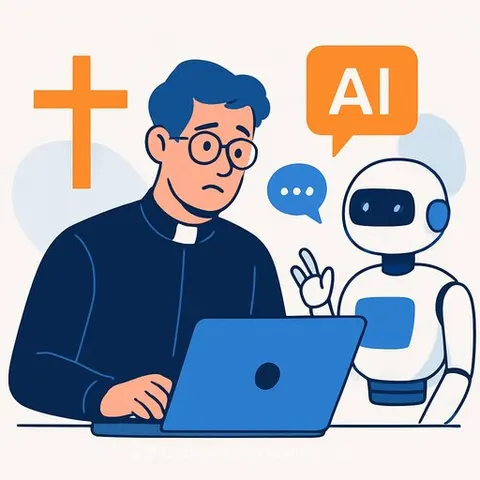
A new Barna Group survey reveals that most Protestant pastors now use artificial intelligence in their ministry, and the share who lean on AI for sermon writing has nearly doubled since 2024. The findings arrive as knowledge workers in many fields-including professional writers-grapple with the same question: where does AI fit into a craft built on human judgment and voice?
AI adoption accelerates among pastors
The online survey, conducted in December with 442 U.S. Protestant pastors, found that 50% use AI for brainstorming or idea generation. Another 37% turn to it for graphic design, 36% for biblical or theological research, and 34% for generating discussion questions or handling administrative tasks like scheduling and emails. The most striking shift came in the pulpit: 24% of pastors now use AI to write or edit sermons, up from 12% in 2024. Barna did not provide a margin of error.
"Pastors are predominantly using AI for behind-the-scenes work-as a thought partner, a visual aid," said Daniel Copeland, Barna's vice president of research. "They're using it to prepare for ministry, not to replace what happens when they're actually with people."
Even as usage grows, discomfort persists. The survey found that 71% of pastors expressed hesitation about the technology, and 40% said they feel conflicted.
Practitioners speak: tool, not replacement
Art DeBruyn, lead pastor of Center Grove Church in Greenwood, Indiana, uses AI to help write sermons but draws a hard line around the core of his calling. "It's a tool, not a shortcut, and it doesn't give us permission to abdicate our own knowledge, our own wisdom, our own experience," said Mr. DeBruyn, 65.
Congregants had mixed reactions. Stacie Marie Ruff, a retired nurse who manages the church's food pantry, said she isn't surprised by AI's presence in emails or image creation. "I think we've all come to the realization, whether we think it's positive or negative, that it's going to be a part of our lives," said Ms. Ruff, 56. She added that small uses of AI need not be disclosed. Fellow church member Jody Veldkamp, 67, disagreed, saying he thinks Mr. DeBruyn should disclose his AI use-though he often uses AI himself.
Catholic priest Father John Thomas Lane takes a different approach. "I just don't think it's authentic to our name," said Father Lane, 62, who avoids AI in preaching and writing. He sees the technology's real value in parish operations, like managing energy costs and building systems amid staffing shortages. "To have an artificial intelligence feature to a system in your parish would be so valuable and so helpful, but not to replace a teacher or not to replace someone, but to add to the existing people you need," he said.
Episcopal pastor Kurt Gerhard of Christ Church Bronxville in New York uses AI to summarize resumes, review sermon drafts, and look over interview summaries-but he won't let it supplant his spiritual judgment. "If I'm using AI to do what I really feel like I was called to do, it seems like I'm not acknowledging that I have these gifts," Mr. Gerhard said.
Jennifer Holloran, president and CEO of the American Bible Society, noted that 32% of "Scripture-engaged" Americans now use AI for biblical insights at least monthly. She sees that as typical of people already committed to study, but she warned against letting AI replace pastoral mentorship or in-person church community. "If there are cases where people are turning to AI and that's causing them to step away from community and from the church, that can be a really unhealthy thing," Ms. Holloran said. "Whereas if it's a supplementing tool that they're using alongside other things, that could be a great resource."
Why this matters for writers
The data from the pulpit mirrors a trend that professional writers know well: AI is quickly becoming a standard brainstorming and drafting partner. The same pattern-use AI for initial ideas, speed up routine tasks, but keep the final voice and ethical judgment human-applies whether you're writing a sermon, a report, or a marketing brief. For writers who want to build these skills intentionally, AI for Writers Courses cover drafting, editing, and style-control techniques that respect your own judgment. And because the quality of AI output depends heavily on how you ask for it, Prompt Engineering Courses focus on the craft of constructing prompts that yield useful, accurate material without flattening your tone. The pastors in this survey are not being replaced by AI; they are navigating a boundary that every writer now faces-how to use the tool without losing the work that matters.