
AI news ·
Bill Gates urges governments to tax AI and protect certain jobs from automation
Bill Gates's 6,000-word essay warns AI will permanently eliminate jobs and urges governments to create "human reserved" roles protected from automation. He proposes taxing AI and robotics to slow displacement, citing 87,700 U.S. layoffs tied to AI since January.
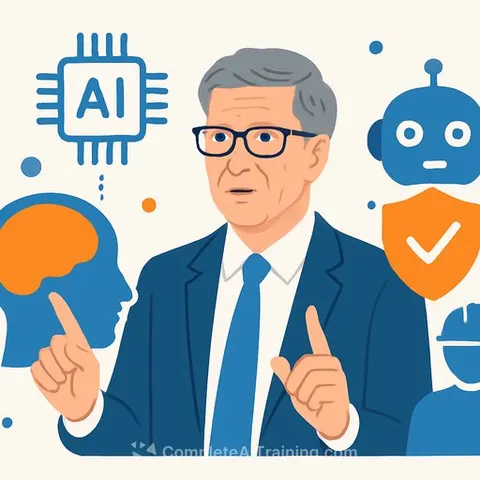
Microsoft co-founder Bill Gates published a 6,000-word essay on Wednesday warning that AI will permanently eliminate jobs and that governments are unprepared for the disruption ahead. The essay, titled "The turbulent AI era is here. The choices we make are critical," proposes designating certain occupations as "human reserved" - roles society would protect from automation even where machines could technically do the work.
"Many jobs will disappear forever," Gates wrote. "I believe that as AI and robots improve, we'll set aside certain things for only people to do."
What "human reserved" means for your workforce
Gates compared the concept to conservation policy. "I like the phrase human reserved because it makes me think of nature reserves," he wrote, describing places "where we could put buildings and roads, but we choose not to because the loss would be too great."
He returned most pointedly to healthcare. Gates described the team of professionals who cared for his father, who died of Alzheimer's in 2020. "Something in the care they gave my dad was irreplaceably human," he wrote. "No robot could or should have done it."
"Imagine a robot giving you the awful news that you have an incurable disease," he added. "There's no technical reason why it couldn't. Yet it shouldn't."
Medicine, law, middle management, and manufacturing are among the sectors Gates expects to face significant disruption within the next decade. Economists have already warned that AI could push up to 10 million Americans out of the workforce as automation spreads beyond manufacturing into white-collar roles.
Taxing AI to slow displacement
Gates argued for taxing AI compute tokens and robotics in a way that mirrors how payroll taxes apply to human workers. "Right now, if you're an employer and you hire someone, you pay payroll taxes on their earnings," he wrote. "But if you buy a robot, you can usually write it off right away as a business expense. The tax system nudges you toward replacing people with machines."
He also flagged competitive dynamics that could accelerate automation across entire industries. "Robots and AI combined can create a vicious cycle," he wrote. "After one company adopts them and uses the savings to lower its prices, its competitors will feel immense pressure to do the same."
AI has already emerged as the leading driver of U.S. job cuts in 2026, cited in more than 87,700 announced layoffs since January, according to Challenger, Gray & Christmas. That surpasses AI-attributed cuts for all of 2025.
Why governments aren't ready
Gates outlined three steps governments must take: creating new national and international institutions to manage the AI transition, establishing human-reserved positions so machines don't displace people simply because they can, and reforming the tax system to stop rewarding companies for replacing workers.
"We do not have the luxury of moving slowly," he wrote. "The place to start is with a process for building the right institutions before the disruption forces governments into crisis mode."
Gates also raised concerns about AI's effect on critical thinking, citing a preliminary survey linking heavier AI use to reduced analytical ability. "This would be the worst possible time for humans to lose their critical thinking skills," he wrote. "In an era of deepfakes and misinformation that can be tailored to you individually, the ability to tell what is true from what is not becomes an essential life skill."
He said some global coordination, including cooperation between the U.S. and China, will be necessary. For HR teams, the essay makes the timeline for workforce strategy newly urgent - the question is no longer whether AI will reshape roles, but how fast and how deeply. That makes resources like AI for Human Resources and the AI Learning Path for CHROs practical starting points for building a response.
Why this matters for HR
Gates's essay gives HR leaders a framework for conversations that are coming whether or not they initiate them. The "human reserved" concept offers a vocabulary for identifying which roles in your organization should be protected from automation - not because the technology can't do them, but because the human element is the value.
The tax reform argument matters for workforce planning too. If compute and robotics become taxed like labor, the cost equation shifts, and automation decisions that look inevitable today may not hold next year. HR teams should model both scenarios: one where AI adoption accelerates because it's cheap, and one where policy changes make human labor comparatively more attractive.
The critical thinking finding deserves attention as well. If heavy AI use reduces analytical ability, then how your organization deploys AI tools affects the long-term capability of your talent pool. That's not a technology decision. It's a workforce development decision.