
AI news ·
Book publishers face growing crisis over AI use as trust between readers and authors erodes
Two literary agencies pulled a crime novel from sale after failing to confirm if the author or AI wrote the multimillion-dollar manuscript. In a 2025 survey, 61% of readers would feel less fulfilled reading an AI-written book.
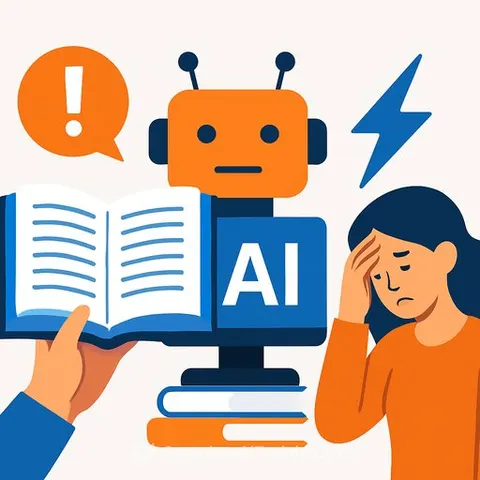
Two literary agencies this summer pulled a multimillion-dollar crime novel from sale after they could not confirm whether the author or an AI chatbot wrote it. The manuscript for Jerry Falade's "Call Me, I'll Hide the Body" had secured deals with major publishers in the United States and United Kingdom and was slated for a 2028 release. The incident follows the cancellation of Hachette Book Group's "Shy Girl" by Mia Ballard earlier this year, after rumors that she used AI to write the horror novel took over the internet. Both controversies show a growing rupture of trust between readers, writers, and publishers as AI use - alleged or proven - continues to reshape the literary world.
"Until AI, there has been the expectation that no matter what is written in a book, it [was] authored by a person," said Vauhini Vara, a journalist and author who has written about technology for more than two decades. "There needs to be new terms in the social contract between reader and writer."
Readers draw the line at full AI authorship
Publishers are struggling to set guidelines for AI use as readers vent their concerns about transparency and quality. In a 2025 survey of U.S. readers by YouGov, majorities disapproved of AI use in all five scenarios presented - from ideation to outlining. Sixty-one percent of readers said they would feel at least "somewhat" or "much" less fulfilled if they discovered a book they'd read was written by AI. Yet only 28% said AI use is unacceptable in all circumstances.
"I think a lot of people probably fall into a middle space of, 'It's cool to use it for research, but I don't want to read any sentences in your book that were written by AI,'" says Rebecca Joines Schinsky, chief of staff at Book Riot.
Kathleen Schmidt, a publishing strategist with more than 30 years in the industry, uses AI for menial tasks and doesn't mind if authors do the same. "I'm not saying that there aren't instances where it should not be used - like, you should not use it to write an entire book," she says. "Can you use it to brainstorm ideas? Sure."
AI detection tools face accuracy problems
In both the "Shy Girl" and Commonwealth Short Story Prize controversies, social media users flagged writing habits they saw as proof of AI use - an overreliance on metaphors, for example. Some readers ran texts through online AI detectors. One tool, Pangram, found that a story that set off the Commonwealth prize controversy was 100% AI-generated. The author, Jamir Nazir, told The Observer he writes exclusively using the text-to-speech function on his Android phone. The Commonwealth Foundation said after reviewing working drafts, time-stamped documents and notes, the author denied using AI and they found no evidence of it.
Tara Radvand, a doctoral student at the University of Michigan who has studied AI detectors, says they work depending on the context. They're better at identifying AI-fabricated fiction than nonfiction, and reliability improves as text length increases. Even a false-positive rate of 1% is high for an industry like publishing, where an accusation can end a career.
Publishers' AI rules remain unclear
Hachette lists "use cases not requiring disclosure" for AI, including "researching elements of a book," but says authors must attest that their work is their own. Penguin Random House recently prohibited AI companies from using authors' copyrighted work to train AI models without permission. Few publishing houses have made their screening methods public, Schinsky says.
Authors are divided. Anthony Horowitz, an English author, said in the spring he uses AI "all the time" but stressed the need to "judge what you're being told, and also look for a second source." Coral Hart told The New York Times she published some 200 romance novels using Claude. In a 2025 poll of more than 1,200 authors by BookBub, 45% said they currently use generative AI to assist with their work. Of those, more than half said they use it to assist with writing.
AI companies themselves may hold solutions. The Wall Street Journal reported in 2024 that OpenAI created a technology - known as watermarking - that can detect ChatGPT-generated content with 99.9% accuracy. The company hasn't released it. Anthropic said this month it will add similar watermarks to all of Claude's outputs, with no opt-out option allowed.
Why this matters for writers
For working writers, the trust gap means a disclosure problem: how hidden AI use erodes the social contract with readers. For Vara, honesty is the core issue. Her recent nonfiction book "Searches" contains several AI-generated passages, all labeled. "For me, the problem arises when AI-generated material appears in text, whether it's a book or something else, and there's no way for us to know," she says. The challenge: many AI training courses or certifications - including AI for Writers Courses - are designed to help writers understand how to ethically and effectively use these tools while maintaining transparency. An AI for Technical Writers learning path might explore how to apply these tools for workflow efficiency while keeping the final work transparent to audiences.