
AI news ·
China uses platform state capitalism to develop artificial intelligence ecosystem while United States debates public equity stakes
The US and China are investing state capital in AI firms via different models. China's RMB60 billion fund uses platform state capitalism to secure supply chains.
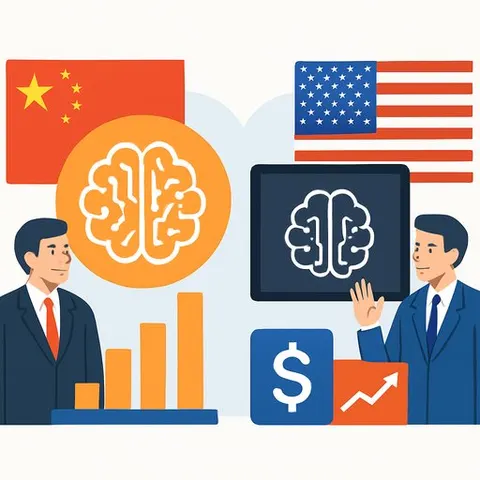
The United States and China are both moving to invest state capital in leading artificial intelligence firms, but their approaches reveal fundamentally different models of AI sovereignty. The Trump administration has discussed taking an equity stake in OpenAI, while China's state-backed National Artificial Intelligence Industry Investment Fund is finalising talks to invest in DeepSeek's first outside funding round. These parallel moves, however, mask a deeper divergence in how each government plans to secure its AI future.
The US push for a public stake in AI
In the US, an emerging coalition across the political spectrum-including President Donald Trump and Senator Bernie Sanders-has floated the idea of a public or sovereign wealth fund to let ordinary citizens share in AI-generated wealth. Both OpenAI and Anthropic have endorsed similar concepts. But once the government takes a stake in an AI lab, a conflict of interest arises. Regulators may hesitate to intervene aggressively on safety, antitrust, or content issues, critics warn. Some also fear creating firms that are "too big to fail," a concern amplified when OpenAI's CFO Sarah Friar suggested a federal "backstop" for computing infrastructure.
China's platform state capitalism
Critics of US state investment often point to China's experience with state-backed semiconductor funds, citing inefficiency and corruption. But that argument overlooks China's recent pivot to what scholars call "platform state capitalism." As S Alex Yang of the London Business School has argued, China's government manages its innovation ecosystem much like a large digital platform. It uses subsidies to attract firms, applies regulation to govern interactions, and imposes exit controls to maintain its competitive advantage. The same logic now guides state investments.
China's Big Tech firms have long invested billions not just for financial returns but to build their own ecosystems. Alibaba has invested in most of China's leading AI labs, often providing cloud computing credits that lock startups into its infrastructure. Similar practices appear in the US, with Nvidia, Google, and Microsoft each investing heavily in AI labs. China's national AI fund, launched in early 2025 with RMB60 billion from the third phase of the semiconductor fund, adopts this ecosystem-building strategy. Its mission targets self-sufficiency across the entire AI supply chain, from chip design to applications.
The DeepSeek investment as platform governance
The planned investment in DeepSeek is not merely a bid to back a national champion. It is a form of platform governance. By funding a key complementor, the state ensures that DeepSeek's open-source models align with China's strategic interests. The more those models are optimised for domestic chips like Huawei's Ascend, the more they stimulate demand for homegrown hardware and encourage developers to build around China's AI stack. DeepSeek is already collaborating with Huawei on its latest V4 models, which have been adapted to run on Ascend chips.
This coordinated approach means Chinese state investment should not be dismissed as inefficient resource allocation. As the US debates whether and how to invest in its AI firms, China's systematic capital deployment deserves closer scrutiny. Analysts warn that the US may end up embracing an old-fashioned version of state capitalism just as China moves toward a more sophisticated model.
Why this matters for government professionals
The contrast between the two models holds direct lessons for policy makers and regulators. The US approach risks creating conflicts of interest and "too big to fail" dynamics, while China's platform state model uses investment to steer an entire ecosystem toward national goals. For government officials addressing these questions, understanding the mechanics of state-backed AI investment is no longer optional-it is a prerequisite for effective policy. Resources such as the AI Learning Path for Policy Makers can help build the analytical framework needed to assess these evolving strategies.