
AI news ·
Chinese radiologist uses AI and remote consultations to boost diagnostics in Zanzibar
A hybrid AI-remote consultation system in Zanzibar uses a three-layer diagnostic model to compensate for imaging expertise shortages, with Chinese specialists providing remote quality control.
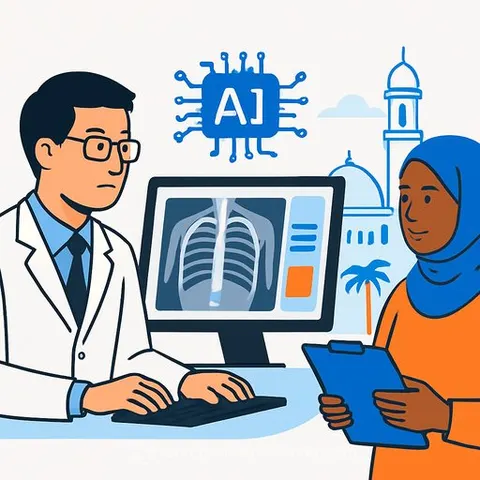
In a radiology room at Lumumba Regional Hospital in Tanzania's Zanzibar, a hybrid system combining artificial intelligence, remote specialist consultations, and local expertise is changing how doctors detect disease and make treatment decisions.
The approach connects radiologist Yuan Gang of the 35th Chinese medical team in Zanzibar with specialists at the First People's Hospital of Lianyungang in east China's Jiangsu Province. This allows local imaging to be analyzed through cloud-based AI and reviewed by Chinese specialists thousands of kilometers away.
Three-layer diagnostic approach
Local physician Haitham Hamudu said Zanzibar's healthcare system has long struggled with diagnosing complex diseases due to limited imaging expertise, heavy workloads, and a lack of advanced tools. "Imaging interpretation, often described as the 'eyes' of modern medicine, has been especially constrained," Haitham said.
To address this, the system uses a three-layer diagnostic model. Local doctors perform initial readings. AI assists with detection and classification. Chinese specialists then provide quality control through remote review.
"Technology is allowing us to overcome distance and resource gaps," Yuan said. "It is not just about solving one case, but about building a system that improves care for many patients."
Cases that show the impact
In one case, a young child in Zanzibar suffered from recurrent vomiting and lethargy. Yuan reviewed MRI scans and diagnosed hydrocephalus but could not identify the underlying cause. He initiated a remote consultation with neuroradiology experts in Lianyungang, who identified the hidden cause and provided treatment recommendations.
AI-powered mammography has also improved breast cancer detection. Many women have dense breast tissue, which makes conventional mammography less effective. The AI system now classifies lesions using the internationally recognized Breast Imaging Reporting and Data System and helps doctors assess malignancy risk. In one case, a 42-year-old woman with mild breast pain showed no abnormalities on routine examination, but AI detected two hidden nodules and accurately classified their risk, avoiding unnecessary procedures while ensuring follow-up.
AI-assisted lung imaging is similarly catching early pulmonary nodules that manual readings miss. A 56-year-old man with a chronic cough was initially diagnosed with inflammation. Yuan's review, backed by AI, identified four small nodules, including one with high-risk features, prompting closer monitoring and potentially stopping an early tumor from progressing.
Building local capacity
Yuan is training local doctors to use AI tools, standardized reporting systems, and structured diagnostic methods through hands-on sessions and case-based teaching.
Beyond radiology, the hospital and its partner in Lianyungang have established regular remote multidisciplinary team consultations that bring together neurosurgeons, oncologists, and other specialists to review complex cases together. "I have never seen this kind of consultation before," Haitham said. "So many experts working together, providing practical solutions. It is very inspiring."
Bao Zengtao, leader of the Chinese medical team, said these remote consultations improve patient care and also enhance the professional capacity of local healthcare workers.
Why this matters for healthcare professionals
This Zanzibar case shows a replicable template for resource-limited settings looking to adopt for AI for Healthcare. The three-layer model does not replace clinicians but works within existing workflows, combining low-cost local capacity with remote expert oversight. This offers a practical path forward for other systems where specialist shortages limit diagnostic speed and quality. The approach is scalable beyond this one hospital: Yuan said the ultimate goal is to build a sustainable model for expansion across Africa, ensuring more patients have access to accurate diagnosis and timely treatment.