
AI news ·
Columbia Law School updates AI policy with new restrictions on written work
Columbia Law School will ban student AI use for graded written work starting August 1, with faculty allowed to permit it in limited cases. The policy joins growing restrictions at other law schools, reflecting a broader shift in legal education.
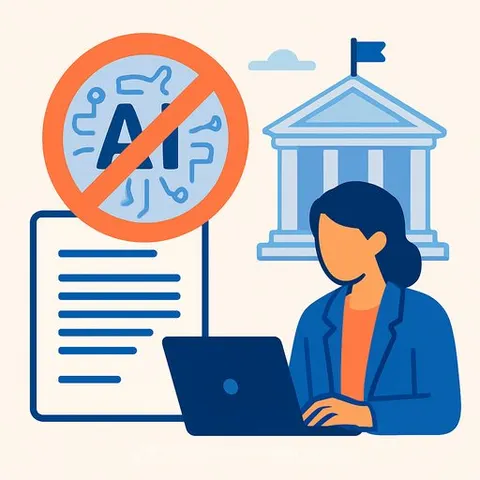
Columbia Law School has issued a new policy restricting student use of artificial intelligence for written exams, legal analysis, and developing arguments, effective August 1. The policy, which applies as the academic year begins, gives individual faculty members discretion to allow AI in some contexts but broadly prohibits it for graded written work.
The policy permits AI use to "support learning" and "perform specific functions," according to coverage from Law360 and Law.com. Faculty retain authority to decide where those boundaries fall in their courses.
This places Columbia among a growing list of law schools refining their rules three years after generative AI became widely available. The University of Chicago Law School adjusted its policy in July, banning phones and laptops in first-year courses and requiring in-class exams without internet access. In May, UC Berkeley School of Law banned AI for class assignments and exams.
Broader trend in legal education
Other schools have moved further. The University of Texas at Austin School of Law called in June for faculty to use Socratic-style questioning and to treat classroom time as "the sole context in which a professor can be certain that a student is learning without AI." Some professors are returning to handwritten finals and oral exams, the ABA Journal reported.
For legal professionals working in law firms or corporate legal departments, this means newly hired lawyers and summer associates have likely trained under AI-restricted policies. Law schools are adapting faster than many professional practices, and the incoming cohort of associates will have a different baseline understanding of AI for legal work than partners might expect.
Why this matters for legal professionals
If you supervise recent law school graduates, expect them to default to "no AI" for memo writing or brief drafting unless you specifically authorize it. The schools that banned generative AI most aggressively have trained a generation of lawyers to see AI as an academic integrity risk, not a workflow tool to that. Legal employers need to rewrite those assumptions if they want to get value from AI tools.