
AI news ·
Coursera to Acquire Udemy in $2.5B All-Stock Deal, Targeting AI Workforce Training
Coursera is acquiring Udemy in an all-stock deal, creating a $2.5B AI-focused learning company. Udemy holders get 0.8 Coursera shares per share, valuing Udemy at about $930M.
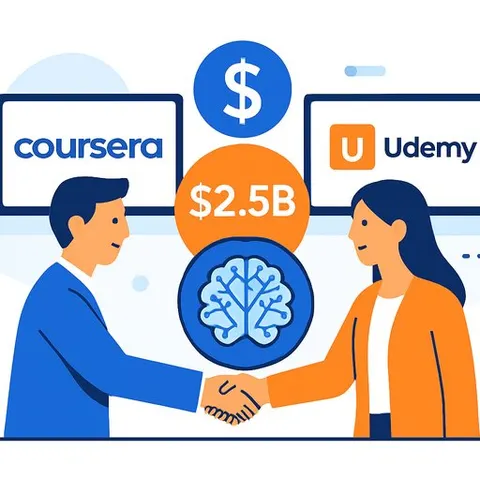
Coursera to acquire Udemy in all-stock deal, creating a $2.5B AI learning company
Coursera and Udemy are combining in an all-stock deal to build a $2.5 billion platform centered on AI and workforce training. Udemy shareholders will receive 0.8 Coursera shares per Udemy share, valuing Udemy at roughly $930 million.
The move follows a post-pandemic slowdown in consumer enrollments and a push to land more enterprise contracts. The merged company will lean into AI, data science, and software training as employers re-skill teams for generative AI.
Why this matters if you work in education
- Consolidated catalogs: Expect broader program bundles spanning university-backed credentials (Coursera) and practitioner-led courses (Udemy). This could simplify vendor lists-and raise overlap questions.
- Enterprise-first shift: More focus on role-based learning paths, team analytics, and LMS integrations. Procurement conversations may center on outcomes, labs, and certifications tied to job roles.
- Content mix and quality: University partners bring structure and assessment, while marketplace instructors move fast with practical skills. You'll likely see faster AI course refresh cycles, but with varied depth.
- AI skills at the center: Data, LLM fundamentals, prompt workflows, AI safety, and automation will anchor catalogs. Hands-on labs and code work will be a differentiator.
- Pricing and licensing: Watch for changes to enterprise seat models, team tiers, and credential pricing as the catalogs merge.
Deal details at a glance
- All-stock merger; Udemy holders get 0.8 Coursera shares per Udemy share.
- Implied Udemy valuation: about $930M; combined value: about $2.5B.
- Expected close: second half of next year, pending regulatory and shareholder approvals.
- Stock performance this year: Udemy down 35%, Coursera down 7%, amid competition and investor caution on AI bets.
Risks and watch-outs
- Catalog overlap: Redundant courses could confuse learners. Standardize on one path per role.
- Instructor economics: Marketplace payout shifts can impact course updates and availability.
- Assessment rigor: Ensure skills verification (projects, labs, proctoring) meets your policy and accreditation needs.
- Data and privacy: Confirm data residency, LTI settings, and how learner data interacts with AI features.
- Certification clarity: Map microcredentials to internal career ladders to avoid "badge sprawl."
Practical next steps for L&D and academic teams
- Audit AI and data skill gaps by role (product, ops, engineering, support) and set quarterly targets.
- Shortlist 2-3 learning paths per role that combine foundations, hands-on labs, and a capstone project.
- For an example of a role-based curriculum for L&D leaders, see AI Learning Path for Training & Development Managers.
- Ask account reps about migration plans, catalog unification, and guaranteed update cadences for AI content.
- Run a pilot: 50-100 learners, 4-6 weeks, measured on skill assessments and project delivery-not hours watched.
- Lock in SSO/LMS integration and reporting early to avoid rework post-merger.
- Budget for credentialing where it's tied to roles (e.g., data analysts, ML engineers, AI product managers).
For official updates and FAQs, check company pages at Coursera and Udemy.