
AI news ·
D&&AD report warns AI cuts junior jobs that build creative judgement
D&AD's 2026 report, based on 197 interviews, warns AI is erasing junior creative roles. AI-declaring award entries doubled to 27.6%, yet winners used it less, signaling judgement, not tools, sets great work apart.
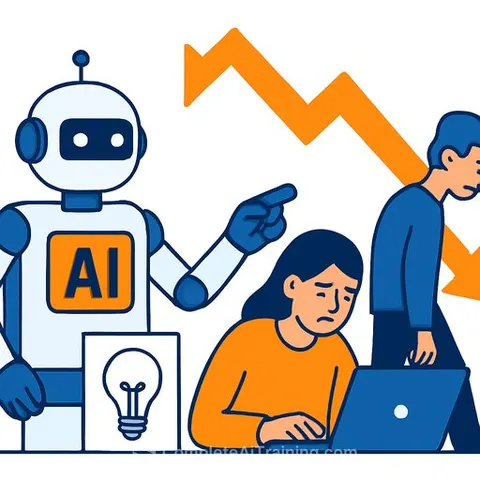
D&AD's 2026 AI & Creativity Report, published August 18, draws on 197 conversations with creative leaders across 30 countries and an analysis of more than 10,000 D&AD Award entries to examine how AI is reshaping creative work. The report's central warning: the industry may be eliminating the entry-level roles through which young creatives traditionally built the judgement that separates great work from competent work.
The proportion of D&AD Award entries declaring AI use more than doubled year-on-year to 27.6 per cent in 2026. Generative AI accounted for 56.2 per cent of AI-declaring entries overall, compared with 44.7 per cent among AI-declaring Pencil winners.
The distinction matters. AI use is rising, but winning work is not necessarily the work that uses the most AI. D&AD argues that AI can raise the baseline quality of output, making it easier to produce technically polished work. Whether an idea is culturally relevant, emotionally resonant or genuinely distinctive still depends on human judgement.
AI raises the floor, judgement sets the ceiling
AI can produce work that is competent, plausible and indistinguishable from everything else. The risk, the report argues, is not that brands will produce obviously bad work - it's that they will produce generic work that looks fine.
David Patton, CEO of D&AD, said: "AI has changed what bad work looks like. It's no longer lazy or derivative in any obvious way - it's competent, polished, and generic, and it's the default output for anyone, anywhere. The real problem sits one step earlier: how do you train someone to tell competent from excellent, when competent is now the easy default everywhere they look?"
That question sits at the heart of the report's concerns about talent development. Creative careers have traditionally been built through repetition: junior creatives work on smaller tasks, observe senior practitioners, receive feedback, make mistakes and gradually develop instincts. AI can now handle many of those repetitive tasks, and agencies are reducing entry-level roles at the same time.
The junior talent pipeline is shrinking
D&AD describes this as a shrinking training ground for the next generation. The industry wants senior creatives with exceptional judgement while removing the environments in which that judgement is learned.
The report argues the solution is not simply to preserve junior jobs in their existing form. Entry-level roles need to be redesigned around skills AI cannot easily replicate - critique, taste, cultural awareness, collaboration and creative decision-making. For professionals working in creative roles, this points to a shift in how junior positions are structured, with more emphasis on evaluation and less on production.
The report also examines how AI can strengthen creative work when it serves an idea rather than becoming the idea. It cites projects including 'Caption with Intention' and 'PainVisible', where AI was used to improve inclusivity and precision at scale. The takeaway: AI's greatest value may come when audiences notice the impact, not the technology behind it.
Six choices for creative organisations
D&AD frames its findings around six "reckonings" for creative organisations. On originality, the report argues that AI naturally gravitates towards the average when left unchecked, and distinctive work emerges when specialist tools are combined with human judgement. On talent, organisations face a choice between using AI to remove learning opportunities or redesigning junior roles around critique and cultural understanding. On leadership, creative excellence cannot be delegated to AI - organisations gaining ground are those where leaders actively decide how the technology is adopted and governed.
The report is not positioned as an argument against AI. It is a warning about treating efficiency as progress. AI can help creative organisations produce more, faster. But exceptional work depends on knowing which idea deserves to survive - and that instinct is built through experience, exposure, critique and practice.
Why this matters for creatives
The report's core challenge for working creatives is about career development, not job replacement. If AI absorbs the repetitive tasks that once trained junior talent, and agencies cut entry-level hiring, the industry could face a shortage of people capable of making nuanced creative decisions. For creatives at any level, the practical takeaway is to build and demonstrate the judgement skills AI can't replicate - critique, taste and cultural awareness - and to seek out roles and projects where those skills are part of the job description. The tools for AI for Creatives will keep improving; the ability to decide what's worth making will remain the differentiator. The same applies to generative art workflows - the technology is only as good as the judgement applied to it.