
AI news ·
Daft Punk's Thomas Bangalter says AI lacks the unpredictability of human creativity
Ex-Daft Punk member Thomas Bangalter says he won't use AI in his art because the technology relies on text prompts that bypass his non-verbal creative process.
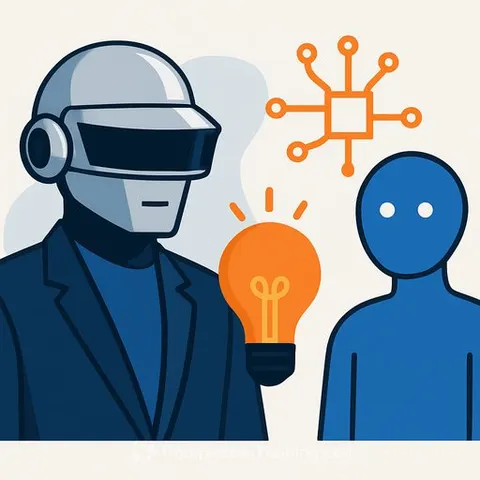
Thomas Bangalter, one half of Daft Punk, says he will not use artificial intelligence in his creative work because the technology's reliance on text prompts conflicts with how he makes art.
The musician and producer, who spent decades performing anonymously as part of the Grammy-winning electronic duo, told Chanel's magazine that his creative process happens at a level that "does not express itself through words."
"That's probably why I'm not really interested in the creative usage of artificial intelligence for many reasons," Bangalter said. "But the main one probably is because it goes through a verbal expression, which is prompting, and I feel really the most interesting part of the creative process is happening not at all on an intellectual level or on an expressive level, where you're actually going through a process which is about understanding your feelings."
Why prompting falls short
Bangalter's critique centers on the mechanic of how most generative AI tools work. Users type a text prompt, the model produces an output. For Bangalter, that word-based interface bypasses the messy, intuitive work that produces interesting art.
The interview took place in a discussion about architecture, but Bangalter made clear his argument applies across creative disciplines. Prompt Engineering - the practice of refining text inputs to get better AI results - is the opposite of how he works. He sees value in the non-verbal struggle of making something not fully understood.
Unpredictability as a feature
Bangalter said human creativity depends on unpredictability, and that quality cannot be programmed safely into machines.
"Unpredictability, I feel. I feel that unpredictability is what will save this society because everything that happens are surprises," he said. "Everything that happened in history is through an impulse of collective derailment from society."
"It cannot happen from the machine because if you have unpredictability from artificial intelligence, then this is very dangerous," Bangalter added. "We need to surprise ourselves and to be more and more unpredictable, and we can't have technology do that for us."
Why this matters for creatives
This is not a Luddite argument. Bangalter, who has collaborated with film director Alfonso Cuarón and producer Rampa since Daft Punk ended, agrees that AI can produce unexpected outputs. He sees that as a safety problem for the machine's operator, not a creative opportunity.
For creatives weighing whether to adopt generative tools, his point is practical: if the value of your work stems from solving problems you can't yet articulate, a tool that requires text-level clarity at the start may miss your process. The AI for Creatives course explores how to identify situations like this where automation helps and others where it undermines the work itself.