
AI news ·
Data lineage helps government agencies build trustworthy AI systems
State and local agencies are adopting AI, but data lineage-tracking data from origin through every transformation-is critical to ensuring trustworthy outputs. Officials say tracing data can cut audit investigation time from weeks to seconds.
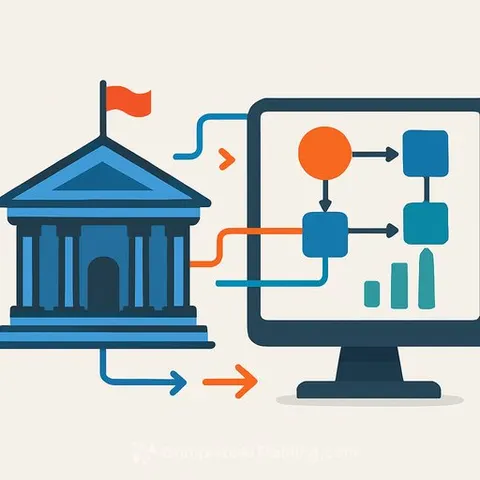
State and local agencies are integrating artificial intelligence into daily operations, from document management to decision support. But as these systems rely on more data, officials face a harder question: where did that data come from, and can it be trusted? Data lineage - the practice of tracking data from its origin through every transformation - is emerging as a critical piece of trustworthy government AI.
Data lineage provides a detailed record of where data originated, how it moved across systems, and every transformation it underwent before reaching an AI model or dashboard. That visibility matters as agencies blend data from legacy applications, cloud platforms, financial systems, public safety databases, and geographic information systems.
"Think of data lineage as the complete history of a piece of data," said Jennifer Chronis, vice president of U.S. Public Sector Sales at Snowflake. "It shows where the data originated, how it has moved across different systems and how it has been transformed over time. Ultimately, it answers two simple questions: Where did this data come from, and how did it get here?"
Lineage vs. governance: What's the difference?
Data lineage is often discussed alongside data governance, but the two serve different functions. Governance sets the policies, roles, and controls for how an agency manages data - who owns it, who can access it, how it's protected. Lineage documents whether those rules were actually followed.
"If data governance establishes the laws and guidelines for your agency's information, data lineage provides the objective, step-by-step trail that proves those rules are actually being followed," Chronis said.
That distinction becomes useful when investigating data quality issues or validating that sensitive data was handled properly before entering analytics or AI applications.
Why AI makes data lineage a requirement
Generative AI and machine learning models often pull from many data sources. Without lineage, agencies may know what data they have but cannot explain how an AI recommendation was produced. That makes it difficult to defend AI-generated outputs in front of auditors, oversight bodies, or the public.
"Government AI is only as trustworthy as the data behind it," Chronis said. "If you cannot trace where that data came from or how it changed before it reached your model, you cannot stand behind what the model tells you."
Data lineage addresses that by documenting each stage of a data set's journey. It also supports explainable AI by showing what information influenced a model's output. And as agencies adopt retrieval-augmented generation and other techniques that combine foundation models with government data, knowing the provenance of the information becomes more critical. AI for Government training increasingly covers these data accountability concepts.
Lineage helps agencies catch outdated, incomplete, or improperly transformed data before it affects AI outputs, which reduces risk and improves reliability.
Compliance and auditability benefits
Government organizations operate under heavy oversight: cybersecurity reviews, financial audits, public records requests, and emerging AI governance policies. These responsibilities often require proof of how information was collected and transformed.
Data lineage maintains a continuous record of data movement across systems. That can reduce investigation time from weeks to seconds when a discrepancy surfaces or an auditor asks for verification.
"Public sector teams operate under strict regulatory mandates, AI action plans and reporting requirements that demand total transparency," Chronis said. "Data lineage provides an automated, verifiable record of every data point's lifecycle, from origin to destination."
Chronis added: "When an auditor or compliance officer needs to verify a report, the agency can trace the underlying numbers back to their exact source in seconds. That can eliminate weeks of manual tracking."
Getting started with data lineage
Agencies should not attempt to document every system at once. The practical route is to select one high-priority AI project and build lineage there before scaling across additional workloads.
"My recommendation is to start with a single high-priority AI project," Chronis said. "Apply clear data ownership and let automated tracking follow data from initial ingestion to model deployment."
Chronis warns against stitching together disconnected tools that capture only parts of the data lifecycle. "Agencies that try to track lineage by stitching together separate, siloed tools end up with gaps the moment data crosses a boundary. The more reliable path is a unified platform that supports open standards and tracks data automatically as it moves through the pipeline." That's a skill set prized by AI for Data Analysts who manage data pipelines behind public sector AI.
"Once that project demonstrates the approach, the same practice can extend to additional workloads without rebuilding from scratch," Chronis said. "Done well, this is what lets an agency move AI from pilot into production with confidence. Every insight can be traced back to its source so leaders can trust the outputs and make consequential decisions using data they know is sound."
The takeaway for government professionals
Data lineage is not a nice-to-have technical feature - it is what allows an agency to stand behind its AI. If you work with AI systems in the public sector, the first question to ask about any data pipeline is whether you can trace a single output back to its source data.
If the answer is no, start with the highest-stakes project, build a clear ownership model, and track lineage from ingestion to output. Those who do will move AI projects from pilot to production with confidence - and be prepared to defend every result in front of auditors and the public.