
AI news ·
Dentsu becomes first global ad group to sign EU AI transparency code
Dentsu became the first global ad holding company to sign the EU's AI transparency code, covering labeling and detection of AI-generated content. The voluntary code supports compliance with the EU AI Act's transparency rules, which took effect August 2, 2026.
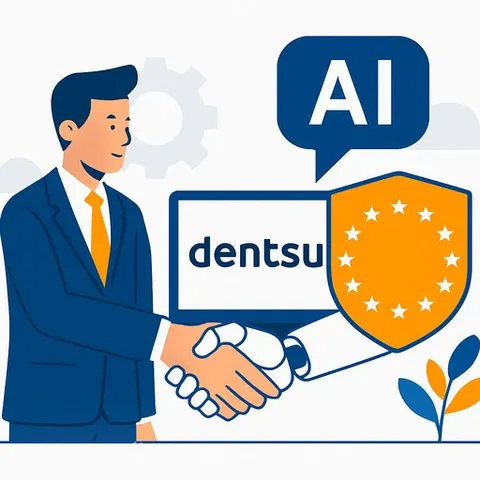
Dentsu has become the first global marketing and advertising holding company to sign the European Union's Code of Practice on Transparency of AI Generated Content. The voluntary code supports compliance with the transparency requirements of the EU AI Act, which took effect on 2 August 2026, and commits the company to recognized standards for labeling and detecting AI-generated content.
The move follows dentsu's 2025 signing of the European Commission's EU AI Pact, also a first for a global marketing and advertising holding company. Together, the two commitments position dentsu alongside organizations including Microsoft, Google, OpenAI, and Anthropic in backing formal standards for AI transparency.
What the code requires
The EU Code of Practice on Transparency of AI Generated Content is the only accredited standard for demonstrating compliance with Article 50 of the EU AI Act. For marketers, the stakes are direct: AI can now produce images, video, and text that are increasingly difficult to distinguish from authentic content, and the content agencies create shapes how people engage with brands.
Dentsu will implement measures in collaboration with clients and partners to clearly label certain AI-generated or AI-manipulated content in client work. That includes building operational workflows, technical capabilities, and employee training designed to embed transparency into how content is produced and managed - rather than treating it as a standalone compliance exercise.
For marketing professionals, the practical implications are worth tracking. The code provides a framework for labeling AI-generated content that goes beyond internal policy, and dentsu's signatory status means its client work will follow those standards. That shift is relevant for anyone in the field as brands face growing pressure to disclose how AI is used in their campaigns. Understanding the mechanics of AI transparency is becoming a core part of AI for Marketing work, not a niche concern.
Why dentsu is making this move
Will Swayne, Global Practice President, Media and Integrated Solutions at dentsu, said the decision is about trust, not just rules.
"AI is creating extraordinary new opportunities for brands, but real value can only be realised when it is built on trust," Swayne said. "By signing the EU Code of Practice on Transparency of AI Generated Content, we are helping clients navigate a rapidly evolving landscape with greater confidence, providing clear frameworks, governance and transparency around how AI generated content is created and used. This is about moving beyond compliance to enable responsible innovation at scale, helping clients unlock the benefits of AI while maintaining the trust of the people they serve."
The announcement builds on dentsu's broader AI for Growth strategy, which the company describes as driving opportunity beyond simple optimization. Dentsu says it will continue working with regulators, technology partners, clients, and industry peers to support consistent approaches to transparency and contribute to practical industry standards.
Why this matters for marketers
For marketing teams, the practical takeaway is that AI transparency is moving from a talking point to a working requirement. When a major holding company commits to labeling AI-generated content in client work, it sets a precedent that other agencies and in-house teams will likely follow - especially those operating in or with the EU.
That means marketers should expect to answer questions about how their content is made, and to build the workflows and skills to support disclosure. For those looking to stay ahead of that shift, structured training on responsible AI adoption can help - a AI for Marketing Managers learning path is one practical starting point for building the governance and technical knowledge this new standard demands.