
AI news ·
DGIST and GIST achieve multi-site brain stimulation using AI-designed ultrasound lens
South Korean researchers built an AI lens for non-invasive brain stimulation using 1 ultrasound transducer. The 3D-printed device reduced neuropathic pain in rats.
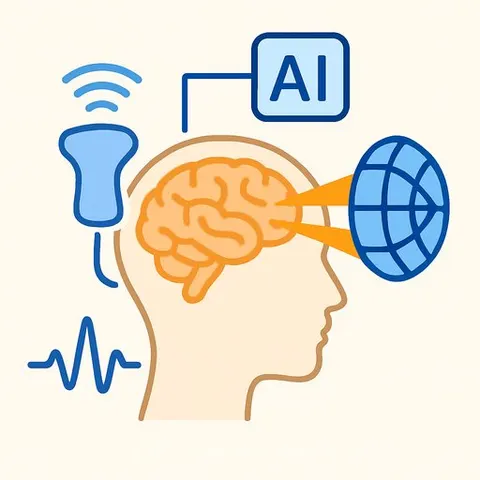
Researchers from South Korea have developed an AI-designed lens that enables precise, non-invasive brain stimulation using a single ultrasound transducer. The technology, published in the journal Brain Stimulation, successfully reduced neural activity linked to neuropathic pain in rats and performed accurately in human skull simulations. For clinicians, the advance points toward patient-tailored therapies that could treat neurological and psychiatric disorders without surgery or incisions.
How the technology overcomes skull distortion
Conventional ultrasound brain stimulation struggles with the skull's irregular shape, which distorts the ultrasound focus and delivers uneven energy to target areas. Existing solutions require multichannel systems with many transducers, making them complex and expensive. The new approach, called TOAH (thickness-optimized acoustic hologram), uses a single 3D-printed lens and one transducer.
The research team combined artificial intelligence with physics-based optimization to directly design the lens's three-dimensional thickness profile. AI calculates how to shape the ultrasound waves so they pass through the skull and converge on multiple brain regions simultaneously. This AI for Healthcare method eliminates the need for costly hardware, relying instead on a lens that can be fabricated with a standard 3D printer.
Animal testing and human skull simulations
Experiments using rat skulls showed that TOAH formed ultrasound focal patterns far more accurately than conventional methods, while delivering uniform energy to multiple targets. The technology also reduced skull heating by cutting unnecessary energy concentration in the bone. In rats with neuropathic pain, simultaneous stimulation of the bilateral thalamic regions decreased excessive neural activity and markedly improved pain responses.
Simulations with human skull data confirmed similar gains in focal accuracy and energy balance across multiple brain regions. The study, published in the July 2026 issue of Brain Stimulation, marks a step forward in AI for Science & Research applied to neuromodulation. The work was supported by South Korea's Ministry of Science and ICT and the National Research Foundation of Korea.
Toward non-invasive neuromodulation
"The key is that AI directly designs the structure of the lens, enabling ultrasound to be delivered accurately to multiple brain regions through the skull," said Prof. Jae Youn Hwang of DGIST's Department of Electrical Engineering and Computer Science. "By enabling precise multi-site brain stimulation using only a single ultrasound transducer and a 3D-printed lens, this technology could be expanded into a patient-tailored, non-invasive therapeutic platform that safely delivers energy without surgery or incisions for the treatment of not only pain but also neurodegenerative brain disorders as well as neurological and psychiatric disorders."
Why this matters for healthcare professionals
For clinicians and researchers in neurology, psychiatry, and pain management, the TOAH platform offers a glimpse of a future where non-invasive brain stimulation is as simple as placing a lens against the scalp. The ability to target multiple brain areas with a single, inexpensive device could lower the barrier to adoption in outpatient settings and open new avenues for treating conditions like chronic pain, Parkinson's disease, depression, and other disorders that currently rely on more invasive or systemic interventions. The demonstrated reduction in skull heating also addresses a key safety concern for transcranial ultrasound.