
AI news ·
Embracing AI While Staying Human: How Leaders Can Balance Innovation With Purpose and Values
As AI advances, leaders must keep human values central, using technology to support critical thinking and empathy. Balancing AI insights with genuine connection fosters resilience and creativity.
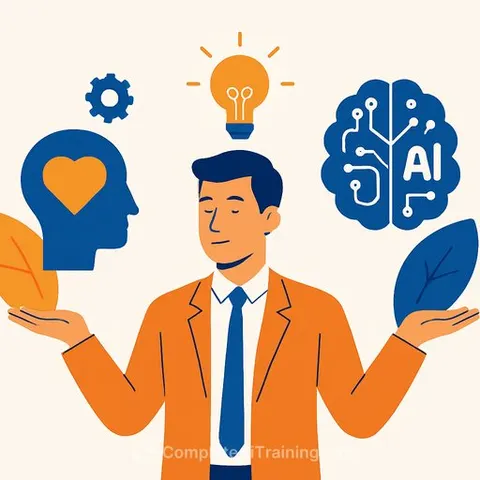
How to Embrace AI Without Losing Ourselves
As artificial intelligence (AI) advances, it’s crucial for leaders and organisations to keep human values front and center. Technology should serve as a tool to enhance the distinct human traits of critical thinking, empathy, and moral judgement—not replace them.
Startup founders stress that while AI can speed up processes and provide vast knowledge, it cannot substitute human discernment or accountability. Leaders should treat AI as a compass, guiding decisions but relying on humans to steer through complex situations and adjust strategies for innovation.
Successfully integrating AI in the workplace means balancing data-driven insights with genuine human connection. Coaching, mentorship, and relationship-building remain essential for employee engagement, retention, and resilience, especially as teams become more diverse and technology-driven.
The future belongs to organisations that embrace both technological and human diversity, foster purpose-driven cultures, and encourage continuous learning. Aligning personal and organisational values can inspire creativity, well-being, and adaptability as AI reshapes how we work and lead.
Power & Purpose | Innovation & AI
AI is becoming part of everyday life—from generative AI tools at work to smart home devices that personalise customer experiences. The question is: how can we adopt AI without losing what makes us human?
Technology moves fast. New AI models and features seem to appear weekly, often feeling like science fiction come to life. This moment is an opportunity to draw on our humanity to drive innovation and use technology to become more human.
Three startup founders share their views:
- Arvin Tang, CEO of Akin by Techlyon, a digital agency focused on client growth and social impact.
- Dorothy Yiu, CEO of EngageRocket, a platform that improves employee engagement and workplace culture.
- Calvin Cheng, CEO of Wizpresso, offering AI-powered market intelligence and compliance tools.
Human Judgment Versus Technology
Yiu points out a simple truth: “AI is here to stay; you either adapt or don’t survive.” Companies must adopt AI at a pace that fits their employees and competition. Understanding AI’s capabilities and limits helps organisations empower their teams effectively.
Cheng highlights a key limitation: “AI doesn’t have a moral compass. It’s a prediction model, guessing the next word. It doesn’t understand right or wrong.” That’s why human judgement remains vital for decision-making and accountability.
Tang describes AI as a compass, not the navigator. Humans still plan the course and make the complex calls, using AI as a tool to guide them.
Being More Human at Work
Yiu and Tang emphasize coaching as a way to deepen human connection. While AI can track performance metrics and generate reports, spending real time with employees uncovers insights data alone can’t provide.
Yiu shares, “It’s about conversations like, ‘What’s your ambition? Where do you want to be in a year or two? How can we help you succeed?’” Strong human relationships drive retention—people don’t leave bad companies, they leave bad bosses.
Data can inform how to better connect and support teams. AI can improve leadership by providing insights that help tailor management approaches.
Cheng suggests using AI to enhance knowledge and skills. Though generative AI sometimes provides inaccurate info (hallucinations), improving models offer vast research capabilities that can boost learning and performance.
Tang adds that being human means engaging critical thinking—both conscious and unconscious processes that shape ideas. Combining this with AI’s different thinking patterns can increase the quality and speed of work.
With AI handling more tasks, leaders and teams will likely do less manual work but continue deep thinking. Tang sees this as a chance to focus on well-being and innovation. He encourages his team to use AI tools to learn new skills and connect those skills to performance.
Leading with Purpose
Leading with a clear mission and purpose is key. Tang realigned his company’s vision to match both organisational and personal values, keeping the team motivated and preventing burnout.
Yiu agrees, noting that engaged employees are more resilient, creative, and willing to go the extra mile during uncertain times. With five generations now in the workforce and AI entering the mix, leadership must adapt to diverse needs.
By understanding technology, fostering genuine human interactions, and leading with purpose, organisations can harness the opportunities AI brings while preserving what makes work meaningful.
For those looking to develop AI skills in a practical way, exploring specialised courses can help you stay ahead. Check out Complete AI Training’s latest courses to build knowledge that complements human strengths.