
AI news ·
ESI PEO expands employer resource initiative as AI reshapes how businesses compare PEO companies
ESI PEO expands its employer education initiative as AI reshapes HR outsourcing, with 20% of U.S. wage employment now at least 50% automated at the task level. The PEO industry already supports 230,000 businesses and 4.5 million jobs, while clients see 50% lower business failure rates.
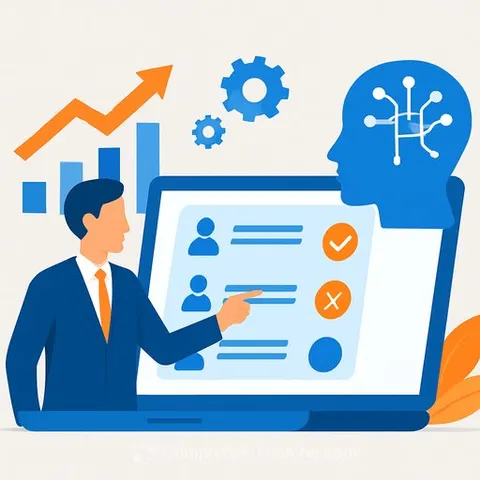
ESI PEO is expanding a national employer education initiative to help businesses compare professional employer organizations, HR outsourcing models, and workforce-management options as artificial intelligence reshapes the economics of administrative work. The expansion, announced September 9, 2026, responds to rising healthcare costs, leaner administrative teams, and a fundamental shift in how employers decide what combination of people, AI, HR technology, and outsourced expertise can manage their workforce most efficiently.
"Businesses are being asked to accomplish more with every employee and every dollar they invest," ESI President Corey Hookstra said. "AI and automation are going to continue changing how administrative work gets done, but businesses still need expertise, judgment, compliance support and people they can trust. Our goal is to combine technology with a flexible service model so companies can build the employment infrastructure that makes sense for their organization instead of being forced into a one-size-fits-all approach."
AI changes the HR outsourcing calculation
SHRM research released in 2026 estimated that 20% of U.S. wage and salary employment is at least 50% automated at the task level, while 21% involves work that is at least 50% performed using AI tools. For most employers, the immediate implication is not eliminating entire jobs but redesigning administrative work. Payroll processing, employee onboarding, benefits administration, employment documentation, reporting, and routine HR workflows contain repetitive activities that automation and modern HCM technology can increasingly support.
This creates a new version of the traditional in-house HR versus outsourcing decision. Businesses can ask which HR activities should remain internal, which administrative tasks can be automated, and which functions a PEO or HR outsourcing provider can handle more efficiently. For small and midsize businesses, those questions can materially change the economics of building an internal HR department. The rise of AI for Human Resources means the decision is no longer just about headcount - it is about infrastructure design.
More employers are evaluating PEO services
The U.S. PEO industry already supports approximately 230,000 businesses and more than 4.5 million jobs, according to the National Association of Professional Employer Organizations. Roughly 14% of employers with 20 to 499 employees use a PEO. NAPEO's 2026 business survey found that 76% of business decision-makers identified economic uncertainty as a major challenge, while 68% cited healthcare costs, 67% cited hiring, and 62% identified employee retention.
Businesses are already outsourcing many employment functions. The survey found 61% outsource health insurance functions, 56% outsource payroll, and 50% outsource retirement benefits. A PEO can potentially consolidate several of those responsibilities into a broader relationship incorporating payroll administration, HR support, employee benefits, workers' compensation, risk management, compliance assistance, and HR technology. Industry research commissioned by NAPEO has also reported that PEO clients grow approximately twice as fast, experience about 12% lower employee turnover, and have a 50% lower likelihood of going out of business than comparable non-PEO companies.
How businesses should compare PEO companies
ESI's expanded resources emphasize comparison over universal rankings. An employer evaluating an ADP TotalSource alternative may be looking for a different service model, greater customization, or a PEO better aligned with its size. A company searching for Paychex PEO alternatives may be reconsidering payroll, HR support, or benefits after reaching a new stage of growth. Technology-oriented employers investigating Justworks alternatives, Rippling PEO alternatives, or Deel PEO alternatives may put greater emphasis on automation, integrations, and digital onboarding.
The underlying comparison should extend beyond brand and headline price. Employers can evaluate total PEO cost and pricing structure, payroll administration and reporting, HR expertise and service model, employee benefits and benefits administration, workers' compensation and risk management, employment compliance support, HCM and HR technology, AI and workflow automation capabilities, implementation and payroll conversion, customization and responsiveness, multi-state capabilities, industry experience, and employee experience. The lowest advertised price may not represent the lowest total operating cost if a solution creates additional administrative work, technology limitations, or service issues.
Company size and industry change the equation
Company size is one reason a universal "best PEO" ranking can be misleading. Industry research indicates half of PEO clients have 10 to 49 employees and another 35% have fewer than 10 employees. But the requirements of a 10-person business differ dramatically from those of an employer with 100 or 300 workers. Businesses with fewer than 10 employees may use a PEO for access to HR expertise and benefits infrastructure that is difficult to build internally. Companies with 50 to 99 employees face a different challenge: HR is no longer incidental, but maintaining separate specialists for payroll, benefits, compliance, and HR may still be inefficient.
Industry can matter as much as employee count. A PEO for construction companies may need to support workers' compensation, workplace safety, and mobile workforces. A PEO for healthcare companies may require stronger capabilities involving recruiting, employee retention, and workforce compliance. Technology companies and startups frequently place greater emphasis on HR automation, digital onboarding, HCM integrations, and scaling without proportionally increasing administrative headcount. ESI's employer resources address PEO selection by both company size and industry, rather than treating "best PEO company" as a single category.
Why this matters for HR professionals
For HR leaders, the PEO decision is shifting from a vendor-selection exercise to an operating-model decision. AI and automation reduce repetitive administrative work, but employment decisions involving compliance, employee relations, benefits strategy, and risk still require professional judgment. The question becomes which combination of internal HR staff, AI tools, HCM technology, and outsourced expertise produces the most effective employment infrastructure for the organization's current size and needs. HR professionals who treat PEO evaluation as a strategic design problem - not just a cost comparison - will be better positioned to build the right model as their companies grow. For those building those skills, an AI Learning Path for HR Managers can provide structured guidance on integrating AI into HR operations.