
AI news ·
FBI seeks AI that predicts threats across government databases for its watchlist center
The FBI wants AI to find correlations across federal databases and produce predictive models for its watchlist screening center, which already holds roughly 1.1 million names. The bureau hasn't disclosed testing or redress rules for how algorithmic leads could affect who faces scrutiny.
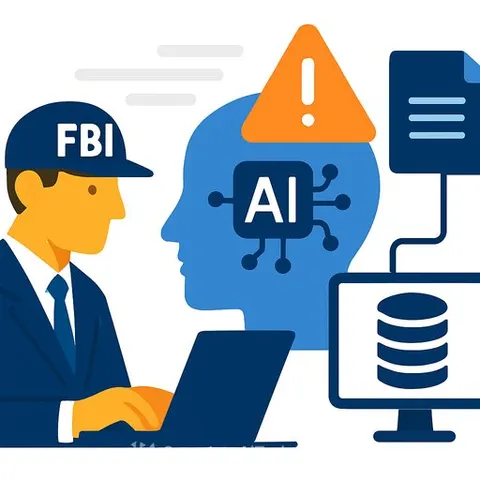
The FBI is seeking artificial intelligence capable of finding patterns across federal databases and producing predictive models for its Threat Screening Center, the office that maintains the government's consolidated terrorism watchlist. The March 27 request for information, posted to SAM.gov, asks companies to describe available technology - it does not mean a system has been purchased or deployed - but the specifications reveal capabilities the bureau wants to develop that could influence who receives scrutiny during travel, surveillance, and police encounters.
The proposed system would create an AI-enabled knowledge base that searches databases held across different government systems. It would summarize records, connect identifiers, answer questions in ordinary language, and retain citations showing where information originated. The most consequential requirement is "predictive modeling that correlates data and new data with preexisting data having traceable lineage." When new information enters the system, the technology would compare it with existing records, identify similarities and correlations, and predict where investigators might find additional relevant information.
That language does not say an algorithm could independently declare someone a terrorist or place a person on the watchlist. It describes a tool intended to help analysts find connections and direct additional searches. Those recommendations could still influence decisions, however, particularly if investigators treat an algorithmic correlation as evidence of dangerousness. For analysts working with tools rooted in AI Data Analysis Courses, the distinction between investigative lead and substantive evidence is a line the procurement request leaves largely unaddressed.
A watchlist with broad reach
The Threat Screening Center, originally named the Terrorist Screening Center, was created after the Sept. 11 attacks when the government consolidated several terrorism databases into one watchlist. It shares information with federal agencies and state, local, tribal, and international law enforcement. Officers can encounter watchlist alerts during traffic stops and contact the center for additional instructions without informing the person that a possible match occurred.
The procurement request says the center supports Homeland Security Presidential Directive 6, which created the consolidated terrorism watchlist, and NSPM-7, a 2017 directive expanding the sharing of identifying information about suspected threats. The Trump administration issued another memorandum numbered NSPM-7 in 2025, directing agencies to map domestic terrorism and organized political violence associated with anti-capitalism, anti-Christianity, and positions involving migration, race, and gender. The procurement request does not identify the year of the NSPM-7 it cites, nor does it reference the ideological categories in the 2025 memorandum.
While the procurement document does not explicitly say the proposed AI would examine people according to political beliefs, the combination of predictive technology, watchlists, and broadly described ideological threats creates a clear civil liberties concern. An automated search for relationships can turn lawful donations, communications, associations, or social media activity into evidence that needs further investigation.
How this differs from earlier predictive policing
Traditional predictive-policing programs attempt to forecast locations or individuals associated with ordinary street crime. Place-based programs process previous crime reports and direct patrols toward areas where another offense supposedly has a higher probability of occurring. Person-based systems use data about arrests, victimization, and social connections to rank people according to their estimated likelihood of becoming involved in violence. An examination of 23,631 forecasts made by Geolitica, formerly PredPol, for Plainfield, N.J., found that fewer than 100 matched a reported crime of the same type in the same place and time - a success rate of less than one-half of 1%.
The FBI is not asking for software that will predict where the next crime will occur. It wants a system that searches separate government databases, connects records involving the same people or associates, and directs analysts toward additional information. Since agencies use watchlist information during airport screenings, border checks, and police encounters, an AI-generated lead could add a person to multiple areas of contact. Technology that summarizes records and answers questions in plain language draws on capabilities covered in Generative AI and LLM Courses, though the stakes here extend well beyond typical enterprise use cases.
The feedback loop problem
Predictive systems inherit weaknesses from the records they rely on. Police databases contain mistaken identities, incomplete reports, outdated or contradictory information, and data that reflects past enforcement actions. The same problem applies to watchlisting. If a database already contains incorrect overviews of particular communities, an AI system may infer that those communities and their associations generate more risk. Its guidance can generate additional investigations and data, confirming the same conclusion.
The Privacy and Civil Liberties Oversight Board reported in 2025 that the list contained approximately 1.1 million people, including fewer than 6,000 U.S. persons. The board said erroneous placement can be difficult to contest because individuals typically cannot access the tips or the underlying claims used against them. A separate Government Accountability Office review examined 289 watchlist-related redress inquiries filed by U.S. persons between December 2021 and September 2023. Twenty-one involved people misplaced on the watchlist, 88 resulted in removal from the list, and nine resulted in placement on a less restricted subset. GAO made 24 recommendations to improve nominations, data quality, evaluation, and response times.
A January 2026 GAO report stated that authorities use watchlist information to screen during national borders, strategic, and meaningful events. GAO found that the FBI had not ensured that state and local users understood watchlist policies or received adequate training. Adding AI-generated correlations would introduce another source of information into a system that federal oversight agencies have already warned the government to make more accurate, transparent, and consistent.
Prediction without public rules
The most consequential part of this request is not faster database search. It is the decision to introduce prediction into watchlisting. Source citations and traceable data lineage may show where information originated, but they cannot establish that the information is true or that an algorithmic connection is meaningful. A system can document every step and still produce a false positive.
The FBI has not said what data the system could examine, what its models would predict, or whether their output could affect watchlist nominations. It has not disclosed how the system would be tested for false matches or what rules would review automated recommendations. It has not said whether a person would ever be able to contest evidence that an automated suggestion contributed to additional scrutiny. Those omissions are serious in a watchlisting system that federal reviews have already described as involving misidentifications, outdated records, and limited opportunities for amendment.
Nothing currently exists to show that an algorithm will independently add names to the watchlist. A more plausible scenario is AI ranking and alerting while a human analyst formally approves every action. The danger is not that the computer replaces the watchlist analyst. It is that prediction begins to function as evidence while the rules remain hidden - even from the public they might be applied to.
Why this matters for government professionals
For federal analysts, law enforcement liaisons, and agency compliance officers, this procurement request signals that predictive tools are moving into national-security screening infrastructure - not as a hypothetical, but as a stated requirement. The gap between what the FBI is asking for and what it has publicly disclosed about testing, false-positive rates, and redress procedures is wide. Professionals who manage watchlist data, oversee interagency information sharing, or handle redress complaints should expect that AI-generated correlations will soon enter their workflows. The question is whether the rules governing those correlations will be written before the system goes live or only after problems surface.