
AI news ·
George Clooney warns against government oversight of AI and raises alarm over deepfakes
George Clooney warned lawmakers lack the expertise to regulate AI, citing a congressional hearing where senators struggled with basic tech questions. He argued deepfakes could make it nearly impossible to verify whether a video of a world leader announcing a nuclear attack is real.
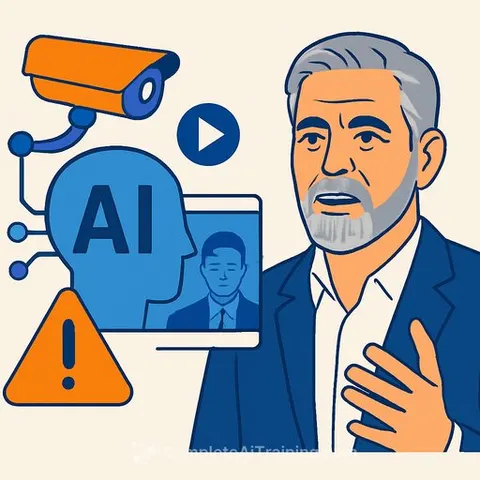
George Clooney warned that government officials may be the wrong people to regulate artificial intelligence, pointing to the technology's capacity to erode public trust and destabilize democratic institutions. Speaking at a Venice Film Festival symposium on September 1, the Oscar-winning actor used a pointed joke about a congressional hearing to underscore his concern about the gap between technological complexity and legislative oversight.
"I don't know that you want government to be regulating this either," Clooney said, referencing Meta CEO Mark Zuckerberg's testimony before Senator Chuck Grassley. "These are not the people that you want to entrust the holy grail with."
Clooney received the Golden Lion for Lifetime Achievement at the 83rd Venice International Film Festival. He used his appearance to connect AI risks with broader questions about media ownership, journalism, and the political pressures affecting public life.
The deepfake threat and the collapse of verification
Clooney focused on how AI-generated material makes authentic events difficult to separate from fabricated ones. The problem, he argued, cuts both ways. Sophisticated fakes can convince audiences of false events, but they also give people reason to dismiss genuine photographs, videos, or reports as manufactured.
He raised the scenario of a deepfake video showing a world leader announcing a nuclear attack. For ordinary citizens, establishing whether such footage is real would become nearly impossible. That uncertainty, Clooney said, could create serious problems for journalists, governments, and the public who depend on shared facts to function.
As AI systems grow more capable, the actor warned, the erosion of trust becomes a structural threat. Audiences may stop believing anything they see, not because they are gullible, but because the tools for deception have outpaced the tools for verification.
Legal systems and invented authorities
Clooney brought the discussion into the courtroom through an example involving his wife, human rights lawyer Amal Clooney. She had encountered instances where AI systems produced invented legal authorities - citations to cases or statutes that do not exist. The risk compounds when lawyers fail to verify AI-generated information before relying on it in court.
This reflects a broader problem with generative AI: systems that produce confident-sounding answers containing inaccurate information. Clooney argued that uncertainty over who ultimately controls these technologies adds another layer of risk, particularly when errors carry legal consequences.
For government professionals navigating these challenges, understanding the technology's limits is as important as understanding its capabilities. The AI Learning Path for Policy Makers addresses the regulatory and oversight questions that Clooney's concerns raise.
Concentration of power and democratic stakes
Clooney also questioned the concentration of power within the technology industry. Some of the most influential AI systems are controlled by extremely wealthy individuals and companies, a dynamic he connected to wider questions about democracy and public trust. He argued that disagreement is essential to a functioning democratic system and said political institutions need younger voices bringing new ideas.
His comments arrive as governments worldwide grapple with how to regulate AI without stifling innovation or ceding oversight to the very companies they aim to govern. The tension Clooney identified - between the need for regulation and doubt about regulators' competence - sits at the center of current policy debates. Resources on AI for Government explore how public-sector organizations can build the expertise required to address these challenges directly.
Why this matters for government professionals
Clooney's warning lands on a concrete operational problem: legislatures and agencies are being asked to write rules for technology they often do not understand. The Zuckerberg-Grassley exchange he referenced became a symbol of that gap. For policy staff, legal advisors, and agency leaders, the immediate task is closing the knowledge gap before regulatory frameworks harden around flawed assumptions. The risk is not just bad law - it is ceding de facto governance to the companies that build the tools, while elected officials provide a veneer of democratic legitimacy without meaningful oversight.