
AI news ·
Google works to build an evidence base for healthcare AI
Google is building clinical evidence for its healthcare AI tools to speed up hospital adoption. Future models will need peer-reviewed studies to prove safety and efficacy.
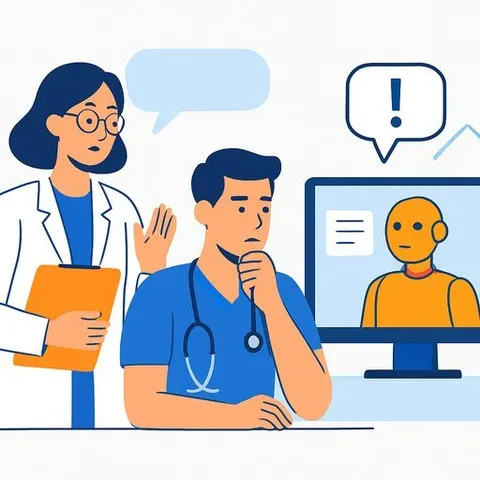
Google is shifting its focus to building a strong evidence base for its healthcare AI tools, according to a July 14, 2026 report. Dr. Michael Howell, the company's chief health officer, is leading the effort to produce clinical validation data that could speed up adoption in hospitals and clinics.
The move responds to mounting pressure from regulators and health systems for proof that AI algorithms are safe, effective, and fair across different patient groups. Without peer-reviewed studies and real-world performance metrics, even technically advanced models face resistance from clinicians and payers.
Building clinical trust
Healthcare AI has long struggled with a gap between laboratory performance and bedside results. Howell's team aims to close that gap by generating evidence that shows how Google's tools perform in actual clinical workflows. The emphasis on validation reflects a broader trend in AI for Healthcare, where clinical evidence is becoming a prerequisite for procurement decisions.
Google has not yet disclosed specific study designs or timelines. However, the company's internal push signals that future product launches will likely be accompanied by published research rather than relying solely on technical benchmarks.
Google's healthcare AI footprint
Google already has several healthcare AI projects in development, including Med-PaLM, a large language model fine-tuned for medical question-answering, and partnerships with organizations like Mayo Clinic. These efforts have produced promising results in controlled settings, but widespread clinical use has been limited by the need for stronger validation.
Beyond product development, Google offers Google AI Courses that cover medical applications, helping professionals understand both the capabilities and the limitations of the technology. The new evidence-building push could eventually feed into those educational resources, giving learners access to real-world case studies.
Why this matters for healthcare professionals
For clinicians, hospital administrators, and health IT leaders, the availability of rigorous evidence will be the deciding factor in whether to adopt Google's AI tools. Rather than relying on vendor claims, healthcare organizations should watch for peer-reviewed studies, trial registrations, and transparent reporting of model performance across diverse populations. The coming months will reveal whether Google's investment in evidence translates into tools that earn the trust of the people who use them.