
AI news ·
Hackensack Meridian becomes first U.S. health system to earn Joint Commission AI certification
Hackensack Meridian Health is the first U.S. health system to earn the Joint Commission's Responsible Use of AI certification, setting a baseline for AI governance and safety.
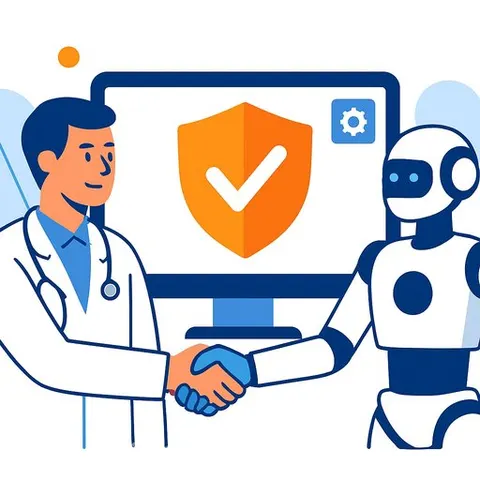
Hackensack Meridian Health has become the first U.S. health system to earn the Joint Commission's Responsible Use of AI in Healthcare Certification, a credential that sets explicit standards around governance, patient safety, and operational accountability for AI programs. The New Jersey-based system's achievement, reported by Healthcare IT News on August 5, 2026, signals that accreditation bodies are now formalizing what responsible AI deployment looks like in practice - and that peer institutions without documented governance frameworks are increasingly exposed.
Governance is now the bottleneck
Amy Chacko, IT portfolio manager at Hackensack Meridian Health, told Healthcare IT News that many health systems are introducing AI deliberately, putting patient safety and alignment with organizational objectives ahead of broader deployment. That measured posture reflects a broader reality: most systems have more AI tools available to them than they have governance structures to manage them.
Earning a certification is not the finish line for hospital IT leaders. It is the proof-of-concept that a repeatable governance model exists.
Healthcare IT News has reported separately that hospitals must now prove they can make AI operational at scale, framing the credentialing challenge as one of sustained execution rather than initial deployment. Procurement teams evaluating AI vendors should expect payer and accreditor questions to sharpen accordingly - moving from what a system can do to how it is monitored and controlled once live.
Physical AI adds a new layer of complexity
Software-based AI tools, from ambient documentation to clinical decision support, are only one front in the current deployment wave. According to a two-part Healthcare IT News series published August 5, 2026, the next challenge for health systems is not selecting robotic platforms but building the governance, safety frameworks, and operational strategies that allow physical AI to assist clinicians at scale.
Physical AI - autonomous robots and AI-guided devices operating directly in clinical environments - carries a distinct risk profile. Errors are not confined to a data record; they can occur at the point of patient contact. Governance frameworks designed for algorithmic tools cannot simply be extended to physical systems without significant additional design work.
For supply-chain and facilities leaders, this raises near-term procurement questions. Purchasing a robotic clinical-assist platform without an accompanying governance and safety validation process is an approach the current accreditation trajectory will likely penalize. Hackensack Meridian's certification offers a reference model for what documentation and process controls that validation requires.
Workforce pressure is making this urgent
The governance push is unfolding against a strained labor backdrop. The U.S. economy shed 23,000 jobs in July 2026, but healthcare continued to add positions, according to Becker's Hospital Review coverage of the August 7 jobs report. Continued healthcare job growth signals sustained demand for clinical and administrative staff, even as AI tools are intended to reduce administrative burden.
That tension is visible in the tele-ICU space. Healthcare IT News reported on August 6 that proactive tele-critical care models are proving effective when board-certified intensivists actively lead them, helping hospitals address staffing shortages and free clinicians from administrative work with AI assistance. The model demonstrates what a functioning governance structure around AI clinical tools can look like in practice.
What the certification benchmark means for health system IT teams
Hackensack Meridian's achievement sets a reference point that CIOs and IT portfolio managers at peer systems will now be measured against, whether or not the Joint Commission certification is on their near-term roadmap. Vendors selling AI platforms into health systems should expect procurement teams to begin asking for documentation that maps to the certification's standards, particularly around monitoring, bias controls, and incident response.
The broader implication is that responsible AI deployment is shifting from a best-practice recommendation to a certifiable, auditable standard. For enterprise health systems, the question is no longer whether to build AI governance infrastructure, but how fast they can build it to keep pace with both deployment velocity and accreditor expectations.
The Joint Commission has not publicly announced the next cohort of applicants. But a named, major health system has completed the process. The pathway is now validated and replicable.
Why this matters for healthcare professionals
If you work in a hospital IT, operations, or procurement role, this certification should change how you evaluate AI tools. Ask every vendor for documentation on monitoring protocols, bias controls, and incident response - not just performance metrics. If your institution has AI projects in flight without a formal governance structure, expect accreditors and payers to insist on one soon.
This is also a career signal. Professionals who can design and operate AI governance frameworks will be in demand as more systems pursue similar certifications. The Joint Commission's decision to certify Hackensack Meridian officially marks the end of the pilot project. The standard is set. The honest work of building to it is now underway at every other major system in the country.